
M&T Bank: Navigating Cost Pressures Amid Net Interest Income Strength and Regulatory Headwinds
Recent results show M&T Bank remains a strong net interest income generator with transparent credit risk management, but persistent operational cost pressures and sector-wide interest rate dynamics could reshape profitability and capital deployment.
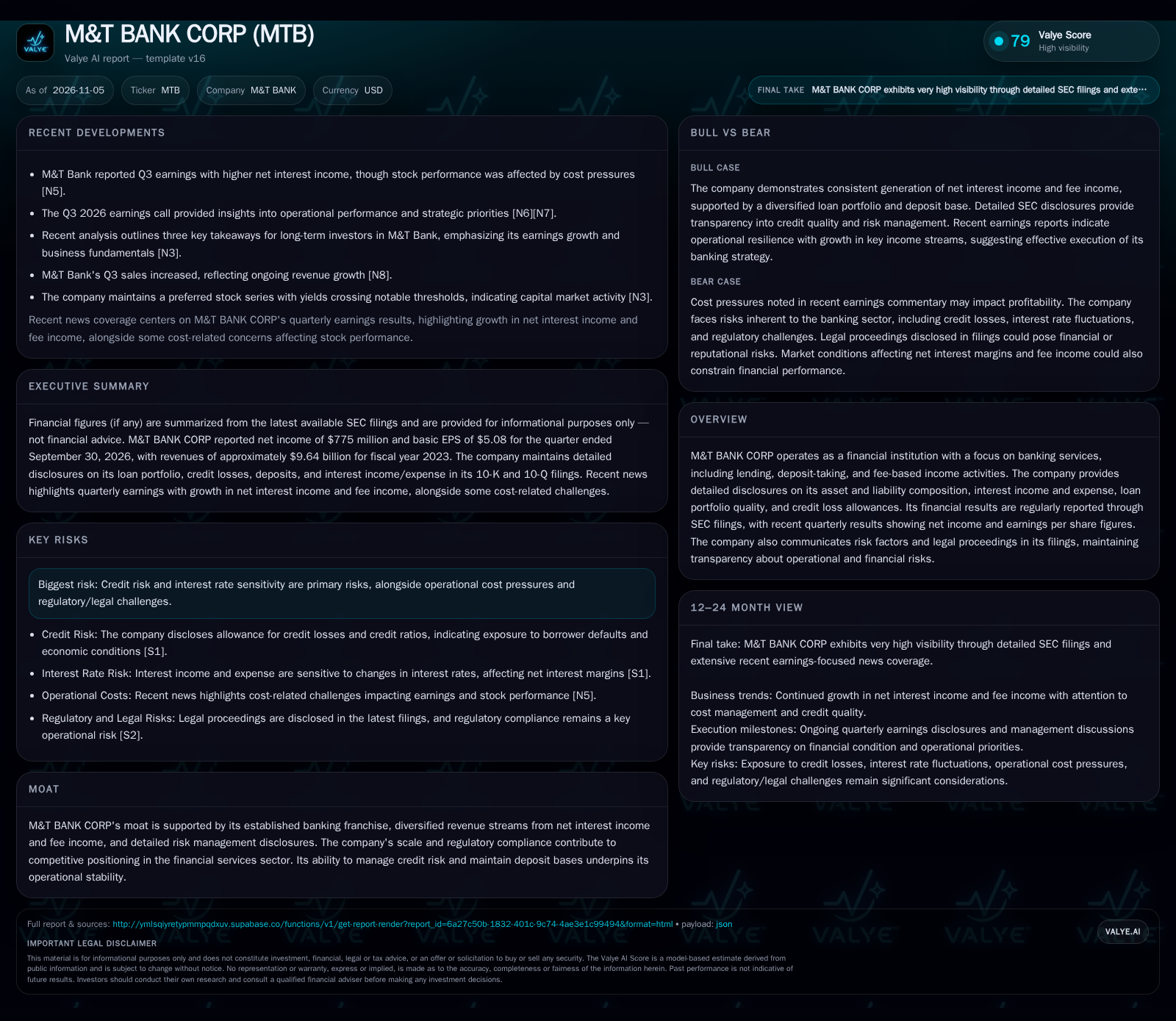
M&T Bank reported Q3 2026 net income of $775 million and basic EPS of $5.08, driven by higher net interest income. Despite this, cost pressures have weighed on stock performance, and regulatory/legal risks remain ongoing. The bank’s future resilience will hinge on its ability to manage expenses while sustaining robust credit quality and adapting to changing rate environments. [S2] [N5]
M&T Bank’s Q3 2026 performance highlights the classic strengths and contemporary challenges of a large regional bank: strong net interest income, a diversified loan portfolio, and rigorous risk disclosures, all set against a backdrop of rising operational costs and regulatory scrutiny. While profitability remains robust, the bank’s ability to sustain earnings growth may depend on navigating sector-wide cost inflation, interest rate volatility, and persistent legal and compliance risks. The question for investors is whether M&T can leverage its balance sheet scale and franchise depth to offset these headwinds and preserve its competitive edge.
Recent Earnings and Operational Pressures: What the Latest Quarter Reveals
For the third quarter of 2026, M&T Bank reported net income of $775 million and basic earnings per share of $5.08, demonstrating continued profitability in a challenging environment. The bank’s revenue base remains substantial, with $9.64 billion reported for fiscal 2023. Recent news coverage emphasizes that net interest income (NII) was a key driver of Q3 results, but the stock underperformed following the release due to cost pressures cited in earnings commentary. The company’s filings show no material changes in credit risk posture or legal exposure, but operational costs are emerging as a focal point for both management and investors. [S2] [N5]
How M&T Makes Money: Interest Margins, Fee Income, and Cost Discipline
M&T’s core economics derive from its ability to generate net interest income by earning a spread between interest-earning assets—primarily loans and securities—and interest-bearing liabilities, such as customer deposits and wholesale funding. Fee-based activities, including service charges and wealth management, contribute additional but typically lower-margin revenue. With a large, diversified loan portfolio and stable deposit base, M&T’s revenue model is sensitive to interest rate movements, which affect both loan yields and funding costs.
Operating leverage is a critical dynamic: while the bank benefits from scale in technology and regulatory compliance, much of its cost base—branch network, personnel, risk management infrastructure—is relatively fixed in the short term. Recent cost pressures, if persistent, could erode the margin gains from rising NII. Capital needs are shaped by regulatory requirements (e.g., CET1 ratios), credit loss provisioning, and dividend or buyback policies. The existence of preferred stock with notable yields suggests ongoing capital market engagement to optimize funding costs and regulatory capital buffers. [N3]
Banking Franchise Strength Versus Sector Headwinds: Where M&T Stands
M&T’s competitive position is anchored by its established regional banking franchise, diversified revenue streams, and disciplined risk management, all of which are supported by detailed regulatory disclosures. Its scale gives it some cost advantages and the ability to invest in digital capabilities, but it faces competition from other large regionals, national banks, and increasingly, fintechs and non-bank lenders.
Key counterforces include sector-wide margin compression as deposit costs rise faster than asset yields in a flattening or inverted yield curve environment, as well as rising regulatory and compliance costs. Technology-driven substitutes—such as digital-only banks or alternative lending platforms—could gradually erode legacy advantages in convenience or pricing. M&T’s ability to retain and grow its deposit base, maintain credit quality, and control costs will define its resilience relative to peers.
Margin Expansion and Credit Stability: The Path to Outperformance
A favorable scenario for M&T involves a sustained or widening net interest margin, supported by stable credit quality and successful control of operating expenses. If the Federal Reserve maintains or increases rates in a way that benefits asset yields more than deposit costs, M&T could see further NII growth. Effective cost management—such as branch rationalization, technology-driven efficiency gains, or lower-than-expected wage inflation—would allow more of that revenue to reach the bottom line.
Signs that would confirm this scenario include sequential NIM expansion, stable or improving efficiency ratios, low net charge-off rates, and management commentary highlighting cost discipline and deposit retention. Falsification would include margin compression, rising credit losses, or cost growth outpacing revenue.
Sector Pressures Offset Core Strengths: A Realistic Outlook for M&T
The most plausible near-term outcome is that M&T continues to generate strong NII but faces persistent cost inflation and regulatory scrutiny, leading to flat or modestly growing earnings. Credit quality remains manageable, but the bank may not be able to fully offset higher compensation, technology, and compliance costs. The deposit base remains stable, but competition for funding keeps a lid on margin expansion.
This scenario would be confirmed by steady net income and EPS, with efficiency ratios showing little improvement and management reiterating a focus on cost management. Falsification would be a material swing in credit losses, major regulatory penalties, or a sudden shift in deposit flows.
Cost Escalation and Credit Deterioration: What Could Derail the Thesis
A negative scenario would see operational costs rising faster than revenue, eroding profitability even as NII plateaus or declines. If economic conditions worsen or sector credit losses rise, M&T could face higher loan loss provisions, compressing earnings further. Regulatory or legal setbacks—such as adverse litigation outcomes or new compliance mandates—could add to non-interest expenses and restrict capital deployment.
Evidence supporting this scenario would include a rising efficiency ratio, declining net income, upward trends in non-performing loans, and management guidance lowering forward expectations. A combination of margin compression, credit deterioration, and regulatory headwinds would put both earnings and valuation under pressure.
Tracking M&T Bank’s Resilience: Metrics and Milestones to Scrutinize
Quarterly trends in net interest margin (NIM) and net interest income, including the impact of funding cost changes.
Efficiency ratio evolution—whether cost growth is being contained relative to revenue expansion.
Credit quality metrics such as non-performing loans, net charge-offs, and allowance for credit losses.
Deposit base stability and growth, especially in core low-cost deposits versus higher-cost funding sources.
Preferred stock issuance, redemption, or yield changes as indicators of capital management and funding costs.
Legal and regulatory developments disclosed in SEC filings that could materially impact expenses or capital.
Management’s commentary on cost initiatives, technology investments, and competitive positioning during earnings calls.
A useful metric would be digital adoption and customer retention trends, if disclosed, to gauge competitive positioning against fintech challengers.
Disclaimer: This is research-only, informational analysis and not investment advice. It may include AI-generated interpretation and general industry context. Always verify important details using primary sources.

Comments