
Ridgepost Capital: Fee-Based Stability, Private Markets Reach, and the Stakes of Data-Driven Expansion
Ridgepost Capital’s multi-asset platform is anchored by long-term fee contracts and proprietary data advantages, but faces the dual challenge of market cyclicality and competition for elite fund access. Recent earnings volatility and expansion moves highlight both the potential and the risks of scaling a diversified private markets franchise.
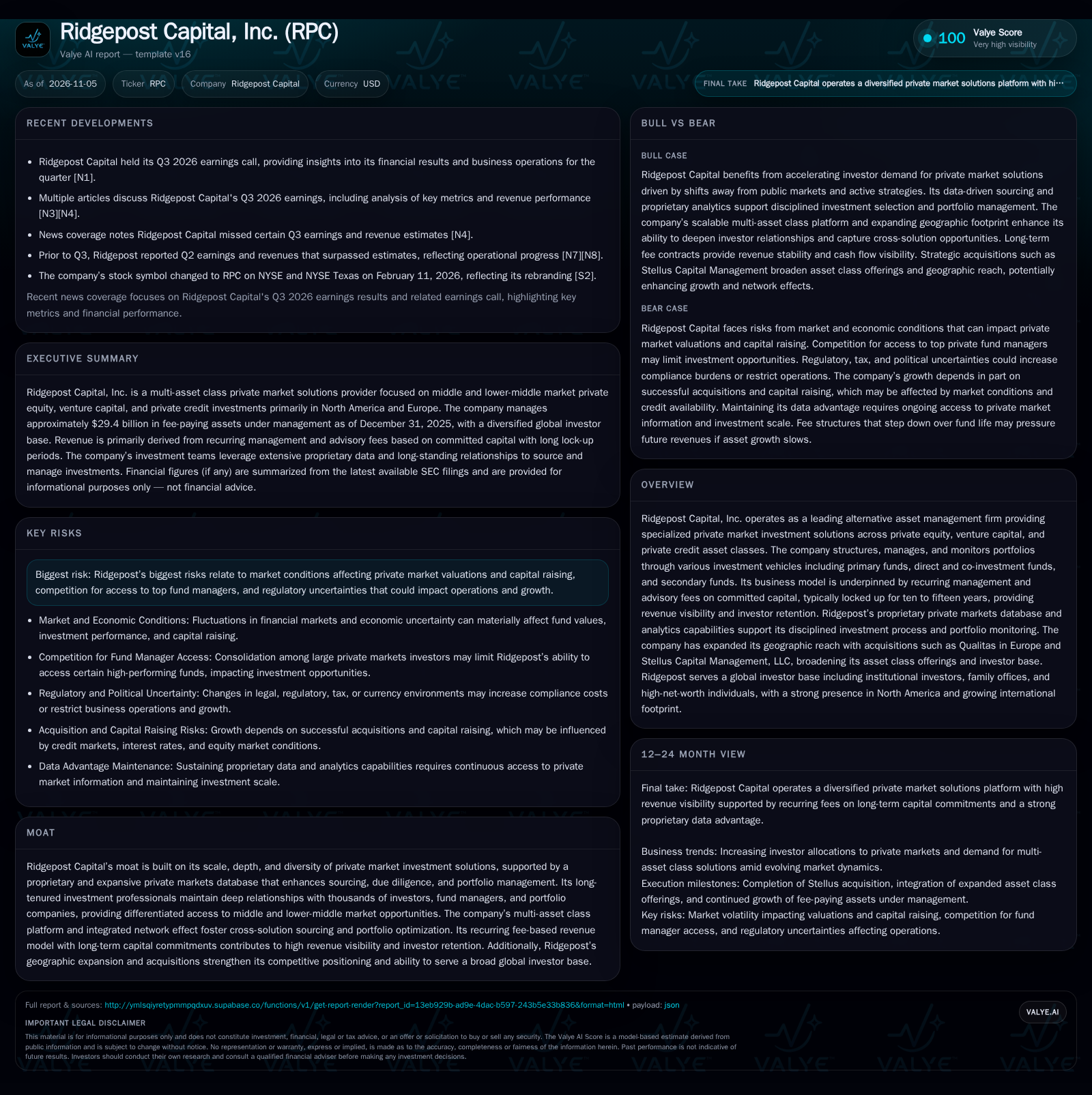
Ridgepost Capital manages $29.4 billion in fee-paying AUM with a diversified private market offering spanning private equity, venture capital, and private credit. Recurring management fees on long-term locked capital provide revenue visibility, while expansion via acquisitions and data-driven sourcing underpin the firm’s growth strategy. However, recent Q3 results missed estimates, underscoring the sensitivity to market cycles and competitive pressures. The path forward hinges on integration execution, sustaining asset growth, and maintaining a data advantage as private markets mature and competition intensifies. [S2] [N3] [N4]
Ridgepost Capital sits at the intersection of structural growth in private markets and the operational realities of managing a scaled alternatives platform. With nearly $30 billion in fee-paying assets and a business model built on long-term, recurring fees, Ridgepost offers investors visibility and the potential for operating leverage. Yet, as recent quarterly results missed expectations, the firm’s growth ambitions are increasingly tested by the cyclicality of private market valuations, intensifying competition for high-performing fund managers, and the need to continuously justify its data-driven edge. The next phase will be defined by Ridgepost’s ability to integrate acquisitions, grow assets, and adapt its model as private markets evolve.
Recent Earnings Miss and Asset Growth Highlight Both Scale and Sensitivity
As of December 31, 2025, Ridgepost Capital managed $29.4 billion in fee-paying assets under management (FPAUM), with a broad portfolio spanning private equity, venture capital, and private credit solutions. The company’s Q3 2026 financials showed net income of $9.92 million and cash of $32.46 million, but importantly, both earnings and revenue missed analyst estimates for the quarter. This result contrasts with Q2, where Ridgepost had outperformed expectations, illustrating the firm’s sensitivity to market cycles and possibly to competitive fee dynamics. The ongoing integration of Stellus Capital Management and the broadening of asset class offerings signal a strategic push for scale and reach, but also introduce execution and operational risks as the firm grows its platform. [S2] [N3] [N4]
The recent earnings miss not only underscores Ridgepost’s sensitivity to external market conditions but also highlights the operational complexities inherent in scaling a multi-asset private markets platform. As the firm integrates acquisitions and diversifies its product offerings, the interplay between fixed infrastructure costs and variable revenue streams becomes more pronounced. For instance, while long-term fee contracts provide revenue stability, fluctuations in deal flow and fundraising cycles can create timing mismatches that pressure short-term earnings. Additionally, the integration phase often demands increased investment in technology, compliance, and talent retention, which can temporarily weigh on margins. Understanding how Ridgepost balances these dynamics is critical to assessing its resilience amid market cyclicality and competitive pressures.
How Ridgepost Monetizes Locked-Up Capital and Scalable Solutions
Ridgepost’s core economics are built on recurring management and advisory fees, typically set at approximately 1% of fee-paying AUM, with capital commitments locked for 10–15 years. This structure provides high revenue visibility and reduces the volatility often seen in mark-to-market asset managers. The firm’s product mix spans primary funds, direct and co-investments, and secondary funds, each appealing to different investor segments and risk appetites. Operating leverage is plausible as incremental AUM growth can be absorbed by existing infrastructure, especially in data and analytics, but is subject to step-downs in fee rates over time as funds mature. Expansion into new asset classes or geographies—such as through the Stellus acquisition—requires upfront investment in personnel and systems, with the potential for cross-selling but also integration costs. The business is capital-light, with limited balance sheet risk, but relies on continuous fundraising and investor retention to sustain growth.
The fee-based model’s reliance on long-term locked capital inherently limits revenue volatility but introduces sensitivity to the pace of capital deployment and fundraising success. If fundraising slows or capital calls are delayed due to macroeconomic uncertainty, revenue growth may lag despite stable committed capital. Moreover, the step-down in fee rates as funds mature introduces a natural revenue decay that must be offset by new capital inflows or higher-margin product offerings. Ridgepost’s expansion into complementary asset classes through acquisitions can mitigate this decay by broadening revenue sources, but it requires careful calibration of investment in new capabilities against expected fee accretion. The scalability of the data and analytics platform is a key enabler here; if it can drive incremental deal flow and improve portfolio outcomes without proportionate cost increases, the firm can achieve operating leverage despite the capital lock-up model’s structural constraints.
Data, Relationships, and Scale: How Ridgepost Stakes Its Private Markets Claim
Ridgepost competes in a crowded field of alternative asset managers, ranging from global multi-asset giants to specialized boutiques. Its asserted edge lies in a proprietary private markets database and analytics platform, which underpin sourcing, due diligence, and portfolio monitoring. Deep relationships with thousands of fund managers, investors, and portfolio companies provide differentiated access to deals, particularly in the middle and lower-middle markets. However, competition for allocations to top-performing funds is fierce, and larger peers may have even greater scale or brand recognition. Regulatory and tax changes could further compress margins or increase compliance costs. The firm’s multi-asset class platform and international reach, especially following recent acquisitions, are intended to foster network effects—cross-solution referrals, information sharing, and investor stickiness. The question is whether Ridgepost’s data advantage and relationship network can be maintained as the private markets industry consolidates and digitizes.
Maintaining a proprietary data advantage in private markets is particularly challenging given the increasing digitization and transparency across the industry. Competitors are investing heavily in technology and data science, which may erode Ridgepost’s differentiation over time unless it continuously innovates and deepens its data assets. Furthermore, the competitive landscape’s heterogeneity—from large-scale global managers to nimble boutiques—means Ridgepost must balance scale benefits with agility. Its multi-asset platform and international expansion offer potential network effects, but these can only be realized if integration across teams and geographies fosters genuine collaboration rather than siloed operations. Additionally, regulatory shifts that increase disclosure requirements or compliance burdens could disproportionately impact firms with complex multi-jurisdictional footprints, potentially diluting the firm’s relative advantage in sourcing and managing private market investments.
Unlocking Operating Leverage Through Asset Growth and Cross-Solution Penetration
In a favorable scenario, Ridgepost leverages its platform to capture increased allocations from existing and new investors, fueled by ongoing shifts toward private market solutions as institutional and high-net-worth clients diversify away from public markets. Successful integration of Stellus and other acquisitions broadens the firm’s product suite, enabling cross-selling and deeper wallet share. The proprietary data platform drives more efficient deal sourcing and superior portfolio construction, translating to better fund performance and higher investor retention. If fee-paying AUM grows at a faster pace than expenses, operating leverage could expand margins. Confirmation would come from sustained double-digit growth in FPAUM, improved management fee margins, rising cross-solution participation rates among investors, and positive fund performance relative to benchmarks.
Sustaining Fee Revenue Amid Market Cycles and Integration Demands
The most plausible path is one of steady, but uneven, AUM growth as Ridgepost navigates market volatility and competitive headwinds. Fee revenue remains relatively stable, supported by long-term contracts and capital lock-ups, but organic growth is offset by periodic fund step-downs and muted capital raising during risk-off periods. The integration of Stellus and other acquisitions proceeds, but with modest incremental contribution as synergies take time to materialize. The data platform supports incremental sourcing efficiency, but advantages narrow as competitors invest in similar capabilities. Confirmation would include stable management fee revenue, moderate FPAUM growth, and successful completion of acquisition integrations without material disruption to margins or investor relationships. Falsification would be a prolonged decline in new commitments, increasing fee pressure, or operational missteps in integrating new teams.
Fee Compression and Market Dislocation Undermine Growth Engine
An adverse scenario would see a combination of market downturns and competitive fee pressure eroding Ridgepost’s revenue base. If private market valuations decline, investors may delay new commitments or redeem where possible, shrinking FPAUM. Competition for top-tier fund access could force Ridgepost to accept lower fee rates or less favorable terms, especially if larger rivals consolidate market share. Regulatory, tax, or political shocks could further increase costs or restrict fundraising. Integration challenges could lead to talent attrition or cultural friction, weakening the firm’s relationship network. Evidence would include sequential declines in FPAUM, management fee margin compression, missed fundraising targets, or negative fund performance relative to peers.
Milestones That Will Shape Ridgepost’s Private Markets Trajectory
Net growth in fee-paying assets under management (FPAUM) by solution (PES, VCS, PCS) and in aggregate, especially after major acquisitions.
Trends in effective management fee rates and average fee step-downs as funds mature—if disclosed.
Success of the Stellus Capital Management integration, including retention of key personnel and new fundraising traction.
Performance dispersion across Ridgepost’s private equity, venture, and credit vehicles relative to industry benchmarks—if disclosed.
Adoption and impact of the proprietary data platform on sourcing efficiency, due diligence speed, and portfolio outcomes—would help test the thesis.
Changes in the mix of investor types (institutional, family office, high-net-worth) and geographic expansion, indicating network effect realization.
Incremental operating margin expansion as AUM grows, testing the scalability of the platform.
External developments in private market regulation, tax policy, or competition that could alter the economics or growth trajectory.
Disclaimer: This is research-only, informational analysis and not investment advice. It may include AI-generated interpretation and general industry context. Always verify important details using primary sources.

Comments