
Vontier’s Multi-Energy Mobility Ambitions: Resilience, Realignment, and the Stakes of Segment Evolution
Vontier’s recent divestitures and performance divergence across segments highlight strategic repositioning within a volatile mobility technology landscape. The company’s forward path depends on whether Environmental & Fueling Solutions and digitally enabled Mobility Technologies can offset Repair Solutions headwinds and deliver on automation and energy transition opportunities.
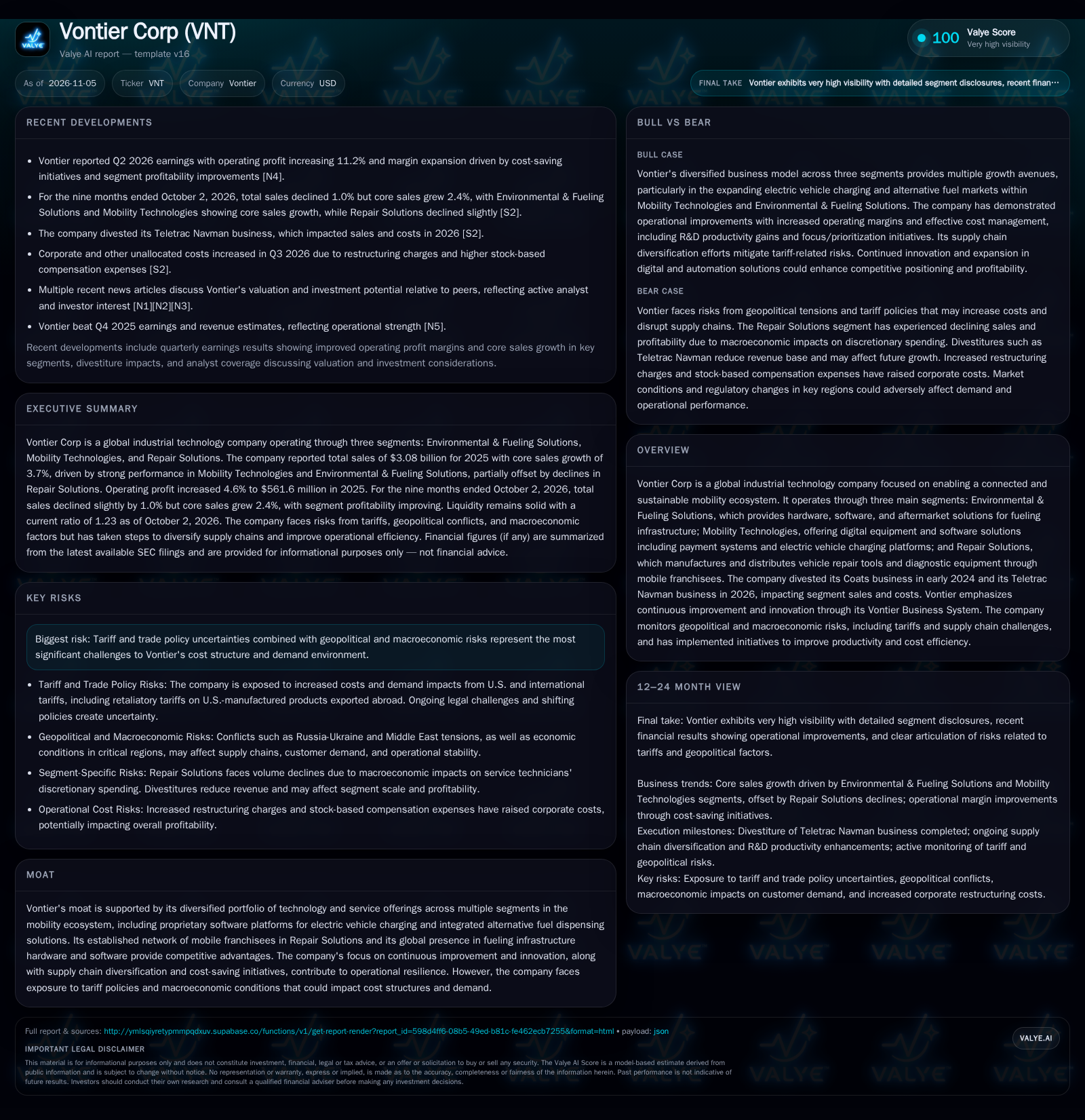
Vontier’s 2026 results reflect a company in active portfolio transition, with Environmental & Fueling Solutions showing robust growth and Mobility Technologies recalibrating after divestitures. While core sales are up, headline revenue is slightly down, and Repair Solutions faces sustained pressure. The thesis now pivots on whether the two higher-growth segments can drive durable value amid macro, regulatory, and competitive crosswinds. [S2]
Vontier Corp stands at a strategic crossroads after a period marked by portfolio pruning and diverging segment trajectories. Environmental & Fueling Solutions is delivering robust growth, and the company has doubled down on digital and multi-energy mobility solutions, reflecting a pivot toward automation and the energy transition. However, Repair Solutions continues to face structural headwinds, and the Mobility Technologies segment is recalibrating following the divestiture of Teletrac Navman. The company’s ability to deliver durable value now hinges on extracting operating leverage from its higher-growth segments while mitigating macro, regulatory, and cost pressures.
Recent Divestitures and Segment Trends Redefine the Core
Vontier reported a 2.4% increase in core sales for the first nine months of 2026, even as total revenue declined by 1.0%. The company’s Environmental & Fueling Solutions segment led the way, with a 4.8% reported sales increase and 8.0% core sales growth, signaling continued demand for infrastructure upgrades and alternative fueling solutions. In contrast, Mobility Technologies saw a 6.8% sales decline due to the exit of the Teletrac Navman business, while Repair Solutions sales fell by 0.8%, reflecting persistent macroeconomic pressure on discretionary spending by service technicians. [S2]
Liquidity metrics as of October 2, 2026, show $258.4 million in cash, a current ratio of 1.23, and a cash ratio of 0.25. The company reported cash and liquidity metrics for the period; these figures do not by themselves establish operating runway, investment capacity, financial flexibility, or financing capacity. [S2]
Corporate costs rose in Q3 2026 due to restructuring charges and increased stock-based compensation, highlighting the expense side of portfolio realignment and the ongoing impact of recent divestitures. [S2]
Segment Economics: Where Margin and Growth Could Diverge
Vontier’s business model is built on a mix of hardware, software, and aftermarket services across three distinct segments, each with different economic drivers. Environmental & Fueling Solutions typically benefits from recurring aftermarket sales and infrastructure upgrade cycles, which can provide some revenue visibility and higher-margin opportunities—especially as alternative energy and regulatory-driven upgrades accelerate. Mobility Technologies, with its digital platforms, payment systems, and EV charging software, may offer scalable, higher-margin revenue if adoption accelerates and platform stickiness increases. However, the impact of the Teletrac Navman divestiture means near-term revenue and potential margin contributions are reduced, with future growth dependent on winning share in EV and automation workflows.
Repair Solutions, historically a stable cash generator, now faces margin compression as volumes decline and price competition intensifies due to weak end-market demand. The mobile franchise network may offer some insulation, but lower technician discretionary spending and potential channel consolidation could erode pricing power further. Fixed corporate costs, including restructuring and R&D, create operating leverage risk if top-line growth stalls.
Capital requirements vary: Environmental & Fueling Solutions and Mobility Technologies are likely to demand ongoing R&D and working capital investment to stay ahead of regulatory and technological shifts, while Repair Solutions may require rationalization or further restructuring to defend margins. Overall, the company’s ability to scale digital revenue, extract operating leverage, and manage capital allocation across segments will be central to future economics.
Competitive Landscape: Diversification as Both Shield and Challenge
Vontier’s multi-segment footprint provides some insulation from shocks in any one area, but it also exposes the company to a wide range of competitors and substitute offerings. In Environmental & Fueling Solutions, Vontier competes with both legacy fueling infrastructure providers and emerging players focused on alternative fuels and environmental compliance. Digitalization and regulatory changes are accelerating competitive turnover, with new entrants leveraging software-centric business models and established firms racing to add integrated platforms.
Mobility Technologies faces competition from payment system vendors, telematics/software specialists, and EV charging infrastructure providers. The divestiture of Teletrac Navman suggests that Vontier is narrowing its digital focus, but success will depend on the ability to create integrated, sticky platforms that customers cannot easily switch away from. The presence of proprietary software and data analytics could support switching costs and recurring revenue, but only if adoption is high and integration deep.
Repair Solutions operates in a fragmented market with price sensitivity and low switching costs, facing both branded competitors and generic tool providers. The mobile franchise model may provide some channel control, but as technician spending weakens, brand loyalty and margin protection are at risk. The company’s overall competitive advantage lies in its breadth and integration, but the risk is that diversification dilutes focus and slows response to fast-moving market shifts.
Unlocking Value from Energy Transition and Digital Integration
A favorable scenario for Vontier would see Environmental & Fueling Solutions and Mobility Technologies outpace end-market growth by capitalizing on regulatory-driven infrastructure upgrades, the acceleration of EV and alternative fuel adoption, and increased demand for integrated digital platforms. If the company succeeds in cross-selling software, analytics, and aftermarket services alongside hardware deployments, it could achieve higher-margin, recurring revenue streams and improved customer retention.
Upside would be confirmed by a return to robust, multi-year core sales growth in both Environmental & Fueling Solutions and Mobility Technologies (well above low-single-digit rates), expanding segment margins, and evidence of platform adoption—such as customer wins in EV charging networks or new integrated payment system contracts. Further, successful cost takeout and supply chain optimization would enhance operating leverage, translating top-line gains into bottom-line improvement.
A key falsification would be if reported growth in the higher-potential segments stalls or margins compress, indicating end-market resistance, pricing pressure, or integration frictions.
Portfolio Rebalancing Yields Mixed, Incremental Progress
The most plausible outcome is that Vontier delivers modest core sales growth driven by Environmental & Fueling Solutions, with Mobility Technologies stabilizing post-divestiture and Repair Solutions continuing to decline or stagnate. Margin trends may be uneven: gains from cost initiatives and mix shift toward digital/software could be offset by restructuring costs and competitive pressure in Repair Solutions.
Supply chain and tariff risks remain a drag but do not result in major disruptions. The company’s diversified footprint limits downside from any one segment, but also caps upside unless digital and energy transition bets scale faster than the market.
Evidence confirming this scenario would include continued low-single-digit core sales growth, stable or slightly improving segment margins, and no major surprises in cash flow or restructuring costs. Falsification would come from a sharp and sustained downturn in any core segment, major cost overruns, or failure to stabilize Mobility Technologies.
Macro Shocks and Segment Decay Expose Structural Weakness
A negative trajectory would be triggered if macroeconomic deterioration or regulatory headwinds sharply reduce infrastructure spending, stalling Environmental & Fueling Solutions and Mobility Technologies. If Repair Solutions volumes continue to erode and price competition intensifies, the segment could shift from cash generator to margin drag.
Compounding these pressures, tariff escalations or supply chain shocks could inflate costs and squeeze margins across the portfolio, while restructuring charges and compensation inflation weigh on corporate expenses. Liquidity, while not currently strained, could come under pressure if working capital needs spike or if operating cash flow turns negative.
Downside would be confirmed by multi-quarter revenue and margin declines in more than one segment, negative cash flow, or the need for external financing. Falsification would require evidence of resilience in core segments despite adverse external conditions, such as stable or growing sales and margins.
Milestones That Will Define Vontier’s Strategic Repositioning
The pace and sustainability of core sales growth in Environmental & Fueling Solutions and Mobility Technologies, especially in light of the Teletrac Navman divestiture.
Segment margin trends, particularly whether cost initiatives and mix shifts result in improved profitability in higher-growth segments.
Repair Solutions sales volumes and margins—signs of stabilization, further decline, or potential for turnaround if disclosed.
Actual adoption rates and customer wins for digital/software platforms, especially in EV charging and integrated payment systems (if disclosed).
The scale and timing of restructuring charges, and whether corporate cost inflation abates or worsens.
Liquidity and working capital trends—especially if external shocks raise cash needs or if operating cash flow deteriorates.
Impact of tariff and supply chain disruptions on input costs, delivery times, and customer demand.
Disclaimer: This is research-only, informational analysis and not investment advice. It may include AI-generated interpretation and general industry context. Always verify important details using primary sources.

Comments