
Five Star Bancorp: Capitalizing on Niche Banking in Northern California Amid Rate and Credit Cycles
A robust capital raise, expanding net interest margin, and disciplined credit management position Five Star Bancorp for further growth in targeted segments—but sector concentration and rate volatility remain pivotal variables for future returns.
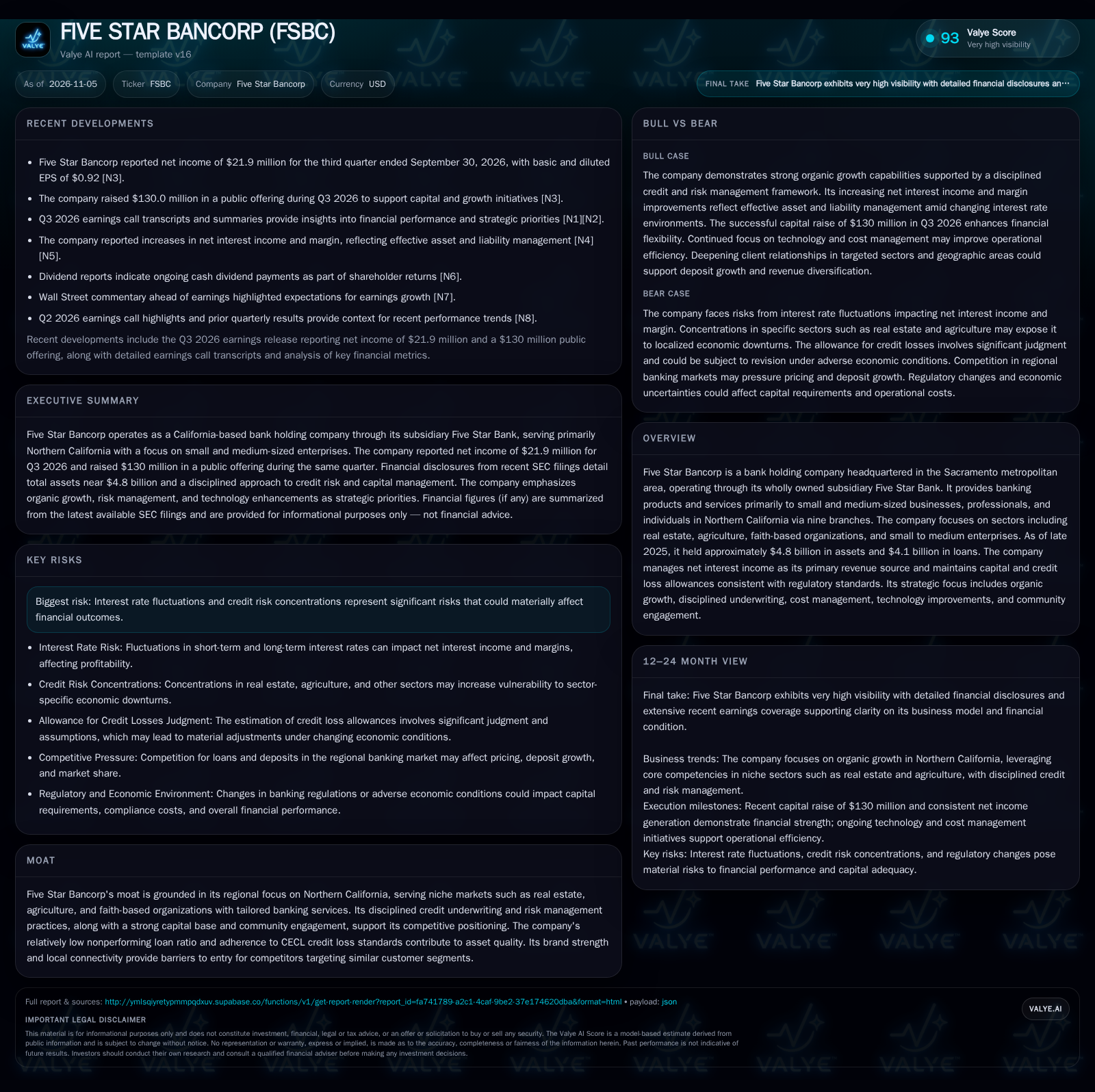
Five Star Bancorp reported $4.8 billion in assets and $4.1 billion in loans at year-end 2025, raised $130 million in Q3 2026, and delivered a net interest margin of 3.55% for 2025. Its strategy centers on serving Northern California’s SMBs, real estate, and agricultural clients through tailored banking services. While recent asset and earnings growth signal operating momentum, the bank’s fortunes remain closely linked to local sector health and interest rate shifts. [S2] [N3]
Five Star Bancorp’s recent $130 million capital raise and its pronounced net interest income growth underscore the company’s ambitions to deepen its presence as a premier business bank in Northern California. With a balance sheet emphasizing real estate, agriculture, and small business lending, the bank’s disciplined approach to credit and capital management has so far produced strong asset quality metrics and a resilient net interest margin. However, the company’s exposure to regional sector cycles and the prospect of future interest rate volatility raise important questions about the sustainability of its recent momentum and the durability of its niche-focused strategy.
Recent Capital Infusion and Margin Expansion Set the Stage
Five Star Bancorp ended 2025 with $4.8 billion in assets and $4.1 billion in loans, reinforcing its status as a significant regional lender in Northern California. In the third quarter of 2026, the company completed a $130 million public offering, which expands its capital base for future growth and risk absorption. Net interest income grew to $151.9 million in 2025—a 26.9% increase over the prior year—while net interest margin reached a healthy 3.55%. Asset quality metrics remain robust, with nonperforming loans at 0.08% of total loans and an allowance for credit losses at 1.09% of loans as of December 31, 2025. These figures highlight a combination of growth, asset quality, and capital strength as the bank faces a dynamic interest rate and competitive environment. [S1] [S2] [N3]
Interest Income Engine and Cost Discipline Define Profit Model
Five Star Bancorp’s core earnings are driven by the spread between interest earned on loans and securities and the interest paid on deposits and borrowings. The bank’s net interest margin of 3.55% for 2025 reflects effective management of asset yields and funding costs, a critical driver of profitability in a rising or volatile rate environment. With $4.1 billion in loans matched by $4.2 billion in deposits, the bank is largely deposit-funded, which can insulate it from wholesale funding volatility but may pressure margins if deposit competition intensifies.
Non-interest income remains modest relative to peers with more diversified fee businesses, totaling $6.5 million for 2025, while non-interest expense was $65 million—suggesting an efficiency ratio that could be improved through further technology investment or scale. The recent $130 million capital raise provides additional lending and investment capacity, but also raises the question of how quickly and profitably these new funds can be deployed. If the bank’s loan growth outpaces deposit growth, it may eventually need to tap higher-cost funding sources, potentially compressing margins.
Operating leverage is plausible but not guaranteed: incremental loan growth could drive higher net interest income without a proportional increase in fixed costs, provided credit quality holds. However, the bank’s focus on relationship-driven, lower-volume business lending may limit some scale benefits compared to larger, transaction-driven banks.
Niche Focus and Local Ties as Differentiators in a Crowded Field
Five Star Bancorp’s competitive stance is built on deep relationships with small and medium-sized businesses, professionals, and sector-focused clients (real estate, agriculture, faith-based organizations) in Northern California. This localized strategy provides insulation from national money-center banks and fintech disruptors, as these customer segments often value personalized service and local decision-making.
However, regional banks and credit unions remain direct competitors, often pursuing similar relationship-driven strategies in overlapping geographies. Larger regional banks may also attempt to encroach with more sophisticated technology or broader product sets. Five Star’s relatively low nonperforming loan ratio and disciplined underwriting are potential advantages, but the bank’s sector and geographic concentration could become liabilities if local economic or real estate cycles turn. Technology remains a double-edged sword: while investments in digital platforms could enhance client stickiness and efficiency, failure to keep pace with industry standards may erode its service differentiation over time.
Leveraging Capital and Relationships for Accelerated Growth
A favorable outcome hinges on Five Star Bancorp deploying its newly raised capital rapidly and prudently into high-yielding, low-loss lending opportunities within its core Northern California markets. If the local economy remains robust—particularly in real estate and agriculture—the bank could sustain above-average loan growth while maintaining asset quality. This would drive further increases in net interest income and support continued margin expansion, especially if deposit growth keeps pace and funding costs remain stable.
Upside could be confirmed by evidence of: sustained double-digit loan and deposit growth, stable or improving credit metrics (low nonperforming loans and charge-offs), and further improvements in the efficiency ratio as technology investments yield cost savings.
Steady Expansion Anchored by Discipline but Limited by Market Cycles
The most plausible trajectory for Five Star Bancorp is continued moderate growth, with net interest income rising in line with regional loan demand and stable, but competitive, deposit gathering. Credit quality is likely to remain solid if the Northern California economy avoids a downturn, and the bank’s capital ratios and recent equity raise provide a cushion against moderate shocks. Non-interest income and operational efficiency may improve incrementally but are unlikely to become dominant earnings drivers in the near term.
This scenario would be confirmed by consistent mid-single-digit growth in loans and deposits, credit loss reserves remaining near current levels, and a net interest margin in the 3.3–3.7% range. Any significant deterioration in local economic conditions, or a sharp increase in funding costs, would challenge this outlook.
Sector Concentration and Rate Shocks Could Disrupt Asset Quality and Margin
Adverse outcomes could arise if Northern California experiences a material economic slowdown, particularly in real estate or agriculture, leading to elevated loan losses and compressed net interest margins. Rapid changes in interest rates could also pressure deposit costs, erode net interest income, or trigger deposit outflows if competitors offer more attractive rates or digital offerings.
This downside scenario would be confirmed by a rising nonperforming loan ratio, an uptick in charge-offs, declining net interest margin below 3%, and negative operating leverage as expenses rise relative to income. Signs of deposit runoff, increased reliance on wholesale funding, or material revisions to credit loss reserves would further validate a deteriorating outlook.
Testing the Sustainability of Five Star Bancorp’s Niche Growth Model
Loan growth rate by sector—especially real estate and agriculture—would help gauge the sustainability and diversification of core lending momentum.
Net interest margin trends quarter-over-quarter will be critical for assessing pricing power and funding cost management.
Deposit growth versus loan growth: A useful metric would be the loan-to-deposit ratio and any changes in deposit composition (if disclosed).
Nonperforming loan and charge-off rates are essential to monitor for early signs of credit deterioration.
Efficiency ratio progression (if disclosed) would indicate whether technology and scale investments are producing measurable cost benefits.
Updates on technology platform enhancements and customer adoption rates would help test the thesis that tech investment is driving operational and client service improvements.
Any sectoral or geographic concentration disclosures in the loan book—such as exposure to commercial real estate or specific counties—would clarify risk concentration.
Evidence of deposit pricing pressure or increased use of wholesale funding would be an early warning for margin and liquidity stress.
Disclaimer: This is research-only, informational analysis and not investment advice. It may include AI-generated interpretation and general industry context. Always verify important details using primary sources.

Comments