
APA Corp: Navigating Profitability and Liquidity Tensions in a Volatile Upstream Landscape
The company’s multi-region upstream operations and commodity price risk management may buffer against shocks, yet exposure to price swings and geopolitical risks in Egypt and the North Sea remain defining factors for future cash flows and capital allocation.
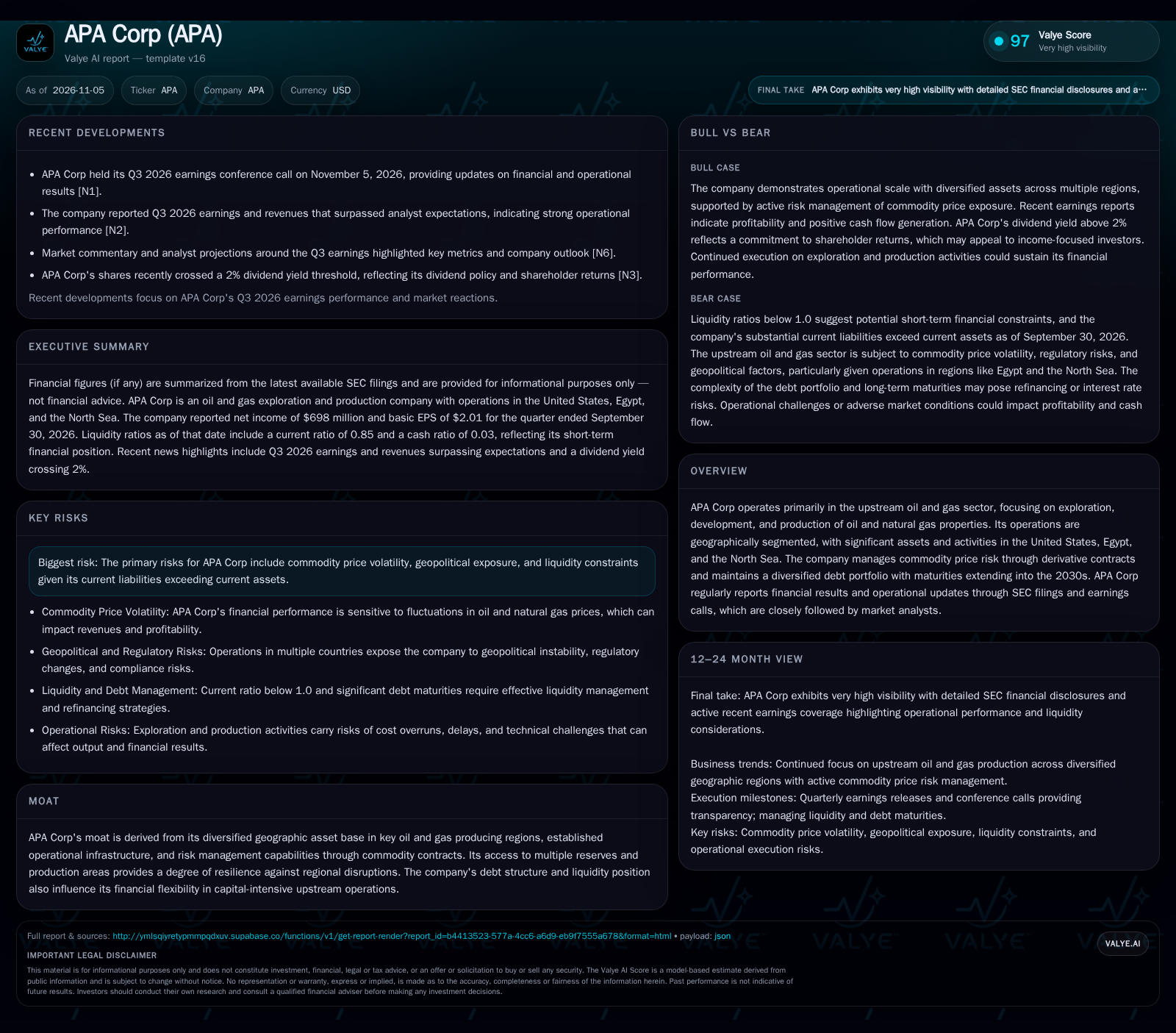
APA Corp delivered strong Q3 2026 earnings and surpassed revenue estimates, signaling operational strength across its U.S., Egypt, and North Sea upstream assets.
APA Corp’s latest quarterly results reinforce its position as a profitable, multinational upstream oil and gas operator, with Q3 2026 earnings and revenues surpassing analyst forecasts. Yet, this operational strength is tempered by a liquidity profile that demands close scrutiny: current liabilities exceed current assets, and the company’s cash on hand remains minimal relative to its obligations. As APA navigates commodity price volatility and geopolitical exposures, the interplay between cash flow generation, debt management, and capital discipline will define its ability to sustain momentum and seize new opportunities.
APA’s Q3 2026 Snapshot: Earnings Outperformance Amid Tight Liquidity
APA Corp reported net income of $698 million and basic earnings per share of $2.01 for the quarter ended September 30, 2026, with both earnings and revenues surpassing analyst expectations [S2] [N2]. This operational outperformance demonstrates the company’s ability to generate profitability from its geographically diversified upstream portfolio. The company reported cash and liquidity metrics for the period; these figures do not by themselves establish operating runway, investment capacity, financial flexibility, or financing capacity. [S2] The company’s debt structure is complex, with multiple unsecured instruments extending into the 2030s, suggesting refinancing and interest-rate management will remain ongoing priorities [S1]. APA’s active use of commodity derivatives highlights its focus on risk management in the face of persistent oil and gas price volatility [S2].
How APA’s Upstream Model Converts Production into Cash Flow
APA Corp’s economics are defined by the upstream oil and gas value chain: capital-intensive exploration and development, followed by production and sale of hydrocarbons. Revenue is driven by realized oil and gas prices, production volumes, and product mix across its U.S., Egypt, and North Sea segments. APA’s profitability in Q3 2026 suggests effective cost control and operational execution, but sustaining this performance depends on commodity prices and the company’s ability to manage lifting costs, exploration outlays, and depletion. Fixed costs—including infrastructure maintenance, lease obligations, and debt service—create substantial operating leverage, amplifying both upside and downside in volatile markets. The use of derivative contracts can dampen revenue swings but may also cap upside in price rallies. Capital needs are ongoing, both for sustaining production and for servicing debt, and the company’s liquidity profile means that free cash flow must be carefully balanced between reinvestment, debt repayment, and shareholder returns.
The upstream oil and gas sector inherently involves significant capital intensity and long lead times, which means APA must carefully prioritize investments that balance near-term cash flow generation with long-term reserve replacement. This dynamic creates a capital allocation tension: aggressive reinvestment supports production growth and reserves, but may strain liquidity and increase leverage if commodity prices falter. Conversely, conservative spending preserves cash but risks reserve depletion and production declines. Moreover, the geographic diversity of APA’s portfolio introduces variability in lifting costs and fiscal terms, requiring region-specific economic optimization. For example, operational efficiency gains in mature basins can offset cost pressures elsewhere, but only if capital is allocated flexibly and with a clear understanding of regional breakeven economics.
Regional Diversification and Risk Management: APA’s Defensive Moat?
APA’s primary competitive strengths lie in its geographic diversification and established operational infrastructure. With significant assets in the U.S., Egypt, and the North Sea, the company is less exposed to single-region disruptions—whether from regulatory changes, geopolitical instability, or regional supply/demand shocks. This diversity, combined with the company’s active commodity price risk management through derivatives, offers some insulation from the sector’s inherent volatility. However, APA operates in mature, highly competitive basins where national oil companies, global majors, and agile independents all compete for resources and capital. Cost discipline, access to reserves, and the ability to navigate local regulatory and political landscapes are key differentiators. Potential substitutes include renewables and alternative energy, but near-term competitive threats remain centered on efficiency, capital access, and portfolio resilience rather than technology displacement.
If Cash Flow Outpaces Debt Pressure: What Sustained Execution Could Deliver
A favorable scenario for APA hinges on continued strong operational performance, stable or rising commodity prices, and disciplined capital allocation. If the company can consistently generate free cash flow above its capital and debt service needs, it could improve its liquidity profile, reduce refinancing risk, and potentially return more capital to shareholders. Confirmation would come from successive quarters of positive free cash flow, rising current ratios, and reductions in net debt. Additional upside could materialize if geopolitical risks in Egypt and the North Sea remain contained and if APA can leverage its asset base to capture incremental production growth at attractive margins. Evidence to watch would include debt reduction announcements, improved liquidity ratios, and sustained outperformance versus peers on production efficiency and cost metrics.
Operational Discipline Balances Liquidity Constraints and Volatility
The most plausible path for APA is a steady-state scenario where operational discipline and risk management allow the company to generate consistent, if cyclical, earnings while managing through liquidity constraints. In this outcome, commodity prices remain within a range that supports profitability but do not resolve the company’s sub-1.0 current ratio, requiring ongoing attention to working capital and refinancing. APA continues to deploy derivatives to buffer price swings, maintains production levels, and meets debt obligations as they come due, but capital allocation remains tight. Confirmation would include stable production volumes, recurring positive net income, and no material deterioration in liquidity or leverage. Falsification would be signaled by rising short-term borrowings, missed debt payments, or forced divestitures to meet obligations.
When Commodity Shocks and Refinancing Risks Collide
A negative scenario unfolds if oil and gas prices decline sharply, squeezing margins and eroding cash flows just as debt maturities or working capital needs peak. In this situation, APA’s reported cash balance and high current liabilities could force the company to access more expensive credit, refinance on unfavorable terms, or divest core assets. Operational disruptions in Egypt or the North Sea—whether from regulatory changes or geopolitical events—would exacerbate financial strain. Evidence of downside would include declining production, negative free cash flow, rising short-term debt, credit rating downgrades, or asset sales at distressed prices. Liquidity-driven constraints could also limit APA’s ability to sustain exploration and development activity, risking future reserve and production declines.
Milestones That Will Shape APA Corp’s Resilience and Upside
Quarterly free cash flow generation and its sufficiency to cover both capital expenditures and debt service.
Changes in the current ratio and cash ratio over time, indicating improvements or deterioration in short-term liquidity.
Announcements of debt refinancing, new credit facilities, or changes in the maturity profile of outstanding obligations.
Production volume trends by region—especially in Egypt and the North Sea—if disclosed, to assess operational stability.
Commodity price realizations and the impact of derivative settlements on reported revenue and margins.
Any asset divestitures, acquisitions, or changes in the company’s geographic portfolio that could affect risk exposure.
Regulatory, tax, or geopolitical developments in core operating regions that could alter cost structures or operational continuity.
Sustained outperformance or underperformance relative to peer group metrics on cost efficiency, reserve replacement, and return on capital.
Disclaimer: This is research-only, informational analysis and not investment advice. It may include AI-generated interpretation and general industry context. Always verify important details using primary sources.

Comments