
ACNB CORP: Dividend Identity, Q3 Profitability, and the Strategic Stakes of Local Banking Scale
ACNB CORP’s record Q3 2026 results and dividend reputation highlight its operational momentum and income-stock positioning—but limited disclosure on business mix and sector dynamics leaves open questions about its long-term resilience and competitive edge in a shifting regional banking landscape.
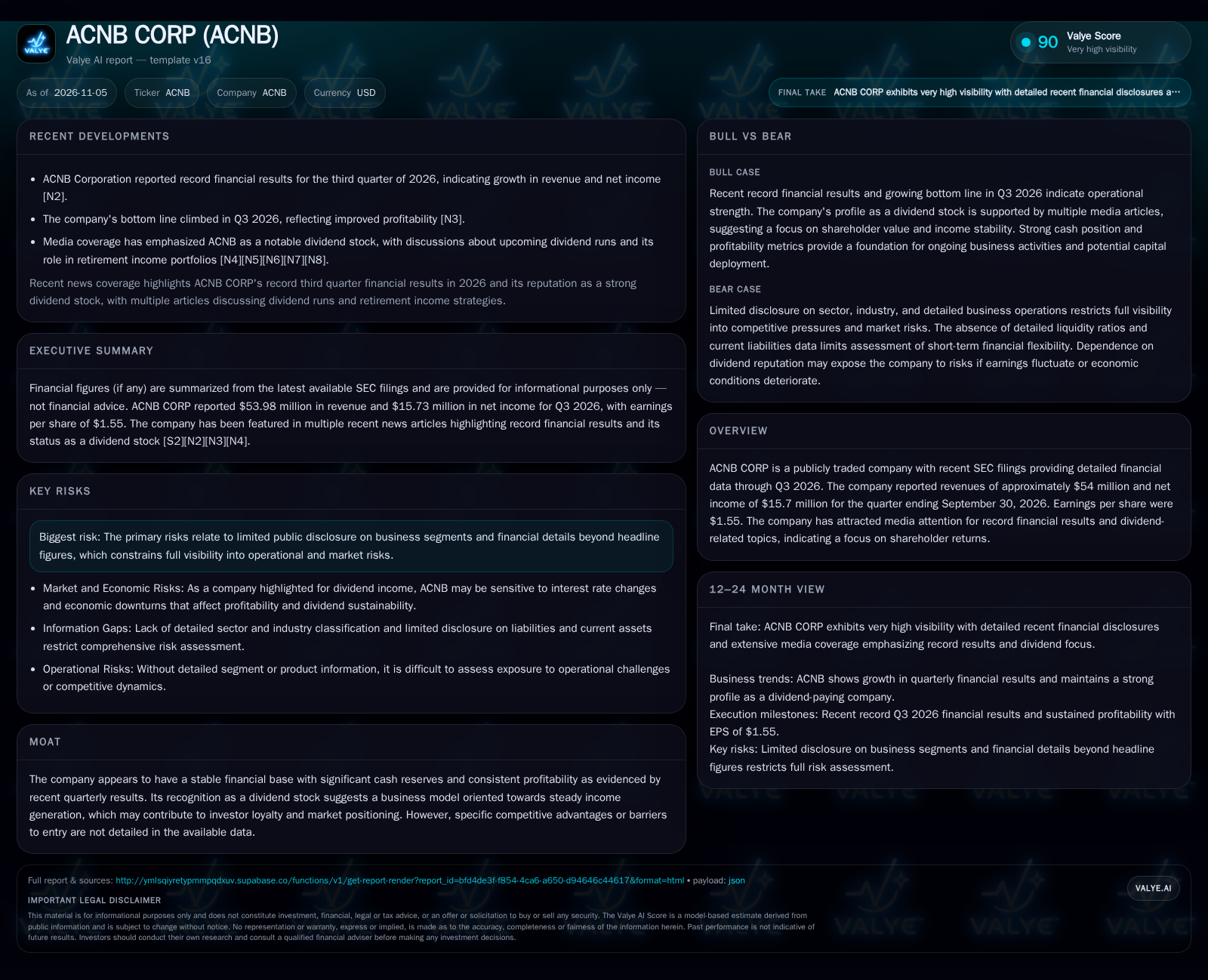
ACNB CORP posted record Q3 2026 financials, with $54M in revenue and $15.7M in net income, reinforcing its profile as a dividend-focused regional financial institution. The company’s future will hinge on sustaining core banking economics, managing credit and rate cycles, and navigating an evolving local competitive field.
ACNB CORP is drawing attention for its record-setting Q3 2026 financials and its well-publicized dividend profile, reinforcing its status as a regional banking institution with a focus on shareholder returns. With revenues nearing $54 million, net income over $15 million, and robust cash reserves, the company’s fundamentals appear strong. Yet, beneath the headline numbers, material gaps in segment and risk disclosure limit visibility into the sustainability of this momentum, especially as regional banks face shifting rate, credit, and competitive dynamics. The next phase for ACNB will test whether its historical strengths and dividend identity can withstand the cyclical and structural challenges reshaping local banking.
Record Q3 Performance and Dividend Reputation Define Current Snapshot
For the quarter ending September 30, 2026, ACNB CORP reported revenues of $53.98 million and net income of $15.73 million, with both basic and diluted earnings per share at $1.55 [S2]. Cash and cash equivalents totaled $88.36 million at quarter-end [S2]. The cited source reports dividend-related activity; that disclosure alone does not establish dividend-policy continuity, management confidence, or a material constraint on capital flexibility. [N2] [N3] [N4] These facts position ACNB as a profitability leader among smaller regional banks, potentially enhancing its attractiveness to income-oriented investors.
How ACNB Makes Money: Core Banking Economics and Dividend Orientation
ACNB’s business model, while not fully detailed in segment terms, is consistent with that of a traditional regional bank: generating net interest income from lending activities, supplementing with fee-based services, and managing a balance sheet geared toward stable, recurring returns. The recent acquisition of Traditions in early 2025 added significant assets, loans, and deposits to the platform, likely increasing both scale and operating leverage [S1]. With a reported net interest margin of 4.23% for 2025 and a return on average assets of 1.16%, ACNB’s recent profitability is notable in the context of compressing industry margins and credit costs. The company’s dividend focus suggests a capital allocation strategy that prioritizes distributable earnings over aggressive reinvestment, appealing to investors seeking stable yield but potentially limiting retained earnings for organic expansion or digital innovation. If industry-standard cost bases and credit quality hold, incremental volume growth should drop meaningfully to the bottom line, driving further dividend capacity.
The balance sheet composition and asset-liability management strategies underpinning ACNB’s core banking economics warrant further scrutiny. For instance, the maturity profile of loans and deposits, as well as the proportion of fixed versus variable rate assets, directly influence interest rate risk exposure and net interest margin stability. A bank with a high concentration of fixed-rate loans funded by short-term deposits may face margin compression in rising rate environments, whereas a more balanced or hedged profile could sustain margins. Additionally, the extent of reliance on non-interest income streams, such as service fees or mortgage banking, affects earnings diversification and resilience during rate or credit cycles. Understanding how ACNB manages these dynamics would clarify the durability of its dividend orientation under varying macroeconomic conditions.
Dividend Stock Status and Local Scale: Potential Moats and Exposures
ACNB’s dual identity as a dividend stock and a regional institution shapes its competitive position. The dividend profile, widely cited in the media, may foster investor loyalty and a stable shareholder base [N4]. Locally, the acquisition of Traditions likely expanded ACNB’s market share and customer relationships, conferring some scale advantages in deposit gathering and lending. However, the lack of detailed segment or geographic disclosure makes it difficult to pinpoint whether ACNB benefits from unique local franchise value, product breadth, or service differentiation. Regional banks face persistent threats from larger national banks, fintech entrants, and direct lending platforms, all of which can erode margins and customer stickiness. The question is whether ACNB’s current profitability is driven by durable advantages—such as community ties, customer loyalty, or cost discipline—or if it is more vulnerable to commodity pricing, rate cycles, and external shocks.
Leveraging Acquisition Scale and Dividend Identity for Sustainable Outperformance
In a favorable scenario, the integration of the Traditions acquisition could deliver lasting scale benefits—lowering unit costs, expanding the customer base, and enhancing cross-sell opportunities. A further indicator would be the successful rollout of new loan or deposit products that expand wallet share without eroding pricing power.
Steady-State Banking: Navigating Rate Cycles and Dividend Expectations
The most plausible trajectory for ACNB is one of moderate, steady-state performance, with profitability tracking regional banking peers and dividend payments anchoring its investor appeal. In this scenario, net interest margins may compress modestly if rates fall or competition intensifies, but core earnings and asset quality remain intact. Dividend continuity persists, but growth slows in line with sector norms. Confirmation for this base path would include stable quarterly earnings per share, a consistent dividend payout ratio, and asset quality metrics (such as non-performing assets and net charge-offs) remaining within historical bands. Any material deviation in loan growth, margin, or credit performance would likely signal a shift away from this equilibrium.
Credit Deterioration or Rate Compression Could Pressure Earnings and Dividend
On the downside, ACNB could face a double hit from worsening credit quality and further net interest margin compression. An adverse local economic event—such as a downturn in key lending sectors or rising unemployment—could drive up loan delinquencies and charge-offs, eroding earnings and possibly forcing a dividend reduction. Additionally, if larger banks or digital challengers undercut ACNB on rates or fees, deposit attrition and revenue loss could follow. Early warning signs would include a spike in non-performing loans, declining net interest margin, and management commentary on competitive or economic headwinds. A dividend cut or suspension, if it occurred, would likely trigger a sharp reevaluation of the company’s income-stock thesis.
Signals That Will Clarify ACNB’s Dividend Durability and Regional Banking Edge
Quarterly trends in net interest margin, especially relative to regional peers, would help test the sustainability of core banking profitability.
Disclosure of asset quality metrics—such as non-performing loans to total loans and net charge-offs—will indicate credit risk management effectiveness.
Loan and deposit growth rates, if disclosed, will signal whether ACNB is maintaining or expanding its local market relevance.
Evidence of successful integration and performance from the Traditions acquisition, such as cost synergies or revenue growth, would support the scale thesis.
Any new products, digital initiatives, or fee-based service rollouts would help assess adaptability to changing customer expectations and competitive threats.
Management’s commentary on local economic conditions, competitive dynamics, and regulatory outlook would provide qualitative context for future risk and opportunity.
Disclaimer: This is research-only, informational analysis and not investment advice. It may include AI-generated interpretation and general industry context. Always verify important details using primary sources.

Comments