
International Bancshares Corp: Liquidity Strength, Profitability, and the Limits of Disclosure
International Bancshares Corp enters late 2026 with significant cash and short-term investments, posting robust quarterly profit and earnings per share. However, incomplete segment and risk disclosure clouds visibility into its true diversification, risk concentration, and competitive positioning.
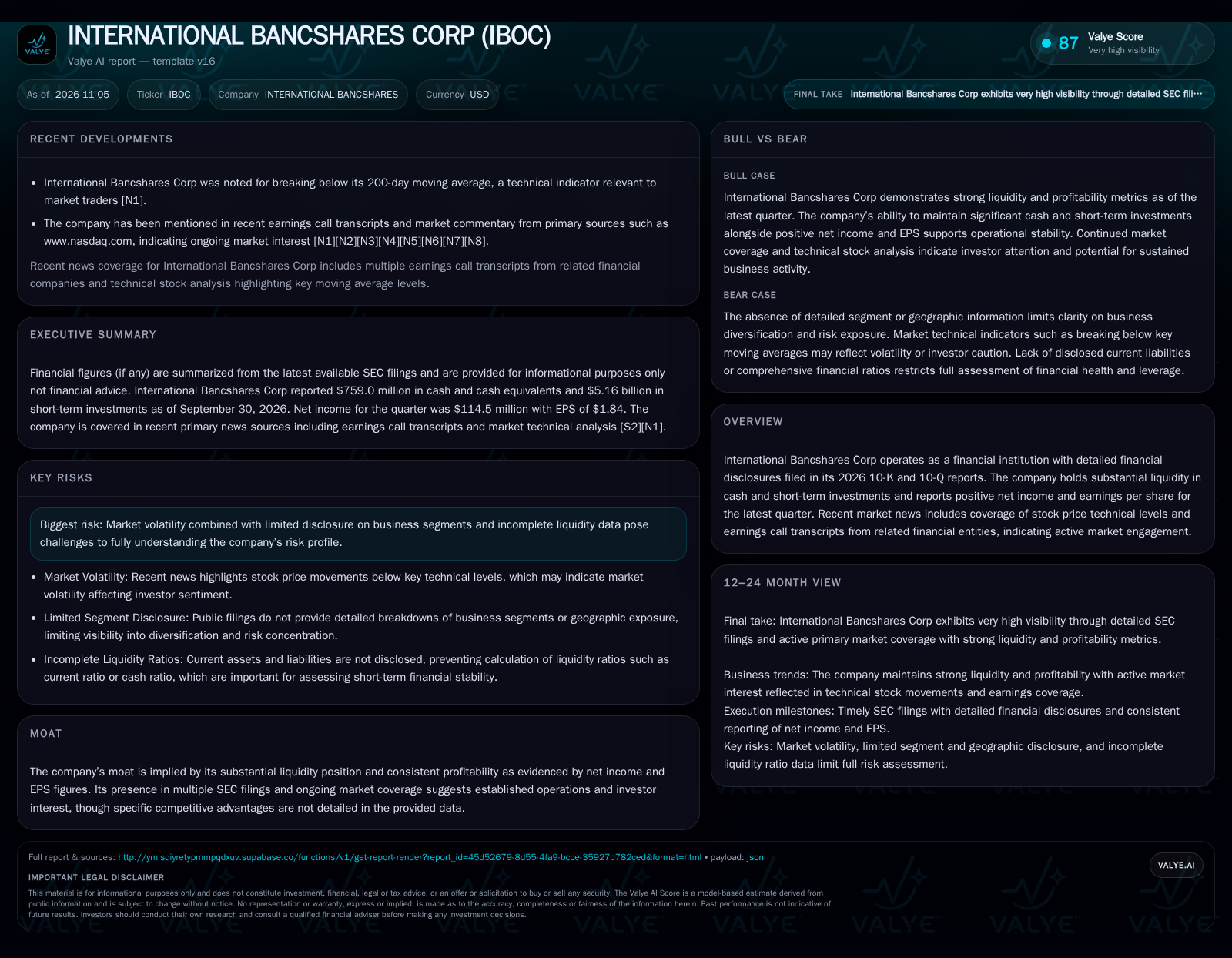
International Bancshares Corp reports $759 million in cash and $5.16 billion in short-term investments as of September 30, 2026, with $114.5 million in net income and $1.84 EPS for the quarter. While these headline metrics suggest financial strength, the lack of detailed segment, liability, and risk disclosures limits a full assessment of its business resilience and strategic flexibility. Market attention is evident, but volatility and concentration risks merit closer scrutiny. [S2]
International Bancshares Corp (IBOC) presents a textbook case of headline financial strength as it closes the third quarter of 2026: ample cash reserves, billions in short-term investments, and robust profitability. Yet, the absence of granular segment data, current liability details, and explicit risk disclosures leaves open major questions about true resilience, diversification, and the sustainability of earnings. For investors and analysts, this tension between surface-level strength and underlying opacity frames the real analytical challenge.
Snapshot of Financial Strength and Disclosure Gaps
As of September 30, 2026, International Bancshares Corp reported $759 million in cash and cash equivalents and $5.16 billion in short-term investments, highlighting a reported liquidity position. Net income for the quarter was $114.5 million, with earnings per share of $1.84. However, the absence of segment breakdowns, current liability data, and comprehensive risk disclosures in the latest filings constrains a full understanding of the underlying business mix and risk concentration. The company's stock has also exhibited technical volatility, recently breaking below key moving averages—an indicator of shifting market sentiment. [S2]
How International Bancshares Could Drive Earnings: Core Banking Levers and Capital Dynamics
International Bancshares Corp operates as a financial institution, with its economics likely driven by the traditional banking model: net interest income derived from the spread between interest earned on loans and investments and interest paid on deposits. The large balance of cash and short-term investments suggests a significant portion of assets are held in liquid, low-risk instruments—potentially reflecting a conservative risk posture or a lack of higher-yielding lending opportunities. In this context, the company’s earnings power will hinge on its ability to manage asset yields, funding costs, and credit quality. Operating leverage in banking often comes from scale efficiencies and stable deposit bases, while fixed costs include branch infrastructure and compliance. Variable costs are tied to loan origination, credit risk management, and customer acquisition. Capital adequacy is another core consideration: the size of the liquidity cushion enables regulatory compliance and provides optionality for future loan growth or defensive positioning in downturns. However, without segment or product-line disclosure, it remains unclear whether earnings are concentrated in certain geographies, customer types, or loan categories—all of which have implications for risk and future returns.
In addition to traditional net interest income drivers, International Bancshares’ profitability may also be influenced by fee-based income streams such as service charges, loan servicing fees, and wealth management commissions. These non-interest revenues can provide a stabilizing effect on earnings, especially in periods of fluctuating interest rates or loan demand. However, the absence of detailed segment reporting obscures whether such income sources contribute meaningfully to the overall financial results or if the company remains predominantly reliant on interest margin compression or expansion. Furthermore, the interplay between asset-liability management strategies and interest rate risk hedging could materially affect net interest margins, particularly in a rising or volatile rate environment, but without disclosure, the extent of such risk mitigation remains speculative.
Assessing Competitive Advantages and Structural Threats in a Changing Banking Landscape
In regional banking, advantages often stem from local market share, relationship-driven lending, and low-cost deposit franchises. However, these can be eroded by digital banking entrants, fintech lenders, or larger national banks with more diversified funding and technology. Without explicit disclosures, it is not possible to confirm whether IBOC enjoys superior cost of funds, differentiated asset quality, or unique service niches. The company’s footprint may expose it to concentrated economic or credit cycles if it is heavily weighted to a particular region or sector. Furthermore, the broader industry faces structural headwinds from technology substitution (digital banking, payments innovation), regulatory pressures, and potential shifts in consumer behavior. The question is whether IBOC’s current liquidity and profitability translate into sustainable advantage or simply reflect a temporarily benign environment.
The company’s competitive positioning also depends on its ability to leverage technology and operational efficiency to offset structural cost pressures. Regional banks face increasing cost burdens from regulatory compliance and cybersecurity investments, which can erode margins if not managed effectively. If International Bancshares has achieved scale or process automation that reduces per-unit costs, it could sustain profitability even amid competitive pressures. Conversely, failure to modernize or differentiate digitally could lead to attrition of core customers to fintech or larger banks offering superior user experiences and product innovation. Additionally, the degree of customer loyalty and cross-selling effectiveness within existing markets would influence resilience against competitive encroachment, yet these qualitative factors remain unquantifiable without further disclosure.
If Defensive Liquidity Enables Opportunistic Growth
If the company can deploy its $5.16 billion in short-term investments into higher-yielding loans or strategic acquisitions, earnings could accelerate. Additionally, if management leverages its balance sheet to expand into underserved markets or invest in digital banking capabilities, it could increase share and improve returns on equity. Confirmation of this scenario would require future disclosures showing loan portfolio growth, net interest margin expansion, or successful entry into new business lines or geographies. Evidence of above-peer loan growth, improved efficiency ratios, or differentiated digital offerings would also support this thesis. Conversely, if these balances remain stagnant and earnings plateau, it would suggest missed opportunities or structural limits to growth.
Sustaining Profitability Amid Incomplete Transparency
The most likely near-term trajectory is continued headline profitability and operational stability, supported by a reported liquidity position and prudent balance-sheet management. However, absent new disclosures, the business may remain opaque, with investors unable to fully assess diversification, risk concentration, or the sustainability of earnings. This scenario would be confirmed by ongoing quarterly profits, stable or modestly growing cash and investment balances, but continued lack of granular segment or risk data. Falsification would occur if material negative credit events, regulatory actions, or outsized losses in a particular business line were disclosed, revealing hidden vulnerabilities.
How Opacity and Market Volatility Could Expose Hidden Risks
A negative scenario could unfold if the lack of segment and risk disclosure masks significant concentration risks or deteriorating asset quality. For example, if a large portion of the short-term investments or loans are exposed to a single sector, geography, or counterparty, a localized economic downturn or credit event could trigger outsized losses. Additionally, technical trading signals—such as the stock breaking below its 200-day moving average—may foreshadow waning investor confidence or anticipation of negative surprises. Downside would be confirmed by sudden increases in loan loss provisions, unexpected write-downs, or regulatory findings that highlight insufficient risk controls. A sharp decline in net interest income, spike in nonperforming assets, or disclosure of material contingent liabilities would also support a bearish thesis.
Testing the Resilience and Strategic Direction of International Bancshares
Disclosure of loan portfolio composition by sector and geography would clarify risk concentration and diversification—critical for assessing resilience.
Updates on net interest margin trends, if disclosed, would reveal the company’s ability to manage funding costs and asset yields in changing rate environments.
Quarterly changes in nonperforming assets or loan loss provisions would help detect emerging credit risks.
Additional details on customer deposit trends and funding mix would inform on the stability and cost of IBOC’s funding base.
Evidence of investment in digital banking or technology platforms would indicate capacity to defend or expand market share.
Management commentary on capital deployment strategy—such as plans for lending growth, acquisitions, or returning capital to shareholders—would illuminate future growth levers.
Any new regulatory disclosures or findings would provide independent validation (or concern) regarding risk management practices.
If disclosed, efficiency ratios and cost trends would clarify operating leverage and scalability of the franchise.
Disclaimer: This is research-only, informational analysis and not investment advice. It may include AI-generated interpretation and general industry context. Always verify important details using primary sources.

Comments