
Global Crossing Airlines: ACMI and Charter Expansion Meets Structural Liquidity Constraints
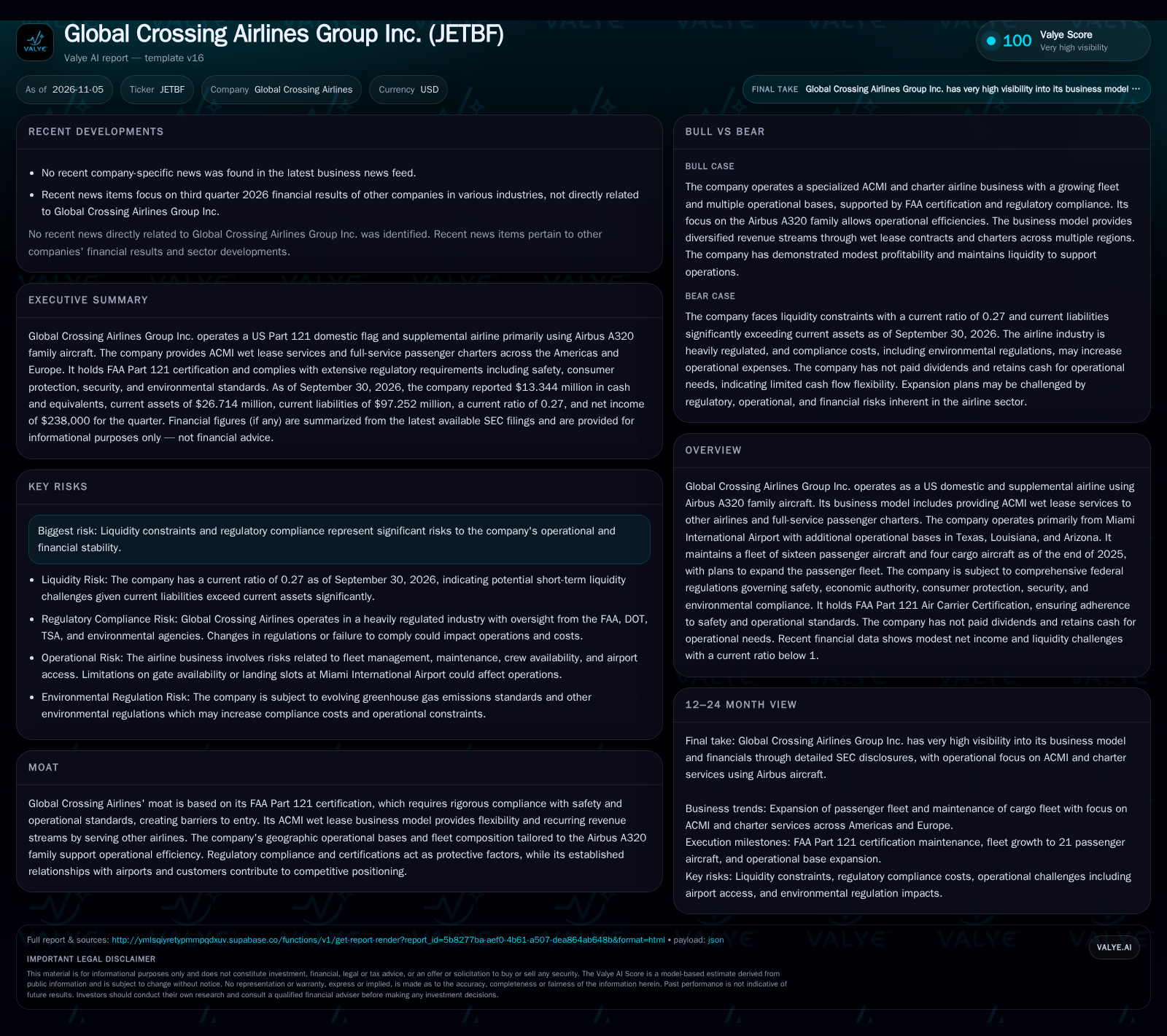
Global Crossing Airlines operates a growing ACMI and charter airline business with a fleet focused on Airbus A320-family aircraft, serving diverse regions from a Miami hub.
Global Crossing Airlines operates a growing ACMI and charter airline business with a fleet focused on Airbus A320-family aircraft, serving diverse regions from a Miami hub. While the company maintains FAA Part 121 certification and has expanded both passenger and cargo fleets, its financials reflect acute liquidity pressures: as of September 30, 2026, current liabilities far exceed current assets, and the current ratio is just 0.27. [S2]
Global Crossing Airlines is attempting to carve out a profitable niche in the fragmented airline market by specializing in ACMI wet lease and charter services, leveraging a homogeneous Airbus fleet and FAA certification to build operational scale. The outcome will depend on the interplay between fleet utilization, contract quality, and the company’s ability to manage capital needs under persistent financial pressure. [S2]
Liquidity Shortfall Overshadows Fleet Expansion
As of September 30, 2026, Global Crossing Airlines holds $13.344 million in cash and cash equivalents against $97.252 million in current liabilities, resulting in a current ratio of 0.27 and a cash ratio of 0.14. The company reported cash and liquidity metrics for the period; these figures do not by themselves establish operating runway, investment capacity, financial flexibility, or financing capacity. [S2]
Despite these financial pressures, the company continues to expand: its passenger fleet reached sixteen Airbus A320-family aircraft by the end of 2025, with plans to grow to twenty-one within the following twelve months, while the cargo fleet stands at four A321Fs. This dual push into passenger and cargo ACMI and charter markets increases both the company’s revenue potential and its exposure to fixed costs and capital requirements. [S2]
The company remains FAA Part 121 certified, which is a significant operational credential that allows it to serve a broad range of domestic and international routes and offers a degree of regulatory moat. [S2]
How the ACMI and Charter Model Shapes Cost Structure and Margin Potential
Global Crossing Airlines’ core revenue streams flow from ACMI (wet lease) contracts and full-service passenger charters. In the ACMI model, the airline supplies the aircraft, crew, maintenance, and insurance, typically under fixed-rate contracts with other carriers, while the lessee covers fuel and certain variable costs. This model can generate steady, recurring revenue when utilization is high, but exposes the lessor to significant fixed costs—including aircraft leases, crew salaries, and maintenance—if aircraft are underutilized.
Full-service charters, in contrast, are typically all-in contracts covering fuel, insurance, landing, and navigation fees. Charters can command premium pricing during peak demand seasons or for specialized routes, but revenue visibility is lower and earnings are more volatile compared to multi-year ACMI agreements.
Operating leverage is material: higher fleet utilization and longer-duration ACMI contracts can drive margin expansion, as incremental revenue flows through a largely fixed cost base. However, low utilization or pressure on contract pricing can rapidly erode margins, especially given the capital-intensive nature of airline operations and the requirement to maintain regulatory compliance.
The company’s expansion plan—growing the passenger fleet by roughly 30% in a year—amplifies both upside and downside. If new aircraft are placed on high-yield, long-duration ACMI contracts, margin uplift is plausible. If not, fixed costs may rise faster than revenue, deepening cash shortfalls.
FAA Certification and Fleet Focus as Barriers—But Not Moat Enough?
Global Crossing Airlines’ FAA Part 121 certification is a real barrier to entry: it requires rigorous safety, operational, and financial controls. This positions the company to serve both US domestic and international routes and to attract ACMI customers needing regulatory-compliant partners.
The focus on a single aircraft family (Airbus A320 for passengers, A321F for cargo) supports operational efficiency and potentially reduces training and maintenance complexity. In principle, this could translate to cost advantages over competitors operating mixed fleets.
However, the ACMI and charter market is highly competitive and sensitive to macro demand cycles. Competitors range from large global lessors with diversified fleets and stronger balance sheets to smaller niche operators able to undercut pricing. Substitution risk is significant: airlines may prefer to add or retire their own capacity, or switch between ACMI providers based on price and reliability.
Customer loyalty and switching costs in ACMI and charter are low unless the provider can demonstrate superior reliability, regulatory compliance, and flexible capacity. The company’s ability to form sticky, recurring relationships is not yet established in the supplied evidence.
Fleet Scale, Contract Wins, and Margin Expansion: What Would Success Look Like?
The bullish scenario hinges on Global Crossing Airlines successfully placing its expanded fleet into long-duration, high-yield ACMI contracts or premium charters, driving high utilization rates. This would enable fixed costs to be spread over greater revenue, unlocking operating leverage and margin growth.
Evidence that would confirm the upside thesis includes: disclosure of multi-year ACMI contracts with major carriers, rising aircraft utilization rates, and sustained positive net income driven by core operations (rather than asset sales or one-off events).
If the company can demonstrate asset-light growth—adding new aircraft with limited incremental capital outlay, perhaps via operating leases—and avoid dilutive equity issuance or expensive debt, the model could generate attractive returns despite the capital intensity typical of the sector.
A shift in the regulatory environment favoring ACMI over full-service airlines (e.g., due to pilot shortages or tighter environmental rules on mainline carriers) could further enhance demand for Global Crossing’s services.
Fleet Growth Meets Margin Compression Under Persistent Cash Stress
The most plausible scenario is that Global Crossing Airlines manages to expand its fleet and maintain FAA certification, but struggles to convert scale into meaningful, recurring profitability due to continued liquidity constraints and competitive pricing pressure.
In this scenario, the company may secure additional ACMI and charter contracts, but at rates that only marginally cover rising fixed costs and regulatory compliance expenses. Utilization could be volatile, with periods of idle aircraft eroding margins and cash flow.
Confirmation would come from modest sequential revenue growth, persistent low or near-zero net income, and continued balance-sheet pressure—reflected in a current ratio remaining well below 1 and limited growth in cash reserves. Evidence of short-term financing, renegotiation of lease terms, or delayed fleet delivery could also signal base-case stress.
Falsification would require a step-change in contract quality or a demonstrated ability to materially improve the current ratio and cash position without reliance on dilutive capital raises.
Liquidity Crunch Forces Retrenchment or Restructuring
The adverse scenario materializes if the company is unable to ramp up fleet utilization or secure profitable ACMI/charter contracts quickly enough, resulting in mounting cash burn and an inability to meet current liabilities.
In this case, Global Crossing Airlines could be forced to sell assets, shrink the fleet, or seek emergency financing under unfavorable terms. Regulatory non-compliance—due to inability to fund required maintenance or upgrades—could trigger FAA actions, further constraining operations.
Confirmation would be a further deterioration of the current ratio, missed payments to lessors or suppliers, covenant breaches (if disclosed), or announcements of asset sales, layoffs, or restructuring efforts.
A useful test would be any negative regulatory developments—such as suspension of certification or fines for safety or environmental violations—that sharply limit the company’s operating scope.
Testing the ACMI and Charter Growth Thesis: What to Track for Global Crossing Airlines
Disclosure of new, multi-year ACMI contracts—especially with large, creditworthy airline partners—would help validate the company’s revenue visibility and ability to leverage its fleet.
Aircraft utilization rates (if disclosed) are a critical operational KPI: sustained high utilization would support margin expansion, while low or declining rates would signal underperformance.
Quarterly changes in the current ratio and cash balance should be tracked to assess whether the liquidity gap is closing or widening.
Breakdown of revenue by ACMI versus charter (if disclosed) would clarify the stability and risk profile of earnings.
Evidence of cost per available seat mile (CASM) trends—particularly in relation to regulatory compliance and maintenance costs—would help gauge operating efficiency.
Announcements regarding fleet delivery delays, asset sales, or renegotiated lease terms could signal operational or financial stress.
Material regulatory actions, such as FAA warnings or penalties, would be a red flag for operational continuity.
Disclaimer: This is research-only, informational analysis and not investment advice. It may include AI-generated interpretation and general industry context. Always verify important details using primary sources.

Comments