
Zions Bancorporation: Leveraging Regional Scale and Affiliate Synergies in Capital Strategy
Zions Bancorporation’s affiliate structure underpins local market strength across the western U.S., but ongoing margin pressures, credit risk, and the capital return framework set the terms for long-term value creation. With Q3 2026 showing robust earnings and a fresh buyback authorization, the challenge is balancing regional growth, risk management, and operational complexity.
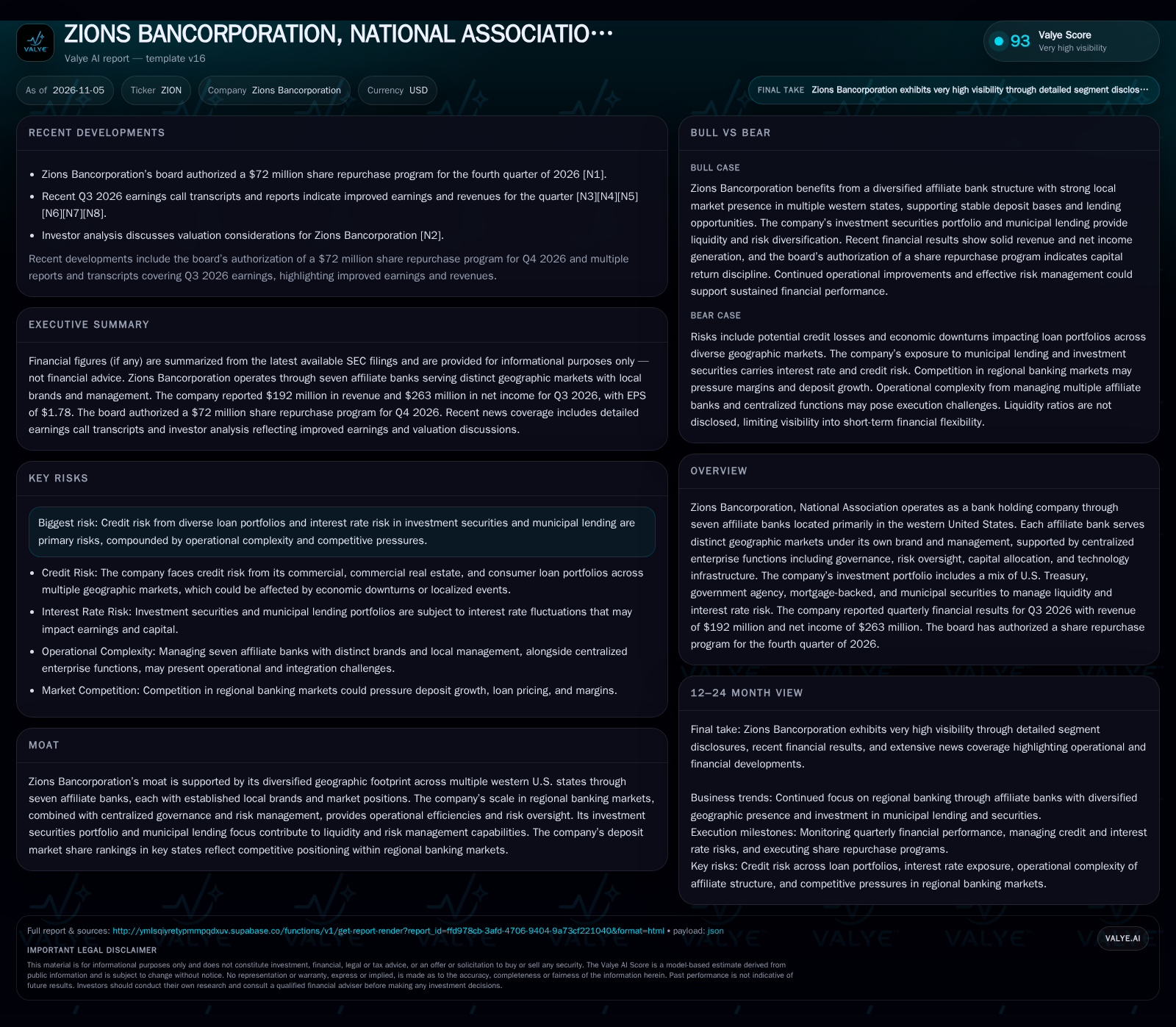
Zions Bancorporation reported Q3 2026 revenue of $192 million and net income of $263 million, reflecting improved earnings and operational momentum. The board has authorized a $72 million share repurchase program for Q4 2026. The company’s affiliate-bank model provides local market depth, but credit and interest rate risks remain central to the long-term thesis. The path forward hinges on managing risk exposures, sustaining deposit share, and executing disciplined capital allocation. [S2] [N1]
Zions Bancorporation stands out among regional banks for its distinctive affiliate model, operating under multiple local brands across the western United States. The company’s Q3 2026 results reflect a period of improved profitability, and a new $72 million share repurchase signals confidence in capital returns. Yet, beneath these headline numbers, the real challenge lies in navigating credit and interest rate risks, the operational intricacies of a decentralized structure, and the shifting competitive landscape of regional banking. The next phase for Zions will test whether local scale, risk management, and disciplined capital deployment can sustain long-term value as macro and market pressures persist.
Strategic Context Defined by Recent Financial and Capital Developments
Zions Bancorporation reported $192 million in revenue and $263 million in net income for Q3 2026, with basic and diluted EPS of $1.78 per share. This marks a period of improved earnings and revenue performance, as highlighted across recent earnings coverage. The company’s board has also authorized a $72 million share repurchase program for Q4 2026, reflecting a willingness to return capital to shareholders amidst ongoing operational momentum. These developments are material because they point to both underlying profitability and management’s confidence in the balance sheet, but they also raise expectations for continued execution on risk and growth fronts. [S2] [N1] [N3] [N4] [N5] [N6] [N7] [N8]
Affiliate Model Balances Local Banking Reach with Centralized Operational Scale
Zions’ business model is built on a network of seven affiliate banks, each operating under its own brand and management within distinct western U.S. markets. This structure enables deep local relationships and market knowledge, potentially supporting stable deposit bases and tailored lending portfolios. At the enterprise level, centralized governance, technology, and risk management deliver scale benefits in back-office operations and regulatory compliance, aiming to reduce redundant costs and improve capital allocation. [S1]
Revenue streams include traditional net interest income from loans and deposits, fee-based income, and returns from a sizable investment securities portfolio—primarily U.S. Treasuries, agencies, mortgage-backed, and municipal securities. The municipal investment and credit portfolio, at $5.9 billion, is notable both for its yield characteristics and as a tool for liquidity and interest rate risk management. [S1]
Economically, the affiliate model can foster strong customer retention and pricing power within local markets—particularly in commercial and small business banking. However, it also introduces higher fixed costs from maintaining multiple brands, branch networks, and management teams. Operating leverage arises when centralized investments (technology, compliance) scale across affiliates, but margin expansion depends on achieving cost discipline and loan growth outpacing expense inflation.
Capital needs are shaped by risk-weighted asset allocations across affiliates, with an internal funds transfer pricing mechanism used for segment performance measurement. This system could incentivize prudent risk-taking and efficient capital use—but also requires rigorous oversight to avoid mispricing or risk concentration.
Zions’ Regional Presence and Brand Portfolio Shape Competitive Dynamics
Zions’ competitive advantage stems from its strong local market positions: second largest by deposit share in Utah, fifth in Idaho and Arizona, and notable presence in California, Texas, Nevada, and Colorado. This regional strength supports core funding via stable, community-oriented deposit bases and builds trust with local customers, especially commercial and municipal clients. [S1]
The affiliate model, with locally branded banks and management, differentiates Zions from monolithic national banks and smaller community lenders. It can offer the relationship banking valued by middle-market businesses and high-net-worth individuals, while leveraging enterprise-level technology and product breadth.
However, competition is intensifying. Larger national banks bring digital scale and broader product suites, while fintechs and direct banks compete on convenience and pricing. Regional peers often aim for consolidation-driven cost synergies, whereas Zions’ decentralized model may limit some efficiency gains. Substitution risk also exists as commercial clients increasingly expect integrated digital services and faster credit decisions—areas where scale and technology investment are critical.
The question is whether Zions can continue to defend and even grow its share in core markets as digital adoption accelerates and pricing for deposits and loans becomes more competitive.
Superior Returns Stem from Operational Rigor and Local Market Expertise
In a favorable scenario, Zions capitalizes on its affiliate model by deepening local market share, growing core deposits, and expanding commercial lending in its western U.S. footprint. Effective risk management keeps credit losses low, while enterprise-level investments in technology and compliance systems generate operating leverage as revenue grows faster than expenses.
The investment securities and municipal lending portfolios provide both yield and liquidity, helping to buffer against margin pressures from interest rate volatility. If Zions can maintain stable net interest margins and generate fee income from treasury management, wealth, and specialized lending, overall returns could outpace regional peers.
Confirmation of this scenario would come from continued positive earnings surprises, visible loan and deposit growth outpacing local market averages, improved efficiency ratios, and evidence that share repurchases are accretive to EPS. Sustained or rising deposit market share in key states would further support the upside thesis. [S2] [N3] [N4] [N5] [N6] [N7] [N8]
Performance Stability Confronts Margin Challenges and Market Complexities
The most plausible path for Zions is moderate growth with periodic margin volatility, as the company balances local market strengths against persistent headwinds. Deposit and loan growth likely track regional economic trends, while competitive pricing pressures constrain net interest margin expansion. The affiliate model continues to deliver stable funding and customer stickiness, but also maintains higher overhead costs versus more consolidated peers.
Investment securities and municipal lending remain a source of yield and liquidity, but interest rate risk and potential mark-to-market volatility may periodically impact reported earnings. Credit costs could remain manageable as long as regional economies avoid sharp downturns, but any meaningful deterioration in commercial real estate or municipal credit quality would pressure results.
This scenario would be confirmed by stable, but not accelerating, earnings; efficiency ratios that improve only incrementally; and continued capital return through buybacks, with limited organic capital growth. Stagnant or slightly declining deposit market share would signal competition is eroding some local advantages. [S2] [N2]
Structural Risks Emerge from Credit Trends and Margin Pressures
In a negative scenario, Zions faces a regional economic downturn or sector-specific shocks—such as commercial real estate weakness—leading to elevated credit losses across its geographically concentrated loan portfolios. Rising nonperforming loans and provisions would erode profitability, while competitive deposit pricing or customer outflows force higher funding costs and squeeze net interest margins.
The complexity of managing seven affiliate banks could slow response times to rapidly changing conditions, increasing operational risk. Interest rate volatility might trigger losses or reduced income from the investment securities and municipal lending portfolios, further pressuring capital. In this scenario, Zions may need to curtail share repurchases or raise additional capital to preserve regulatory ratios.
Evidence of this downside would include a spike in nonperforming assets, sharply higher provision expenses, sequential declines in net interest margins, and delays or reductions in planned capital return programs. Deterioration in deposit market share or branch-level closures could indicate competitive or franchise stress. [S2] [N2]
Factors Influencing the Trajectory of Zions’ Value Creation
Quarterly trends in nonperforming loans, net charge-offs, and provision expenses—if disclosed—would directly test credit risk management.
Loan and deposit growth rates by affiliate and region, relative to local market benchmarks, would clarify whether the affiliate model is driving share gains or losses.
Net interest margin (NIM) trends and the mix of interest-earning assets versus funding costs would indicate how well Zions is managing margin pressures.
Reported efficiency ratios and underlying expense trends would reveal whether centralized investments are translating into sustainable cost leverage.
The pace and accretiveness of the $72 million share repurchase program, including impact on EPS and capital ratios, should be tracked for capital allocation discipline.
Market share rankings in core states—especially Utah, Idaho, Arizona, and California—would help assess franchise durability and competitive positioning.
Changes in the size and risk profile of the investment securities and municipal lending portfolios could signal shifts in liquidity or risk appetite.
If disclosed, digital adoption rates, customer satisfaction, and retention metrics would provide insight into Zions’ ability to compete as customer expectations evolve.
Disclaimer: This is research-only, informational analysis and not investment advice. It may include AI-generated interpretation and general industry context. Always verify important details using primary sources.

Comments