
Six Flags: Integration, Fixed Costs, and the Stakes of Scale in Post-Merger Operations
Six Flags’ recent merger creates both scale opportunities and integration challenges, amplifying fixed cost leverage in a high-stakes environment for discretionary spending.
Six Flags’ recent merger creates both scale opportunities and integration challenges, amplifying fixed cost leverage in a high-stakes environment for discretionary spending. The business’s economics remain highly sensitive to weather, seasonality, and macro trends, while a new leadership team aims to navigate operational and strategic complexity. Execution on integration, cost control, and capital investment will determine whether the combined entity can deliver on its expanded promise.
Six Flags Entertainment Corporation stands at a strategic crossroads, having merged with Cedar Fair to form a North American amusement park giant. This combination offers the promise of greater scale, cost synergies, and geographic diversification—but also introduces operational risk and financial strain. With a high fixed-cost structure, pronounced seasonality, and a recent quarterly net loss, Six Flags’ fortunes now hinge on its ability to integrate operations, drive attendance, and manage liquidity. The next phase will test whether the expanded platform can convert scale into sustained profitability amid shifting economic and consumer dynamics.
Merger Aftermath: Integration, Liquidity, and Financial Volatility
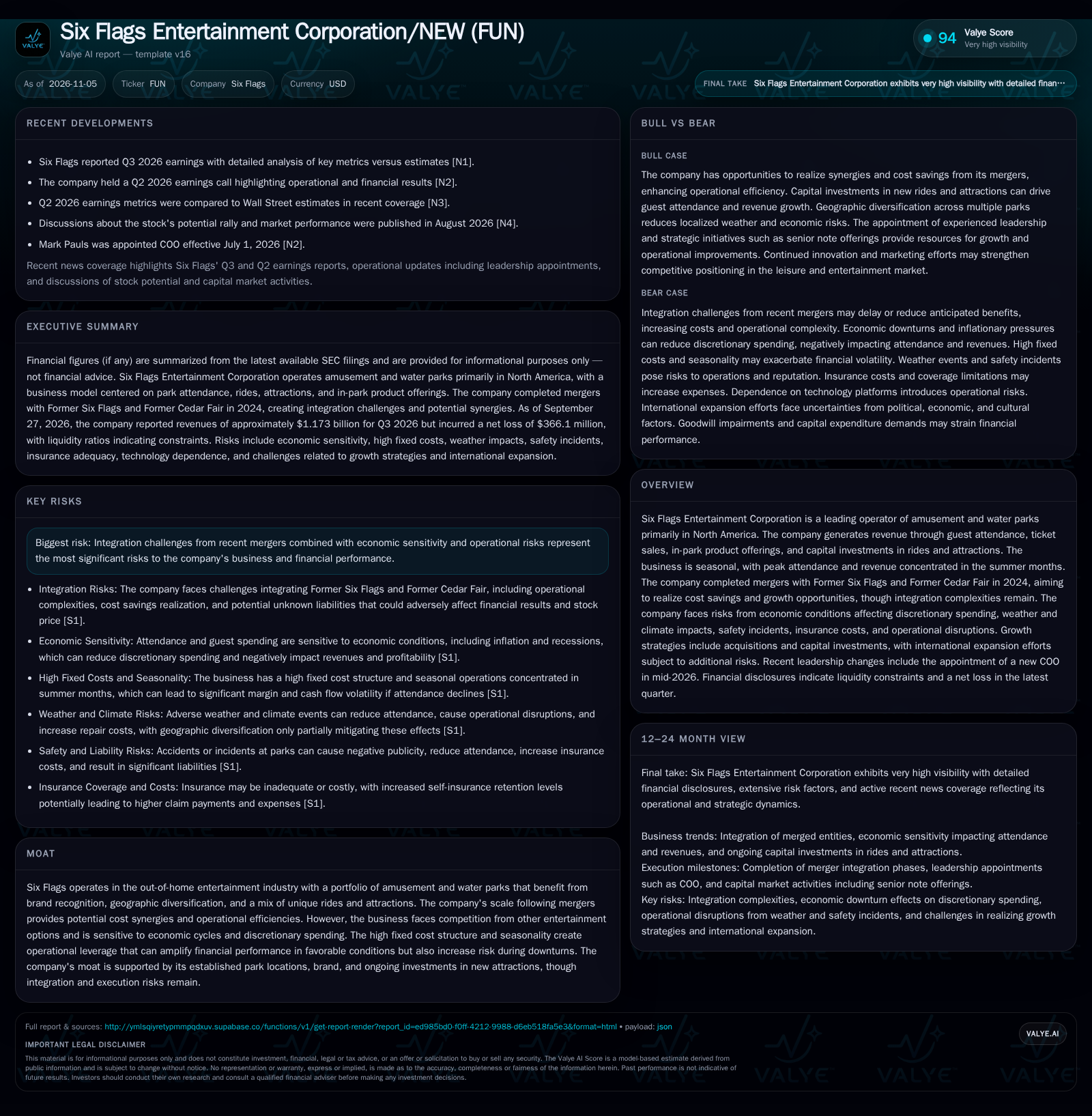
The July 2024 merger of Six Flags and Cedar Fair created one of the largest amusement park operators in North America, drastically increasing operational complexity and the potential for both cost synergies and integration risk. The company reported a current ratio of 0.52 for the period. The company plans a $1 billion senior notes offering to address these constraints. Recent leadership changes, including the appointment of Mark Pauls as COO, underscore the urgency of operational realignment. These facts highlight a company at an inflection point: integration and financial management now dominate the near-term agenda. [S2]
How Scale and Seasonality Shape Amusement Park Profitability
Six Flags’ core business model revolves around park attendance, ticket and season pass sales, and in-park spending on food, merchandise, and premium experiences. Revenue is highly seasonal, with roughly 70% of annual attendance and revenue generated in the second and third quarters, concentrating risk in a few peak periods. The capital-intensive nature of amusement parks means fixed costs—labor, maintenance, insurance, and debt service—are high regardless of attendance, creating substantial operating leverage. This structure magnifies both the upside in strong years and the downside in periods of weak demand or external shocks.
The merger with Cedar Fair offers theoretical cost synergies through shared procurement, consolidated marketing, and streamlined back-office functions, but also increases integration costs and complexity. Large-scale capital investments in new rides and attractions are required to sustain attendance and pricing power, yet these outlays can strain liquidity and may not always deliver expected returns. A significant portion of the company’s expenses are not easily variable, so shortfalls in attendance or guest spending can quickly erode margins and cash flow. The company’s recent net loss and liquidity ratios suggest these dynamics are front and center.
A critical aspect of Six Flags’ economics lies in the tension between fixed and variable costs within its operating model. While fixed costs such as maintenance and debt service remain constant regardless of attendance, variable costs tied to guest volume—like food and merchandise procurement or seasonal staffing—offer some flexibility but are limited in scale. This dynamic means that even small fluctuations in attendance or guest spending can disproportionately impact profitability. Moreover, the capital-intensive nature of new attraction development introduces timing risk: investments often require upfront expenditures well before revenue benefits materialize, creating a lag that can strain liquidity if attendance growth does not meet projections.
The seasonality inherent in the amusement park industry also complicates cash flow management and operational planning. Concentrating the majority of revenue into a few quarters necessitates careful working capital management and liquidity buffers to cover off-season fixed costs. Additionally, weather volatility during peak periods can lead to sudden revenue swings, challenging the company’s ability to forecast and control costs effectively. In this context, the merged entity’s increased scale could provide some smoothing benefits through geographic diversification, but only if regional attendance patterns and weather impacts are not highly correlated—an assumption that would benefit from empirical validation if park-level data were disclosed.
Defending the Moat: Brand, Scale, and the Battle for Discretionary Dollars
The combined Six Flags and Cedar Fair entity commands brand recognition, an extensive geographic footprint, and a diverse portfolio of rides and attractions. These factors underpin its competitive position within the out-of-home entertainment sector. The scale advantage could, if realized, yield procurement leverage and marketing efficiency, while geographic diversification may help buffer localized weather or economic shocks.
However, the company faces intense competition—not just from other theme parks and water parks, but from a widening array of entertainment options vying for consumer discretionary spending. Streaming, gaming, travel, and experiential retail all represent substitutes, especially as consumer habits evolve. Moreover, high fixed costs and the need for continual reinvestment in new attractions limit pricing power and expose the business to cyclical and event-driven risks. The challenge is to translate scale into a true moat rather than just greater exposure to industry volatility.
When Integration Works: Synergies, Attendance Growth, and Margin Recovery
A favorable outcome for Six Flags would see the successful integration of Cedar Fair operations, with the realization of cost synergies, streamlined management, and minimal customer disruption. If the company can execute on capital improvement projects—launching new rides and attractions that drive incremental attendance and in-park spending—it could leverage its fixed cost base for outsized margin recovery during peak seasons.
Confirmation of this scenario would come from evidence such as improved operating margins, positive cash flow trends, and a narrowing or reversal of net losses in subsequent quarters. Rising attendance figures, higher per-capita guest spending, and tangible cost savings from merged operations would all support the upside case. Conversely, failure to show these improvements in disclosed KPIs, or continued operational hiccups, would undermine the scenario.
Scale Without Synergy: Managing Through Volatility and Gradual Integration
The most plausible medium-term outcome is that Six Flags experiences a protracted integration process, realizing only partial synergies while contending with ongoing margin volatility. Attendance and guest spending likely remain sensitive to macroeconomic conditions, with inflation or recessionary pressures periodically weighing on demand. The company may succeed in stabilizing its liquidity position through debt offerings and incremental operational improvements, but persistent high fixed costs and capex requirements could limit margin expansion.
Evidence for this scenario would include modest improvements in operating efficiency, continued but narrowing net losses, and steady—but not breakout—attendance growth. Watch for management commentary that emphasizes ongoing integration challenges, incremental progress on cost control, and cautious capital allocation. If disclosed, a slow but steady improvement in per-guest spending and park-level profitability would signal this base case is playing out.
Cascading Integration Failures and the Dangers of Fixed Cost Leverage
In a negative scenario, integration challenges from the merger overwhelm management capacity, leading to operational disruptions, missed cost-saving targets, and increased customer dissatisfaction. Economic headwinds—such as a recession or persistent inflation—could further suppress attendance and in-park spending, while weather events or safety incidents exacerbate revenue shortfalls. The company’s high fixed costs and liquidity constraints would then amplify losses, potentially triggering further asset sales, capital raises, or even debt covenant pressures.
Indicators of this scenario would include sustained or widening net losses, declining attendance, negative cash flow, and adverse credit developments. Rising insurance costs, safety incidents, or negative publicity could further erode the brand and attendance. Management turnover and goodwill impairments would add to the evidence of a deteriorating situation.
Milestones That Will Reveal Whether Six Flags Can Deliver on Its Scale Ambitions
Realization of cost synergies from the Cedar Fair merger, as evidenced by lower SG&A and improved margin, if disclosed.
Quarterly attendance and per-capita guest spending figures to gauge demand elasticity and park-level performance.
Capex outlays and the on-time completion of new ride/attraction projects, as delays or overruns could impact revenue growth.
Trends in net income, operating cash flow, and debt service coverage ratios to assess financial sustainability.
Any evidence of significant weather, safety, or operational incidents affecting attendance or leading to negative publicity.
Updates on the $1 billion senior notes offering and subsequent balance sheet/liquidity developments.
Management commentary on integration progress, unexpected costs, or revised synergy targets.
If disclosed, park-level profitability metrics or EBITDA by region to evaluate geographic diversification benefits.
Disclaimer: This is research-only, informational analysis and not investment advice. It may include AI-generated interpretation and general industry context. Always verify important details using primary sources.

Comments