
Earnings Volatility and Strategic Transition at First Northwest Bancorp: Navigating Leadership Change and Portfolio Diversification
First Northwest Bancorp faces a period of earnings instability and executive transition as it seeks to balance traditional community banking with broader investment partnerships and loan diversification. The company's recent net loss, coupled with ongoing leadership changes, underscores both execution risk and the potential for strategic renewal.
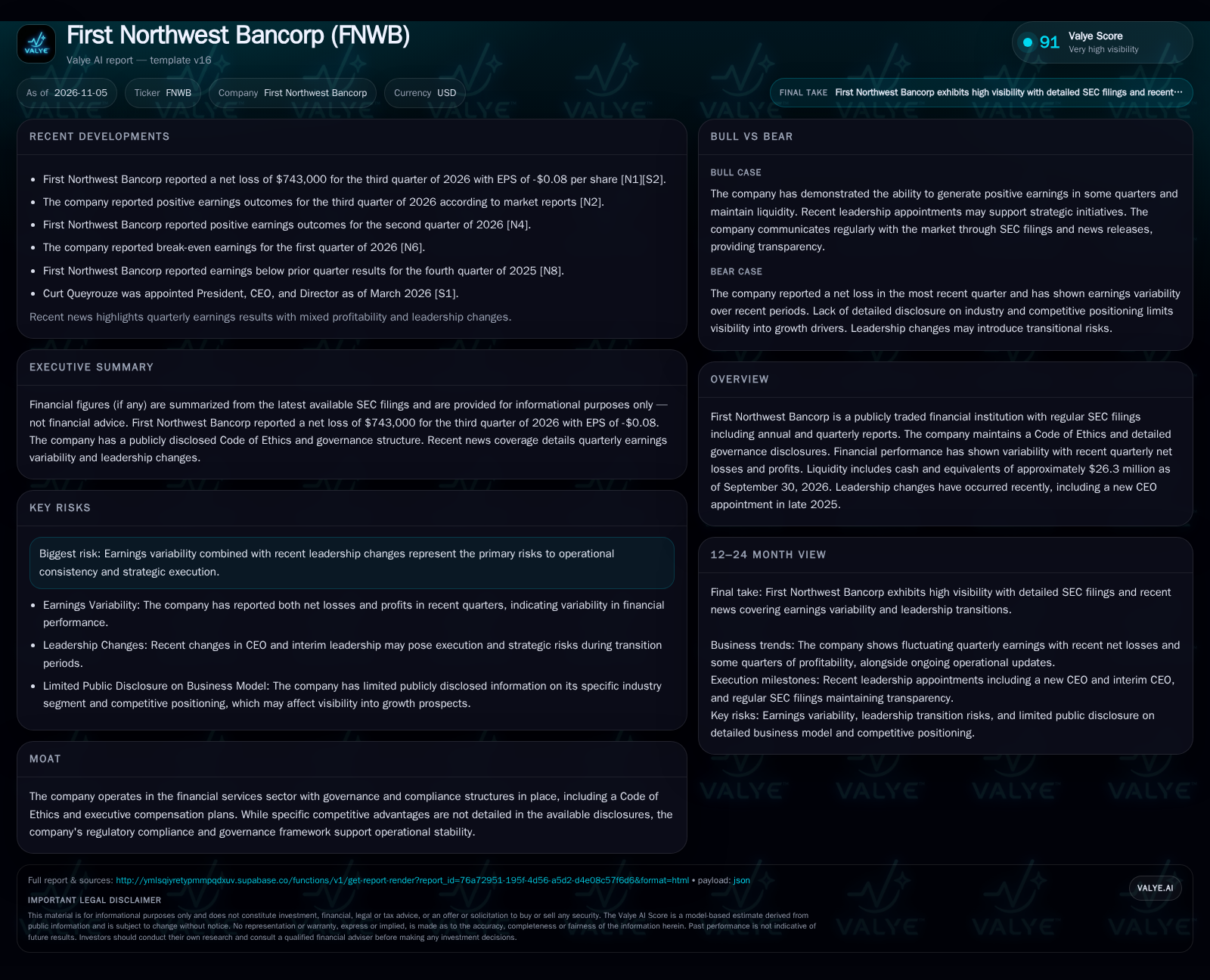
First Northwest Bancorp reported a net loss for Q3 2026 amid ongoing leadership changes and continued efforts to diversify its loan and investment portfolios. The company's liquidity position remains intact, but earnings volatility and incomplete disclosure on business model specifics elevate the importance of execution and external conditions over the coming quarters. Strategic success will likely depend on integrating new leadership and clarifying the path for core banking and alternative investments.
First Northwest Bancorp is navigating a complex period marked by earnings volatility and leadership turnover, as it seeks to reposition itself within both traditional community banking and an expanded investment ecosystem. With a recent net loss in Q3 2026 and ongoing executive transitions, the company's ability to execute on portfolio diversification and realize returns from fintech partnerships will be pivotal. The next phase will test whether new leadership can stabilize earnings and drive sustainable growth, or if structural headwinds and operational uncertainty will continue to dominate the narrative.
Recent Losses and Leadership Changes Shape the Operating Environment
First Northwest Bancorp reported a net loss of $743,000 for the third quarter of 2026, reversing a pattern of break-even and profitable quarters earlier in the year [S2] [N1] [N2] [N6]. This result signals ongoing volatility in earnings and raises questions about the sustainability of recent business strategies. The company reported cash and liquidity metrics for the period; these figures do not by themselves establish operating runway, investment capacity, financial flexibility, or financing capacity. [S1] These factors collectively set the stage for a critical period where strategic execution and operational discipline will be under heightened scrutiny.
How Portfolio Diversification and Community Banking Drive (or Detract from) Profitability
First Northwest Bancorp’s core economic engine remains community-oriented commercial banking, with deposits serving as the principal funding source for lending and investment activities [S2]. The company has sought to diversify its loan book beyond traditional residential mortgages, increasing origination in commercial real estate, multi-family, and auto loans. This shift may enhance yield potential but typically brings higher credit and duration risk, especially if underwriting standards are stretched to drive volume.
Fee income is supplemented through mortgage originations for sale in the secondary market, generating noninterest revenue and servicing fees. However, this revenue stream is sensitive to interest rate cycles and housing market activity. On the investment side, the company has participated in several limited partnerships targeting fintech ventures, aiming to capture upside from digital transformation in banking. While such investments offer optionality, their returns can be lumpy and may not offset core banking volatility in the short term.
Operating leverage is likely constrained by the cost structure of a branch-based community bank, with fixed costs tied to personnel, compliance, and physical infrastructure. This can magnify the impact of revenue swings on net income, especially in periods of margin compression or rising credit costs. The unwinding of the Hero Fund investment in 2026 may release capital, but the timing and magnitude of any gains remain uncertain [S2].
Competitive Pressures from Bigger Banks, Fintechs, and Local Rivals
First Northwest Bancorp operates in a highly competitive region, facing pressure from both traditional banks and non-bank entrants. Larger regional and national banks often have superior access to low-cost funding, broader product suites, and greater technology investment, making it difficult for smaller institutions to defend share or maintain pricing power in core deposit and loan markets.
The company’s foray into fintech partnerships and nontraditional investments is a response to the encroachment of digital-first competitors and the evolving expectations of retail and business clients. However, the efficacy of these partnerships depends on integration with core operations and the ability to translate innovation into customer retention and new business. Community banks also face substitution risk from credit unions and challenger banks, which compete aggressively on rates and digital convenience.
Without clear evidence of a defensible niche or proprietary technology, First Northwest Bancorp’s competitive advantage likely rests on local relationships, service quality, and regional knowledge. Whether these factors suffice as digital adoption accelerates remains an open question.
Leadership Stabilization and Portfolio Realignment Unlock Earnings Recovery
If the new executive team successfully implements a coherent strategy—balancing disciplined loan growth, prudent risk management, and targeted investment in digital capabilities—First Northwest Bancorp could restore earnings momentum and improve return on equity. The unwinding of the Hero Fund investment could provide a capital boost, while fintech partnerships may start to generate meaningful noninterest income or operational efficiencies.
Confirmation of this scenario would include a return to consistent quarterly profitability, evidence of stable or improving net interest margins, and positive fee income trends from both mortgage and partnership channels. Additional signs would be the retention or growth of core deposits in a rising rate environment and improved cost discipline as measured by efficiency ratios. Early wins from digital initiatives or fintech partnerships—such as increased customer engagement, reduced servicing costs, or incremental revenue—would further support the bull case.
Earnings Fluctuate as Transition and Market Forces Counterbalance Progress
The most plausible near-term outcome is continued earnings variability as First Northwest Bancorp manages through executive transition and repositions its portfolio. Loan growth in higher-yielding segments may partially offset margin compression, but credit costs and operational expenses could remain elevated amid uncertain economic conditions. Returns from fintech and partnership investments are likely to be modest or delayed, contributing little to near-term stability.
This scenario would be confirmed by a pattern of alternating profitable and unprofitable quarters, with net interest margin and fee income showing only incremental improvement. Expense ratios may remain stubbornly high if operational restructuring or technology investments lag expectations.
Execution Missteps and Market Headwinds Deepen Earnings Pressure
Should leadership instability persist or new strategies fail to gain traction, First Northwest Bancorp could see further deterioration in earnings. Aggressive loan growth in riskier segments might lead to elevated credit losses in a downturn, while delays or missteps in unwinding investment positions could tie up capital and distract management. Intensifying competition from larger banks and fintechs could accelerate deposit attrition and compress lending margins.
Evidence for this scenario would include a string of quarterly losses, rising nonperforming loans, declining core deposit balances, and negative operating leverage as expenses outpace revenue. Regulatory scrutiny or adverse examination findings could further constrain flexibility, and the inability to deliver on promised digital initiatives or partnership returns would erode both investor and customer confidence.
Milestones and Metrics That Will Clarify FNWB’s Strategic Trajectory
Quarterly net income trends: Sustained return to profitability would indicate successful stabilization; continued losses would signal ongoing execution risk.
Net interest margin movement: Expansion or stabilization would suggest effective loan pricing and asset-liability management; compression could signal competitive or funding pressures.
Noninterest income from fintech and partnership activities: A useful metric would be the contribution of these channels to overall revenue, if disclosed.
Credit quality indicators: Rising nonperforming loans or charge-offs would raise concerns about loan book diversification strategy.
Core deposit retention and growth: Monitoring changes in deposit balances will help assess franchise strength amid competition.
Efficiency ratio and expense trends: Improvement would signal successful cost control and operating leverage; deterioration would suggest structural challenges.
Progress and terms of the Hero Fund redemption: Actual capital returned and timing will clarify the impact on balance sheet flexibility.
Management commentary on digital initiatives and integration of partnership investments: Updates here would help test the company’s ability to translate strategy into operational results.
Disclaimer: This is research-only, informational analysis and not investment advice. It may include AI-generated interpretation and general industry context. Always verify important details using primary sources.

Comments