
Westwood Holdings Group: Asset Management Stability, Product Expansion, and the Stakes of Regulatory Complexity
Westwood Holdings Group demonstrates operational stability, reported liquidity position, and ongoing product innovation in a competitive asset management landscape. As it expands its ETF offerings and institutional reach, the company's performance will depend on navigating integration risks, regulatory demands, and evolving client needs.
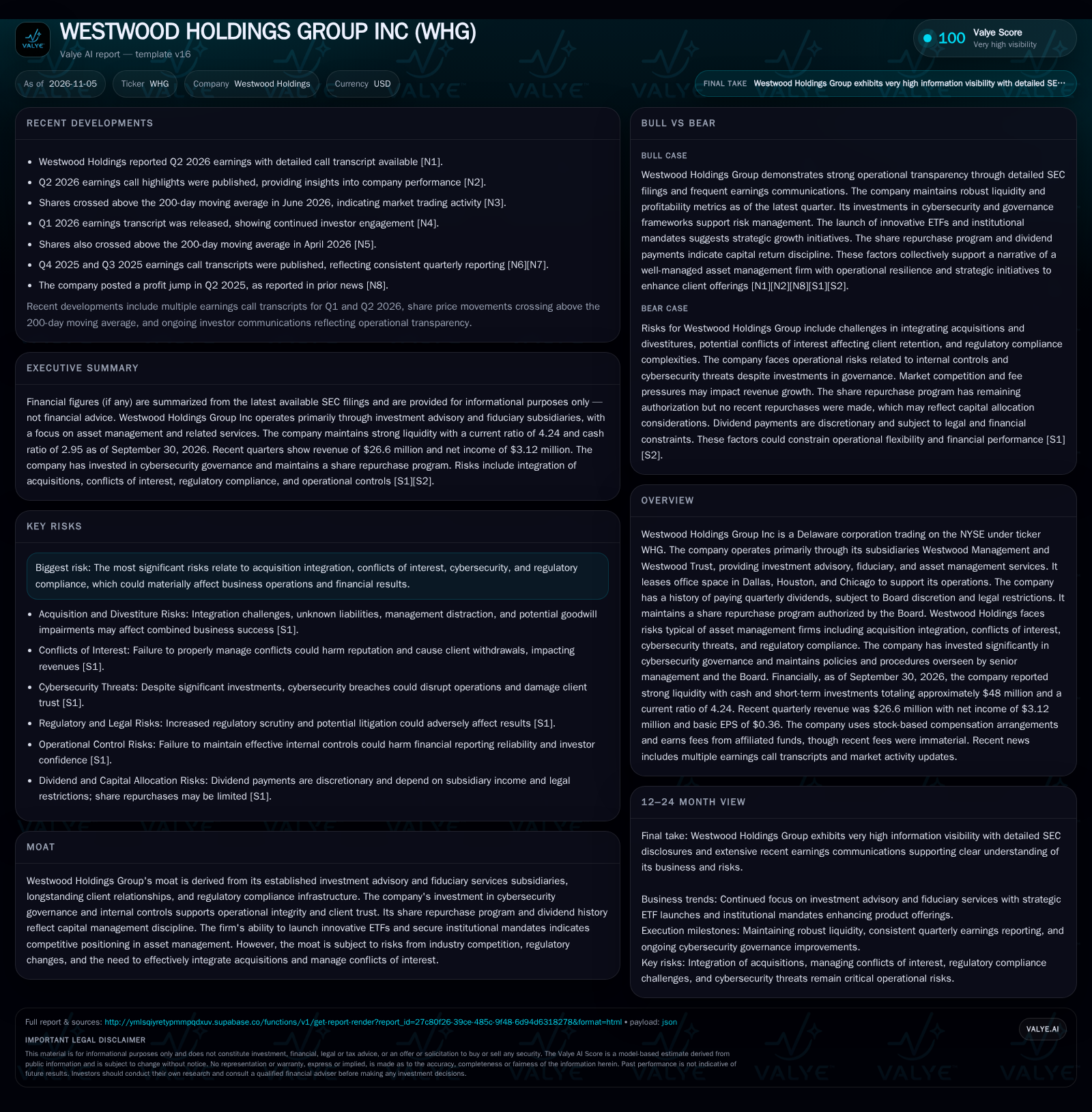
Westwood Holdings Group reported Q3 2026 revenue of $26.6 million and net income of $3.12 million, backed by strong cash and short-term investments totaling $48 million and a current ratio of 4.24 [S2]. The firm continues to launch innovative ETFs and expand institutional mandates [N8]. Risks include acquisition integration, regulatory compliance, and cybersecurity threats [S1].
Westwood Holdings Group Inc. stands out for its financial stability and robust information transparency, reporting $26.6 million in Q3 2026 revenue and maintaining a substantial liquidity position with $48 million in cash and short-term investments [S2]. As the firm navigates a shifting asset management environment, its focus on new ETF products and institutional mandates suggests an active growth agenda. Yet, integration risks, regulatory scrutiny, and the need for operational vigilance—especially around cybersecurity—remain prominent hurdles. The question is whether Westwood can convert its operational strengths and product initiatives into ongoing client growth and margin resilience amid industry headwinds.
Recent Financials and Strategic Initiatives Shape the Current Outlook
Westwood Holdings reported $26.6 million in revenue and $3.12 million in net income for the quarter ended September 30, 2026, with basic earnings per share of $0.36 [S2]. The company’s liquidity, as measured by $24.1 million in cash and $23.7 million in short-term investments, positions it with a current ratio of 4.24 [S2]. The company reported cash and liquidity metrics for the period; these figures do not by themselves establish operating runway, investment capacity, financial flexibility, or financing capacity. Meanwhile, Westwood’s launch of innovative ETFs and expansion of institutional mandates indicate a strategic push to diversify revenue streams and enhance product relevance in a crowded asset management space [N8]. The continuation of a share repurchase program (with $5.5 million remaining authorization) and a history of quarterly dividends further signal a capital return orientation, though both are subject to Board discretion and legal restrictions [S1].
How Westwood’s Fee-Based Model and Cost Structure Drive Profitability
Westwood Holdings generates the bulk of its revenue through investment advisory and fiduciary services, earning fees tied primarily to assets under management (AUM) [S1]. This fee-based model is typically characterized by high operating leverage: incremental revenue from asset growth can expand margins, as core costs—such as personnel, technology, and regulatory compliance—are relatively fixed in the short term. However, revenue is sensitive to market-driven AUM fluctuations, client inflows/outflows, and fee compression, especially as institutional clients negotiate lower rates.
The company's fixed cost base includes significant investments in cybersecurity governance, real estate leases in multiple cities, and compliance infrastructure [S1]. Variable costs are driven by compensation (including stock-based arrangements) and sales efforts to attract new mandates. Westwood’s ability to scale new ETF products or institutional accounts could increase revenue without proportional cost increases, supporting margin expansion. However, if product launches or mandate wins require substantial upfront investment or fail to gain traction, returns may be diluted.
Capital needs are modest relative to asset-heavy sectors, but regulatory capital, working capital for operations, and potential acquisition funding remain relevant. The share repurchase and dividend history suggest management is willing to return excess capital when not needed for organic or inorganic growth.
Differentiation in a Crowded Asset Management Arena
Westwood’s primary competitors are other asset managers, trust companies, and ETF sponsors, ranging from boutique firms to global financial conglomerates. Differentiation for mid-sized firms like Westwood often depends on specialized product offerings, superior client service, and the ability to innovate—such as by launching targeted ETFs or customized institutional mandates.
Operationally, Westwood’s investment in cybersecurity and compliance may help build client trust and withstand regulatory scrutiny, but these are increasingly table stakes rather than unique advantages. Longstanding client relationships and fiduciary reputation can serve as switching frictions, particularly in trust and advisory businesses, but high-net-worth and institutional clients remain sensitive to performance, fees, and product innovation.
The asset management industry faces ongoing fee compression, the proliferation of passive and low-cost vehicles, and technology-driven disruption. Westwood’s willingness to launch new ETFs and pursue institutional mandates suggests it is seeking to remain relevant amid these pressures, but its moat may be limited by the scale and distribution reach of larger competitors.
Product Innovation and Institutional Wins Accelerate Growth
If Westwood’s new ETFs and expanded institutional mandates gain meaningful traction, the company could see accelerated AUM growth and improved revenue mix. Successful product launches would drive higher fee income, particularly if new offerings command differentiated pricing or attract sticky assets from long-term clients. Margin expansion could follow if incremental revenue outpaces the cost of new product development and distribution.
Evidence confirming this scenario would include sustained AUM growth, increased ETF flows, new institutional mandate announcements, and higher advisory fee revenue in subsequent quarters. Disclosure of above-peer retention rates, positive net flows, or the ability to launch further innovative products would further support the case. Conversely, tepid adoption, limited net flows, or evidence of fee pressure would challenge the upside thesis.
Steady-State Operations with Incremental Product Expansion
The most plausible trajectory is for Westwood to maintain operational stability, with modest growth driven by incremental product launches and disciplined capital management. Core advisory and trust businesses are likely to remain stable, while the impact of new ETFs and mandates is gradual rather than transformative. Margins may remain steady if cost discipline offsets any fee compression.
If disclosed, a moderate increase in ETF flows or mandate wins without major cost overruns would reinforce the view. Evidence against this scenario would be sharp declines in AUM, significant client losses, or large-scale operational disruptions.
Integration Missteps and Regulatory Headwinds Undermine Performance
A negative outcome could emerge if Westwood faces difficulties integrating acquisitions or suffers from internal control lapses, leading to client attrition, regulatory penalties, or reputational harm. Cybersecurity incidents or failure to properly manage conflicts of interest could also drive client withdrawals and legal costs. Revenue could decline if fee compression accelerates or if new products fail to gain traction, while fixed costs remain high.
Evidence for this scenario would include regulatory actions, client lawsuit disclosures, unexpected costs from acquisition integration, or a material drop in AUM and fee income. A spike in compliance expenses, restatement of financials, or high-profile cybersecurity breaches would also support the downside case. Conversely, clean regulatory audits and stable client relationships would weaken it.
Testing the Westwood Thesis: Operational and Market Outcomes to Monitor
Quarterly AUM growth and net flow data, if disclosed, would help assess the traction of new products and the health of legacy mandates.
ETF and institutional mandate win announcements or flow disclosures would indicate the effectiveness of recent product launches.
Trends in advisory fee revenue and average fee rates, if reported, would clarify pricing power and competitive positioning.
Sustained operating margin and cost discipline, even as the product suite expands, would support the case for scalable growth.
Evidence of client concentration, retention rates, or large client wins/losses would reveal underlying business stability or vulnerability.
Regulatory filings or disclosures about integration progress, cybersecurity incidents, or compliance costs would signal operational execution quality.
Disclaimer: This is research-only, informational analysis and not investment advice. It may include AI-generated interpretation and general industry context. Always verify important details using primary sources.

Comments