
S&T Bancorp’s Earnings Resilience, Regulatory Strategy, and Risks from Concentrated Lending
Solid Q3 profitability and prudent risk management highlight S&T Bancorp’s operational foundation, but evolving compliance demands and exposure to commercial real estate lending test the bank’s resilience and adaptability in a shifting regulatory and economic landscape.
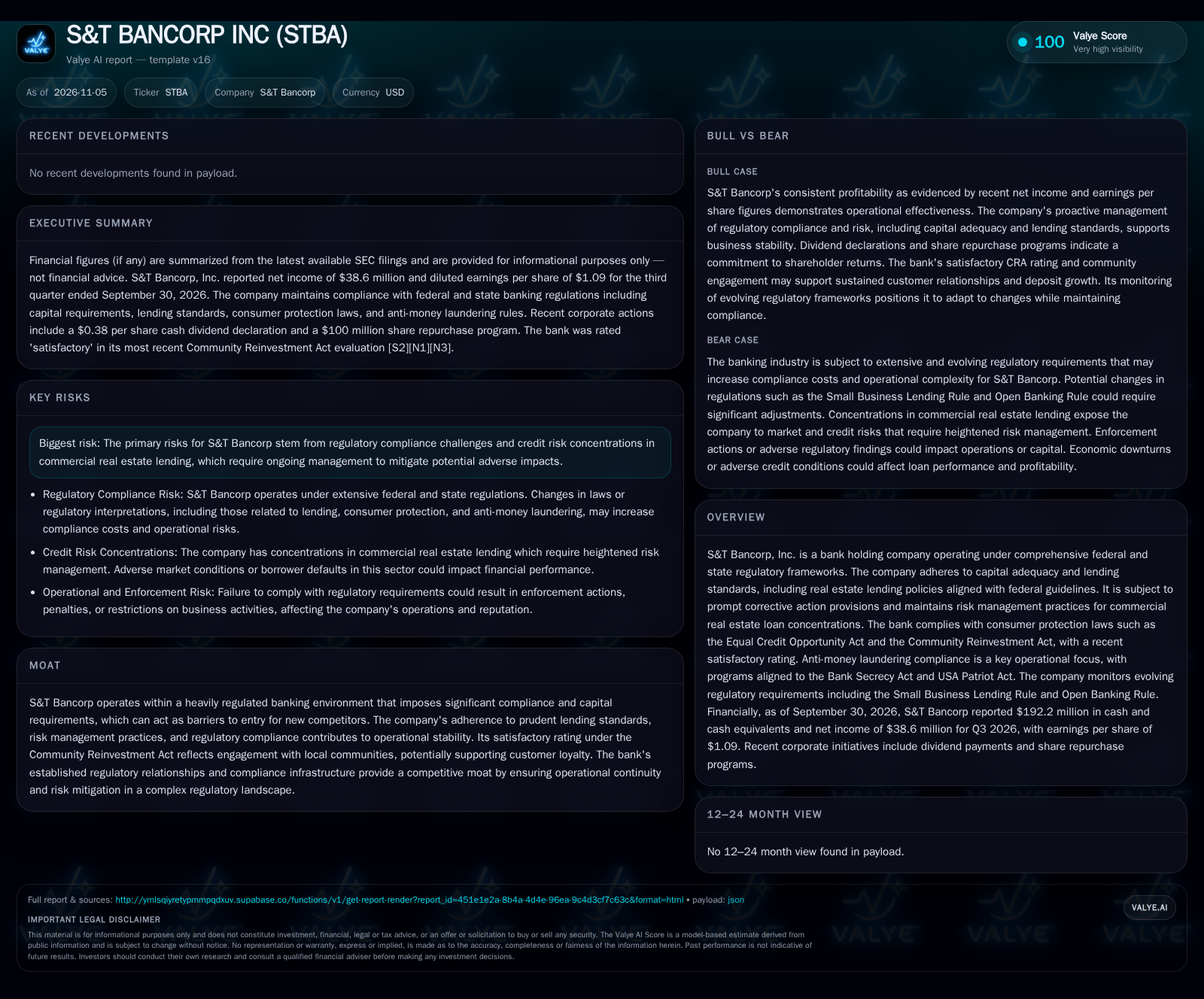
S&T Bancorp delivered net income of $38.6 million and $1.09 EPS in Q3 2026, reflecting ongoing profitability. The bank’s satisfactory CRA rating and robust compliance infrastructure support operational continuity, yet its significant commercial real estate exposure and pending regulatory changes present material strategic and risk-management challenges. The interplay between regulatory costs, credit quality, and deposit franchise growth will shape future outcomes.[S2]
S&T Bancorp’s latest quarter demonstrates the bank’s ability to translate its regional franchise and compliance rigor into consistent profitability, with $38.6 million in net income and a $1.09 EPS for Q3 2026. However, this operational stability is set against a backdrop of heightened regulatory scrutiny, evolving compliance demands, and a loan book with notable commercial real estate exposure. As regulatory frameworks tighten and economic conditions remain uncertain, S&T’s future performance will hinge on its ability to adapt its risk management, maintain asset quality, and grow core deposits without sacrificing its earnings power.
Profitability Trends and Regulatory Positioning Shape Outlook
S&T Bancorp reported net income of $38.6 million and diluted earnings per share of $1.09 for the third quarter of 2026, reflecting continued profitability in a competitive regional banking landscape.[S2] The bank’s satisfactory Community Reinvestment Act (CRA) rating highlights its standing with regulators and its engagement in local lending and community initiatives. [S1] [S2] [S2] These facts establish a foundation of operational strength, but also frame the bank’s vulnerability to regulatory and credit environment shifts—especially given its concentrations in commercial real estate lending and the impending adoption of new banking rules.
Earnings Drivers and Cost Challenges for S&T Bancorp
S&T Bancorp’s revenue model is rooted in net interest income from loans (notably commercial real estate, commercial & industrial, construction, and consumer lending) and fees from retail, business, and trust services.[S2] The cost side is dominated by interest paid on deposits and borrowings, loan loss provisions, and operating expenses (including compliance, personnel, and technology). The bank’s fixed-cost base—branch infrastructure, regulatory reporting, and compliance systems—creates operating leverage, but this is sensitive to both asset growth and margin compression.
Commercial real estate lending, while supporting higher yields, brings cyclical credit risk and potential for outsized loan loss provisions during downturns. [S2]
Capital adequacy requirements and evolving compliance mandates (such as the Small Business Lending Rule and Open Banking Rule) may increase operational costs and constrain capital deployment. The need to maintain a robust allowance for credit losses (ACL), especially for commercial real estate exposures, further influences earnings volatility and capital flexibility.
Regional Banking Scale Constraints and Regulatory Advantages
S&T Bancorp’s competitive position is anchored by regulatory barriers—capital requirements, lending standards, and complex compliance regimes—which deter new entrants and favor established operators with mature risk management systems.[S1] The bank’s satisfactory CRA rating and strong community presence may support deposit franchise stability and customer loyalty.
However, S&T operates in a regional market where larger national banks, digital-only competitors, and credit unions vie for both deposits and loans. Larger banks may benefit from scale in technology investment and regulatory compliance, potentially eroding the relative cost advantage of mid-sized players. Fintechs and digital banks, though lacking physical presence, can target profitable lending segments and offer frictionless customer experiences. S&T’s ability to maintain its competitive moat depends on evolving its technology, sustaining compliance excellence, and managing credit exposures more nimbly than its peers.
The concentration in commercial real estate lending, while a yield enhancer, exposes S&T to sector-specific downturns, potentially magnifying losses relative to more diversified or retail-focused competitors. The company’s regulatory compliance infrastructure provides some insulation, but does not immunize it from credit cycles or shifts in customer preferences.
Potential for Outperformance Through Deposit Gains and Credit Stability
A favorable scenario for S&T Bancorp would see the bank leveraging its community relationships and CRA engagement to expand its core deposit base, reducing funding costs and supporting loan growth. If commercial real estate credit quality remains stable, and new regulatory requirements (like the Small Business Lending and Open Banking Rules) are absorbed without material increases in compliance costs, S&T could preserve or expand net interest margins.
Earnings momentum would be enhanced if fee income from trust and brokerage services grows, and if the bank deploys technology to improve efficiency or customer retention. Confirmation of this scenario would come from sequential deposit growth outpacing regional peers, a stable or declining allowance for credit losses (ACL) relative to loan growth, and regulatory filings showing limited increases in compliance-related expenses. Evidence that S&T is winning share from larger banks in commercial or small business lending would further support the upside case.
Expected Results Under Credit and Regulatory Pressures
The most plausible path is that S&T Bancorp continues to deliver modest earnings growth, balancing credit quality concerns in commercial real estate with incremental deposit franchise expansion. The bank’s regulatory compliance infrastructure remains a source of stability, but compliance and technology costs gradually rise as rules evolve. Net interest margins may compress if competition for deposits intensifies or if funding costs rise faster than loan yields.
In this scenario, S&T’s profitability remains solid but not exceptional, with periodic fluctuations tied to credit cycle dynamics and regulatory expense. Confirmation would include stable quarterly earnings, maintenance of a satisfactory CRA rating, and steady asset quality metrics (non-performing loans, charge-offs, and ACL coverage ratios if disclosed). Falsification would be signaled by a sharp increase in loan loss provisions, significant deposit outflows, or an adverse regulatory finding affecting operations.
Impact of Credit Worsening and Regulatory Burdens on Profitability
In an adverse scenario, a downturn in commercial real estate markets could lead to elevated delinquencies and charge-offs, forcing S&T Bancorp to increase its allowance for credit losses and eroding net income. If new regulatory mandates (such as expanded reporting or capital requirements) drive compliance costs sharply higher, profitability could be further squeezed—especially if the bank cannot pass these costs on to customers.
Deposit competition from larger banks or digital entrants could drive up funding costs or trigger outflows, straining liquidity and narrowing margins. Evidence confirming this scenario would include rapid increases in non-performing loans, a spike in ACL as a percentage of loans, material declines in quarterly net income, or a downgrade in regulatory ratings. Regulatory enforcement actions or the imposition of business restrictions would further validate the downside risk.
Factors Influencing S&T Bancorp’s Future Performance
Quarterly trends in non-performing loans, charge-offs, and allowance for credit losses (ACL)—especially within the commercial real estate segment—would help test credit risk management.
Deposit growth or attrition by segment (core, non-core, business, retail) would clarify the strength of S&T’s funding franchise, if disclosed.
Changes in net interest margin and funding costs, especially relative to regional peers, would indicate competitive pressures and pricing power.
Quarterly regulatory filings detailing compliance expenses, fines, or remediation costs (if any) would signal the operational impact of new rules.
Updates on CRA ratings and regulatory evaluations would provide external validation of community engagement and compliance standing.
Disclosures around technology investments or digital service adoption would show S&T’s ability to modernize and compete with fintechs.
Market share trends in targeted lending segments such as small business or commercial real estate, if disclosed, would help assess growth potential.
Management commentary or external disclosures regarding the impact of the Small Business Lending Rule and Open Banking Rule on business strategy would clarify regulatory adaptation.
Disclaimer: This is research-only, informational analysis and not investment advice. It may include AI-generated interpretation and general industry context. Always verify important details using primary sources.

Comments