
Curtiss-Wright’s Growth Momentum: Segment Dynamics, Defense Exposure, and the Stakes of Diversified Engineering
Curtiss-Wright’s recent sales and margin expansion highlight the interplay between its diversified segment structure, government contract exposure, and ongoing investment in engineering. The company’s ability to sustain growth amid cyclical and policy-driven end markets will hinge on innovation, competitive differentiation, and disciplined capital allocation.
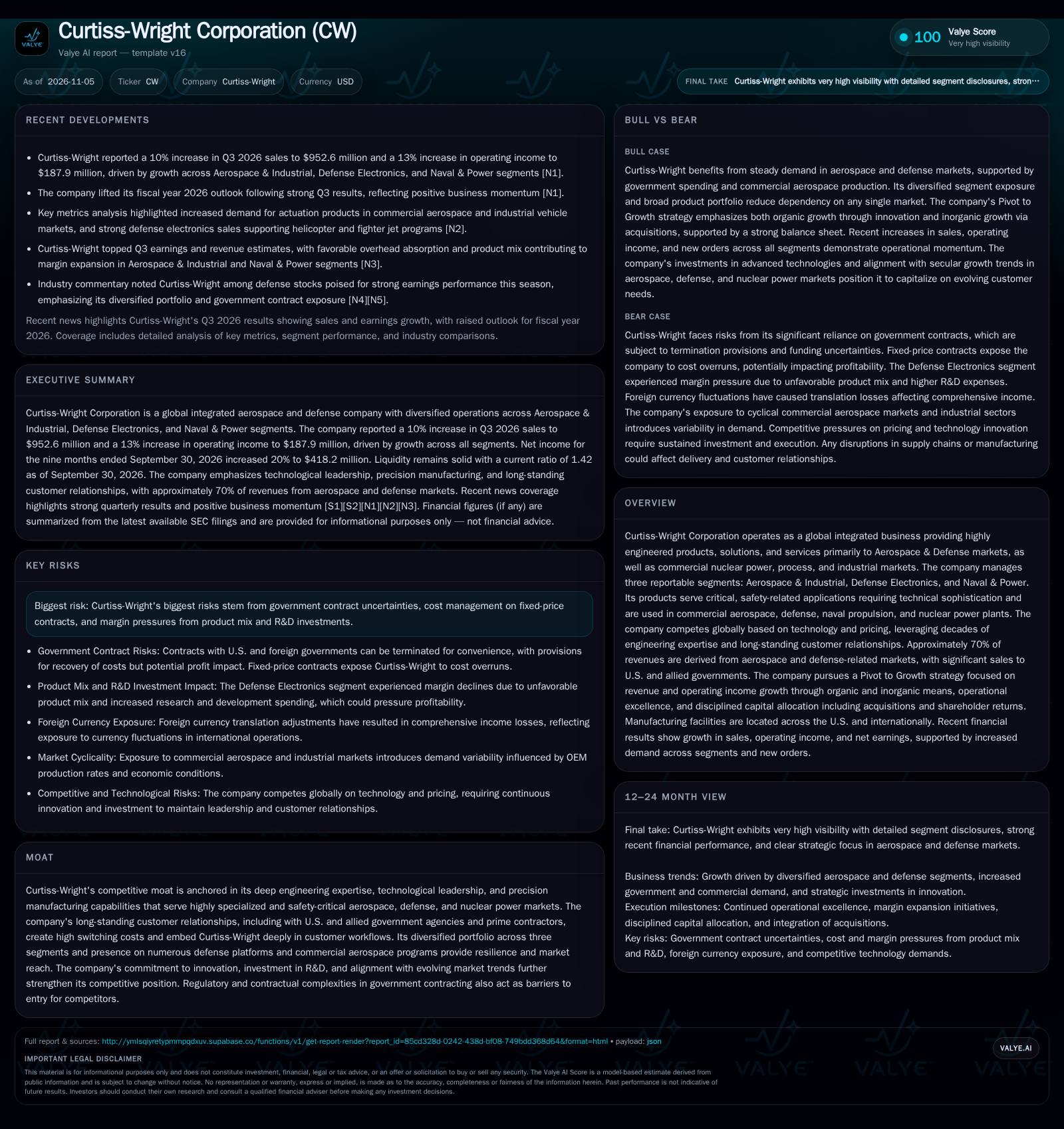
Curtiss-Wright posted a 10% year-over-year sales increase and a 13% gain in operating income for Q3 2026, with robust growth in both Aerospace & Industrial and Naval & Power segments. Roughly 70% of revenue is tied to aerospace and defense, and more than half of sales derive from government customers. Margin expansion reflects both favorable mix and operational leverage, but the Defense Electronics segment saw margin pressure from higher R&D investment. The company lifted its full-year outlook, but faces ongoing risks from government contract terms, fixed-price exposure, and cyclical commercial markets. Sustained outperformance will require navigating these cross-currents while maintaining technological leadership and disciplined execution. [S1] [S2] [N1] [N2] [N3]
Curtiss-Wright’s Q3 2026 results underscore the company’s strength as a diversified supplier of highly engineered components and systems to critical end markets, particularly aerospace, defense, and nuclear power. With double-digit sales and operating income growth, Curtiss-Wright is benefiting from robust demand across its portfolio. Yet, its heavy reliance on government contracts and the inherent volatility of both defense and commercial aerospace introduce a complex risk-reward calculus. The company’s next phase will likely be shaped by its ability to manage margin pressure in R&D-intensive segments, leverage its engineering expertise for continued differentiation, and balance disciplined capital allocation with the imperative to innovate and adapt to shifting market and policy environments.
Recent Performance Reflects Broad-Based Growth and Margin Improvement
In Q3 2026, Curtiss-Wright achieved total sales of $952.6 million, reflecting a 10% increase from the prior year, with operating income up 13% to $187.9 million and operating margin climbing to 19.7% [S2]. Growth was driven by all three segments: Aerospace & Industrial rose 14%, Defense Electronics increased 2%, and Naval & Power posted a 12% gain [S2]. Net income for the first nine months of 2026 was $418.2 million, up 20% year-over-year [S2]. New orders grew across all segments, notably in aerospace defense, ground defense, commercial aerospace, and commercial nuclear markets [S2].
Approximately 70% of revenues are tied to aerospace and defense markets, and 58% of 2025 sales were to government entities [S1] [S2]. The company lifted its 2026 outlook following these strong results, pointing to continued business momentum [N1]. Liquidity at quarter-end included $343.4 million in cash and a current ratio of 1.42 [S2].
The Impact of Curtiss-Wright’s Segment Mix on Revenue Quality and Profitability
Curtiss-Wright’s business model is built on providing highly engineered, technically sophisticated products and solutions for mission-critical and safety-related applications. Revenue streams are diversified across three segments, each with distinct demand drivers and margin profiles. The Aerospace & Industrial segment serves both commercial and defense aerospace as well as industrial markets, subject to OEM production cycles and capital investment trends. Defense Electronics is closely tied to military procurement cycles and defense platform refreshes, while Naval & Power leverages long-cycle government and utility contracts in naval defense and nuclear power.
The company’s economics are characterized by a mix of fixed and variable costs, with significant gross margin sensitivity to volume, product mix, and operational leverage. Margin expansion in Q3 2026 was attributed in part to favorable overhead absorption and a stronger mix in Aerospace & Industrial and Naval & Power [N3]. However, the Defense Electronics segment experienced margin compression due to increased R&D investment and an unfavorable product mix [S2] [N2]. This underscores a classic tradeoff: higher R&D spending can enable future growth and differentiation but may dilute near-term profitability if not matched by incremental revenue or premium pricing.
Curtiss-Wright’s capital needs stem primarily from ongoing R&D, precision manufacturing investments, and—inorganic growth—acquisitions. The company’s disciplined capital allocation strategy focuses on balancing organic investment, accretive M&A, and shareholder returns. The durability of its cash flows is supported by multi-year relationships and programs, but the prevalence of fixed-price contracts introduces exposure to cost overruns, requiring rigorous project management and cost control [S1].
Engineering Expertise and Customer Loyalty in the Defense Spending Arena
Curtiss-Wright’s competitive position is anchored in its deep engineering heritage, ability to meet stringent technical and regulatory standards, and long-standing relationships with government agencies and major OEMs. The company’s portfolio spans critical defense platforms, commercial aerospace programs, and nuclear power systems—markets where reliability, certification, and integration are essential and switching costs can be high.
However, Curtiss-Wright operates in intensely competitive arenas. In defense, it competes with both large primes and specialized component suppliers on technology, price, and integration capability. In commercial and industrial markets, it faces cyclicality and the threat of lower-cost or technologically advanced substitutes. The company’s ability to sustain premium pricing and defend share depends on continued R&D investment, successful platform wins, and maintaining its reputation for quality and delivery.
A further competitive lever is the company’s embeddedness in customer workflows—especially for long-cycle defense and nuclear projects where qualification, certification, and integration can create substantial barriers to entry. Nevertheless, contract renewal is not guaranteed, and government customers retain broad rights to terminate contracts for convenience, which can disrupt visibility and profitability [S1].
Margin Expansion Potential from Accelerating Defense and Nuclear Demand
The favorable scenario for Curtiss-Wright hinges on several reinforcing drivers: sustained or rising defense budgets, increased commercial aerospace production, and continued investment in nuclear power infrastructure. If new orders in defense and nuclear segments convert efficiently to revenue, and if the company successfully manages cost and product mix, operating margins could expand further.
Key mechanisms would include: (1) new platform wins or content gains in next-generation defense and aerospace programs; (2) realization of pricing power or cost pass-throughs in the face of inflation; (3) accretive acquisitions expanding the company’s technology base or customer reach; and (4) successful commercialization of new technologies arising from elevated R&D spend.
Evidence that would confirm this scenario includes continued double-digit growth in new orders and backlog, sequential margin improvement in R&D-intensive segments, and announcements of major program wins or strategic acquisitions. Conversely, stagnation in order growth or unexpected cost overruns would falsify the thesis.
Growth Outlook Amid Cyclical Trends and Policy Ambiguity
The most plausible outcome is steady, moderate growth driven by Curtiss-Wright’s diversified end-market exposure and ongoing operational execution. Aerospace & Defense, comprising about 70% of revenues, provides a stable backbone, while the company’s commercial and industrial exposure adds both opportunity and risk depending on macroeconomic conditions.
Margins are likely to be maintained or improve modestly as operational efficiencies and favorable mix offset periodic margin pressure from R&D investments or cost overruns. The company’s disciplined capital allocation approach and long-term customer relationships should support earnings resilience even if individual segments experience intermittent softness.
Confirmation of this scenario would be reflected in consistent mid-single-digit sales growth, stable or gradually improving operating margins, and ongoing new order strength across segments. A shift in government procurement cycles or protracted downturn in commercial aerospace could challenge this trajectory.
Earnings Vulnerabilities from Contract Challenges and Demand Fluctuations
The adverse scenario centers on the interplay of contract risk, cost discipline, and demand volatility. Curtiss-Wright’s heavy exposure to government contracts—often with termination for convenience provisions—means that defense spending cuts, program cancellations, or delays could materially impact revenue and margins. The company’s significant portfolio of fixed-price contracts further exposes it to the risk of cost overruns, especially in inflationary environments or if supply chain disruptions re-emerge.
Additional downside risk is posed by cyclical downturns in commercial aerospace or industrial markets, which could lead to underutilization of manufacturing capacity, unfavorable product mix, and reduced overhead absorption. If R&D investments fail to yield new program wins or marketable innovations, margin pressure could persist or worsen.
Evidence for this scenario would include a sharp drop in new orders or backlog, margin compression in R&D-heavy segments without corresponding revenue growth, cost overrun disclosures, or negative surprises related to contract terminations or customer delays.
Key Developments Influencing Curtiss-Wright’s Future Trajectory
Sustained growth in new orders and backlog by segment—especially in defense and nuclear—would validate momentum and provide forward visibility; a useful metric would be the ratio of orders to sales if disclosed.
Quarterly and annual operating margin trends at the segment level, with particular attention to the impact of R&D investments and product mix shifts.
Disclosure of major new program wins, contract renewals, or content gains on next-generation defense and commercial aerospace platforms.
The magnitude and direction of R&D spending, and whether it translates into new product launches or increased market share.
Incidence and impact of cost overruns or contract loss provisions, particularly on large fixed-price contracts.
Exposure to and management of foreign currency translation risks, given the company’s international manufacturing footprint.
Updates on the company’s capital allocation—especially the balance between M&A, organic investment, and shareholder returns—as a signal of strategic discipline.
Disclaimer: This is research-only, informational analysis and not investment advice. It may include AI-generated interpretation and general industry context. Always verify important details using primary sources.

Comments