
PLAYSTUDIOS: Loyalty-Driven Social Gaming Faces Profitability Hurdles and Strategic Crossroads
Despite a reported cash position and a differentiated loyalty rewards model, PLAYSTUDIOS continues to grapple with persistent net losses, restructuring costs, and competitive headwinds in the evolving mobile gaming sector. The company's future hinges on its ability to translate user engagement into sustainable earnings while navigating platform dependencies and shifting consumer habits.
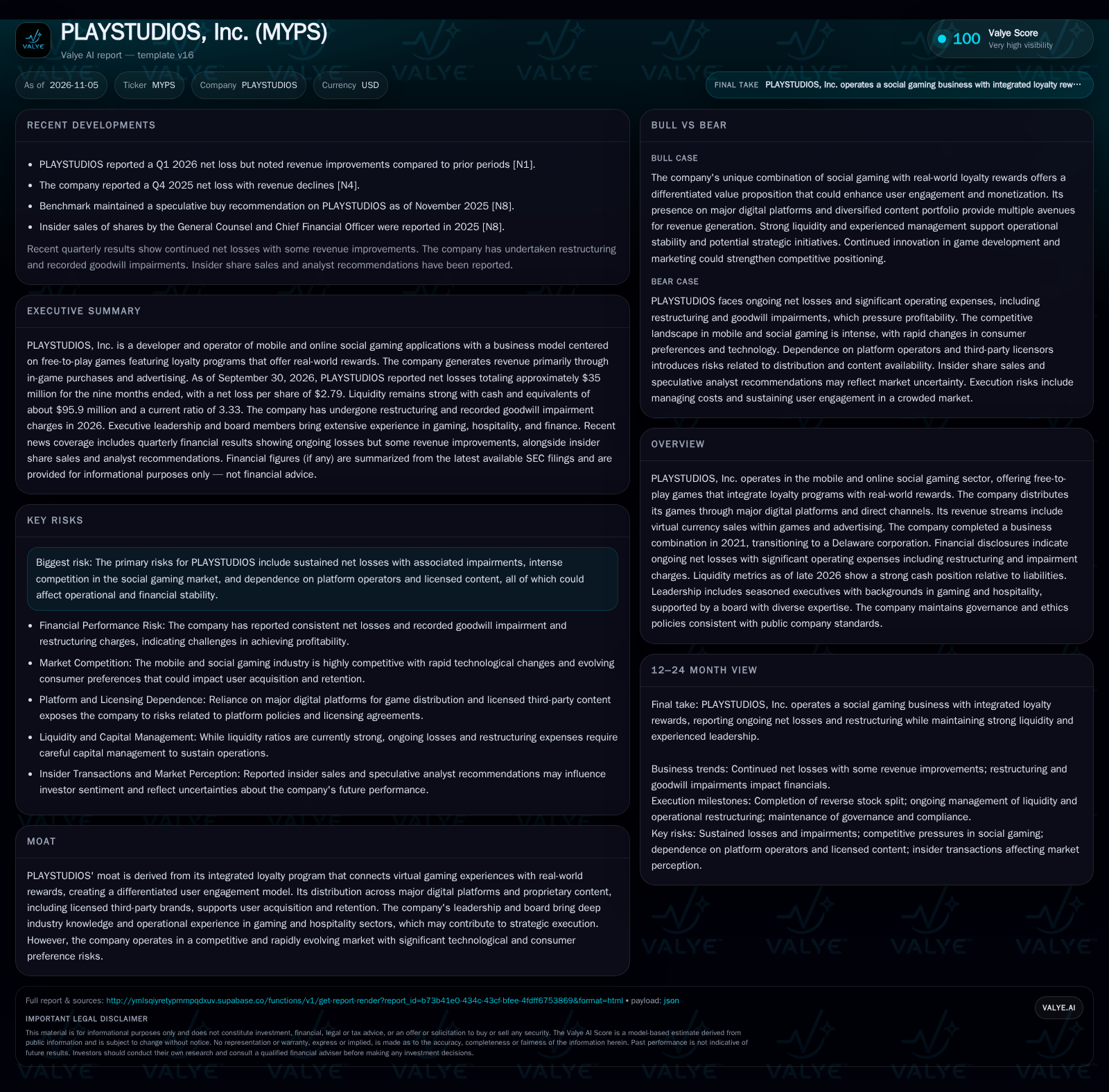
PLAYSTUDIOS, Inc. operates a portfolio of free-to-play social games with integrated real-world loyalty rewards, distributed through major digital platforms. As of Q3 2026, it reported ongoing net losses, substantial operating expenses, and recent impairment charges, though it maintains a reported cash position relative to liabilities. The company's unique engagement model could drive user retention, but profitability remains elusive amid restructuring and intense competition. Strategic execution and sustained monetization improvements are critical for the next phase.
PLAYSTUDIOS, Inc. stands at a pivotal moment as it seeks to leverage its unique blend of social gaming and real-world loyalty rewards to drive growth. As industry competition intensifies and consumer preferences evolve, PLAYSTUDIOS must prove it can convert its user engagement advantage into durable profitability—while managing the risks of platform dependence and fluctuating digital gaming trends.
Recent Financial Performance and Strategic Inflection
PLAYSTUDIOS reported a net loss of approximately $35 million for the nine months ended September 30, 2026, with a net loss per share of $2.79. Quarterly revenue for Q3 2026 was $48.9 million, down from $57.6 million a year earlier, reflecting both ongoing losses and declining topline momentum [S2]. The company has also recorded restructuring costs and goodwill impairments during 2026, signaling both operational challenges and attempts to realign its cost structure. The company reported cash and liquidity metrics for the period; these figures do not by themselves establish operating runway, investment capacity, financial flexibility, or financing capacity. [S2] A 1-for-10 reverse stock split was effected in September 2026, which may indicate a response to share price pressure or listing requirements. These developments highlight a business at a crossroads—facing profitability and growth challenges, but with the liquidity and leadership to pursue strategic options.
How PLAYSTUDIOS’ Loyalty Model Influences Monetization and Cost Structure
PLAYSTUDIOS’ core business model centers on free-to-play mobile and online social games, with revenue generated primarily from in-game purchases of virtual currency and advertising [S2]. The integration of real-world rewards through a proprietary loyalty network is designed to increase player engagement and retention—potentially driving higher lifetime value per user compared to conventional social games. However, this model also introduces added costs: funding the rewards network, managing partnerships, and potentially higher marketing and R&D outlays to maintain a competitive content portfolio.
The business is highly sensitive to player acquisition costs and the effectiveness of in-game monetization strategies. Fixed costs include platform fees (to Apple, Google, etc.), development and content licensing, and SG&A, while variable costs scale with user engagement and marketing intensity. Given the reported net losses and recurring restructuring charges, PLAYSTUDIOS may be struggling to achieve the operating leverage needed for profitability, especially if the incremental cost of acquiring and retaining users (including loyalty rewards) outpaces incremental revenue generation.
Competitive Moats and Eroding Edges in Social Gaming
PLAYSTUDIOS’ primary competitive advantage is its integration of a real-world rewards loyalty program, which can increase switching costs and differentiate its games in a crowded market. This model is not easily replicated at scale without significant investment and partner relationships, potentially enhancing player retention and engagement. The company’s distribution across major app stores and direct channels ensures broad market reach.
However, the social and mobile gaming sector is intensely competitive, with low barriers to entry and frequent shifts in player preferences. Large incumbents and well-funded startups can rapidly iterate on game design, marketing, and monetization mechanics. Platform dependency (on Apple, Google, and Amazon) exposes PLAYSTUDIOS to risks from policy changes, fee structures, and discoverability challenges. Additionally, reliance on licensed third-party content introduces renewal and royalty risks.
The company’s seasoned leadership and board, with backgrounds in gaming, hospitality, and finance, are assets. But in a sector where content innovation and user acquisition efficiency are paramount, the durability of PLAYSTUDIOS’ moat depends on its ability to continually refresh its game portfolio and maintain the perceived value of its rewards ecosystem.
If Loyalty Rewards Drive Engagement, Monetization Could Inflect
The most favorable trajectory for PLAYSTUDIOS would see its loyalty rewards model meaningfully boosting player retention, engagement, and in-game spending. If the company can demonstrate that users acquired through the rewards network have higher lifetime value and lower churn than industry averages, this could translate into improved ARPU (average revenue per user) and margin expansion—even with competitive user acquisition costs.
Evidence that would confirm this scenario includes sustained sequential growth in active users, higher in-game purchase rates, and improving cohort monetization metrics (if disclosed). Additional confirmation would come from expanding major brand partnerships within the rewards program and positive operating leverage as revenue growth outpaces fixed cost increases.
A successful pivot to higher-margin titles, efficient marketing spend, or new monetization channels (such as premium features or direct-to-consumer distribution) would further support this outcome. If restructuring results in a leaner cost base without sacrificing growth, PLAYSTUDIOS could shift toward profitability while solidifying its differentiated market position.
Stabilization Hinges on Cost Control and Incremental Revenue Gains
The most plausible near-term scenario is one of gradual stabilization: PLAYSTUDIOS continues to face net losses, but restructuring and cost containment efforts slow the rate of cash burn. Revenue trends could remain mixed, with some quarters showing improvement due to new game launches or marketing initiatives, but offset by the competitive pressure and the high cost of user acquisition.
Confirmation of this scenario would include modest improvements in operating margins, a reduction in restructuring and impairment charges, and stable or slightly growing revenue in sequential quarters.
If Engagement Fades or Costs Escalate, Losses Could Widen
The adverse scenario materializes if PLAYSTUDIOS fails to maintain or grow its user base, or if the cost of acquiring and retaining players (including loyalty rewards) continues to rise faster than monetization. In this case, revenue could stagnate or decline further, while fixed costs and ongoing restructuring expenses erode the company’s reported cash balance.
This scenario could be confirmed by declining active user metrics (if disclosed), falling ARPU, or evidence of increased platform or licensing costs. Additional warning signs include further goodwill or asset impairments, accelerated cash usage, or the need for dilutive capital raises. Competitive threats may intensify if larger gaming companies launch similar loyalty-integrated offerings or if platform operators adjust their policies to disadvantage third-party developers.
If restructuring fails to yield cost savings or impairs the company’s ability to deliver new content, PLAYSTUDIOS could face a cycle of dwindling engagement, revenue decline, and eventual financial distress.
What Will Determine Whether PLAYSTUDIOS' Loyalty Model Delivers Profitable Growth?
Sequential and year-over-year revenue growth trends, especially in the context of new game launches or rewards program expansions, will be crucial to watch.
Operating margin progression and the scale of restructuring/impairment charges are central to assessing whether cost controls are working.
Active user and engagement metrics—such as daily/monthly active users or retention rates—would help test the effectiveness of the loyalty rewards model if disclosed.
Average revenue per user (ARPU) and cohort monetization statistics would clarify whether the rewards program is delivering incremental value.
Major changes in platform policies, partner relationships, or licensing terms could materially affect distribution economics.
Expansion or renewal of key rewards partnerships, or entry into new content verticals, would signal strategic momentum.
Insider transactions and management commentary on capital allocation or strategic pivots may provide insight into board and executive confidence.
Disclaimer: This is research-only, informational analysis and not investment advice. It may include AI-generated interpretation and general industry context. Always verify important details using primary sources.

Comments