
Arteris at an Inflection: IP Leverage, Chiplet Demand, and the Economics of SoC Complexity
Arteris, Inc. stands at a strategic crossroads as demand for advanced Network-on-Chip IP accelerates with AI, chiplet, and multi-die adoption, even as persistent losses and fierce competition challenge its ability to scale profitably. The next phase hinges on the company’s execution in automation, customer integration, and capturing value from SoC design trends.
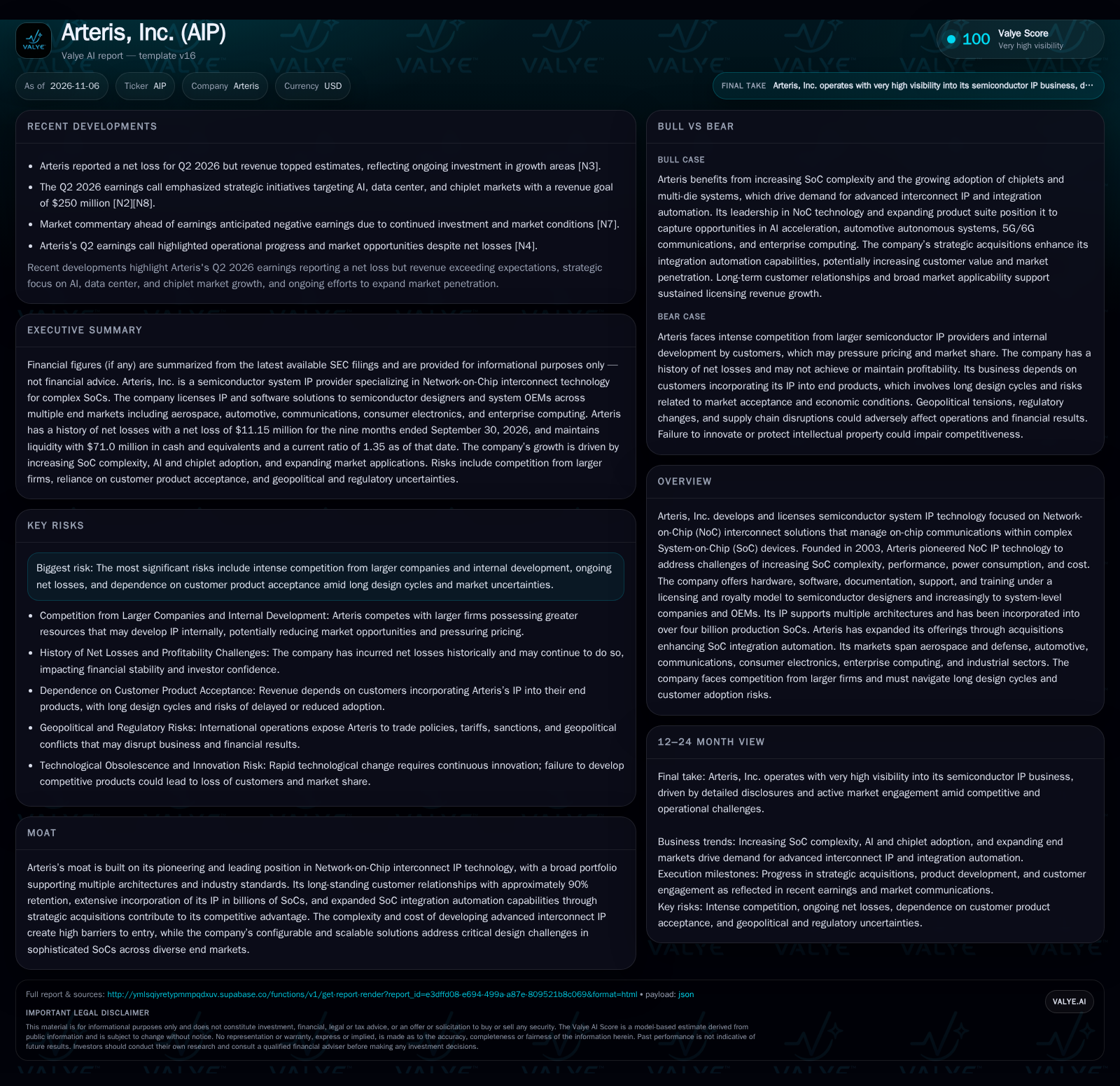
Arteris, Inc. is a leading provider of Network-on-Chip IP for complex SoC designs, targeting fast-growing AI, automotive, and chiplet markets. While the company’s technology is widely adopted and its integration automation capabilities are expanding through recent acquisitions, Arteris continues to report net losses and faces competition from larger IP vendors and internal development by customers. Its future depends on converting design wins in high-complexity segments into sustained, higher-margin royalty streams, while managing long sales cycles and maintaining its technological edge amid rapid industry change. [S1] [S2] [N2] [N3] [N8]
Arteris, Inc. occupies a pivotal role in the semiconductor value chain as a specialist in Network-on-Chip (NoC) intellectual property, powering the communication infrastructure inside complex System-on-Chip (SoC) designs. With its IP embedded in billions of devices and a customer retention rate near 90%, Arteris is well positioned to benefit from surging demand for AI acceleration, chiplet architectures, and multi-die integration. However, persistent net losses, intense competition from heavyweight IP vendors, and the slow, high-stakes nature of SoC design cycles mean the company’s ability to scale profitably—and to capture a meaningful share of next-generation silicon designs—remains an open question. The company’s next act will be defined by its success in automating SoC integration, deepening customer entrenchment, and translating design wins into robust, recurring royalty streams. [S1] [S2] [N2] [N8]
Recent Losses, Strategic Acquisitions, and the $250M Revenue Ambition
Arteris reported a net loss of $11.15 million for the first nine months of 2026, with an accumulated deficit of $204.8 million as of September 30, 2026. reported liquidity position, with $71.0 million in cash and a current ratio of 1.35, but there is no evidence of a near-term return to profitability. [S2]
The company’s Q2 2026 revenue exceeded estimates despite the loss, and management reaffirmed a strategic focus on AI, data center, and chiplet markets, targeting a $250 million revenue goal. [N2] [N3] [N8]
Three recent acquisitions—Magillem (2020), Semifore (2022), and Cycuity (2026)—have bolstered Arteris’s automation of IP configuration and SoC integration, a key differentiator as chip designs become more complex. [S1]
The company maintains approximately 90% customer retention, reflecting strong relationships and a broad base of deployed IP, but future growth will depend on converting these relationships into new design wins in high-value markets. [S1]
How Arteris’s Licensing Model Scales—And Why Margins Remain Under Pressure
Arteris generates revenue through a mix of upfront license fees, support and maintenance charges, and ongoing royalties tied to the volume of end products shipped by customers. This model offers high gross margins on incremental royalties but is highly sensitive to design win timing, customer product cycles, and the ramp of volume production.
The economics are characterized by heavy upfront R&D and customer support investments, with long sales and integration cycles before royalty streams materialize. As SoC complexity rises, customers increasingly value IP that reduces integration risk and accelerates time-to-market—but they also expect robust support, driving up Arteris’s fixed costs.
Operating leverage is possible if Arteris can win more sockets in high-volume, multi-die, or AI-centric designs, since incremental royalties from these wins can flow through at high margins. However, the company’s persistent net losses suggest that current revenue scale and mix do not yet cover its growing R&D and SG&A base. [S2]
The recent automation-focused acquisitions aim to make Arteris’s platform stickier and lower customer integration costs, potentially increasing the company’s share of wallet and customer lock-in. If successful, this could improve both the frequency and size of design wins, supporting margin expansion over time.
Competitive Moats and the Threats of Internal IP and Mega-Vendors
Arteris’s foundational moat is its deep expertise and established leadership in NoC IP, supported by a broad portfolio compatible with x86, Arm, RISC-V, and other architectures. Its IP is present in over four billion shipped SoCs, and its customer retention rate (historically ~90%) underscores the value placed on its technology. [S1]
However, the company faces formidable competition from well-capitalized IP vendors such as Arm and Cadence, as well as from semiconductor companies developing similar IP internally. These competitors can bundle interconnect IP with other core offerings and may undercut pricing or offer more integrated design environments.
Switching costs in NoC IP can be high due to the deep integration of interconnect within SoC designs, but large customers may still opt for internal development to reduce long-term royalty exposure or to tightly control their roadmap.
While Arteris’s automation tools (enhanced by recent acquisitions) could increase customer stickiness, the risk remains that larger players will match or exceed these capabilities, especially as the market pivots toward chiplets, AI, and custom silicon for hyperscale data centers.
If Automation and Chiplet Trends Converge: A Royalty Flywheel Emerges
In the most favorable scenario, the industry’s pivot toward chiplet-based and multi-die architectures, coupled with surging AI demand, creates a wave of complex SoC projects that are too risky or time-consuming for in-house IP development. Arteris’s automated integration tools, now strengthened by recent acquisitions, become the industry standard for managing interconnect complexity, driving a step-function increase in design wins.
As these customer projects enter production, royalty streams scale rapidly, especially in high-volume segments like automotive ADAS, data center AI accelerators, and advanced communications. Operating leverage kicks in—incremental revenue flows through with limited additional cost, margins expand, and the company approaches or achieves its $250 million revenue target.
Confirmation would come from a visible acceleration in new design wins, a shift in revenue mix toward royalties (vs. upfront licenses), and evidence that large customers are standardizing on Arteris technology for next-gen chiplet designs. Falsification would be signaled by continued flat or declining design win velocity, or by evidence that major customers are shifting to internal or competitive IP platforms.
Sustained Complexity Drives Moderate Growth—But Profitability Remains a Challenge
The most plausible trajectory is that SoC complexity continues to rise across AI, automotive, and communications, sustaining demand for Arteris’s NoC IP and integration automation—but the ramp in high-royalty production remains gradual. Design cycles stay long, and a mix of internal development and external IP keeps pricing competitive.
Revenue grows, driven by ongoing license and modestly expanding royalty streams, but high R&D and support costs persist as the company chases new verticals and must continuously update its platform to meet customer needs. Margins improve incrementally but remain below those of larger, more diversified IP vendors.
Supporting evidence would include steady customer retention, incremental growth in design wins, and gradual improvement in gross margins or operating loss. Falsification would come from a sharp slowdown in design win activity, rising customer churn, or inability to translate automation investments into higher-value contracts.
Competitive Pressure and Long Cycles Lock Arteris in a Loss-Making Pattern
In the adverse scenario, larger IP vendors and internal development continue to erode Arteris’s pricing power and win key sockets in the most lucrative AI and chiplet projects. Customers, facing their own margin pressures, opt for bundled or in-house interconnect solutions, and the company’s automation investments fail to deliver a decisive differentiation.
Design win velocity slows, royalty streams plateau, and high fixed costs keep the company in a persistent loss-making mode. Liquidity is gradually drawn down, and Arteris is forced to either dilute shareholders via capital raises or cut back on R&D, risking further competitiveness.
This scenario would be confirmed by declining design win announcements, shrinking customer retention rates, or a deterioration in cash reserves without corresponding revenue growth. Falsification would require evidence of significant new customer adoptions in high-growth segments or a sudden improvement in royalty-driven margins.
Thesis-Testing Markers: What Will Determine Arteris’s Strategic Trajectory?
Design win velocity—especially in AI, automotive, and chiplet-based SoC projects—remains the core lead indicator of future royalty growth. A useful metric would be the number and size of new design engagements announced each quarter, if disclosed.
Royalty revenue as a percentage of total revenue: An increasing share would indicate that past design wins are translating into higher-margin, recurring income.
Customer retention and churn: Sustained or improved retention rates, particularly among top customers, would support the company’s competitive position.
Gross margin trends: Expansion would suggest improving mix and operating leverage from automation and higher-value design wins.
Integration and cross-selling of acquired automation platforms: Evidence that Magillem, Semifore, and Cycuity are driving larger or stickier contracts would signal successful execution.
Competitive responses: Tracking new product introductions or pricing shifts by Arm, Cadence, or major customers developing in-house IP would help assess ongoing moat durability.
Market adoption rates for chiplet and multi-die architectures: External industry data on chiplet adoption would help validate the addressable market expansion thesis.
Disclaimer: This is research-only, informational analysis and not investment advice. It may include AI-generated interpretation and general industry context. Always verify important details using primary sources.

Comments