
Globus Medical’s Regulatory Edge and Supply Chain Tensions: What Drives Value in Regenerative Biologics and Devices?
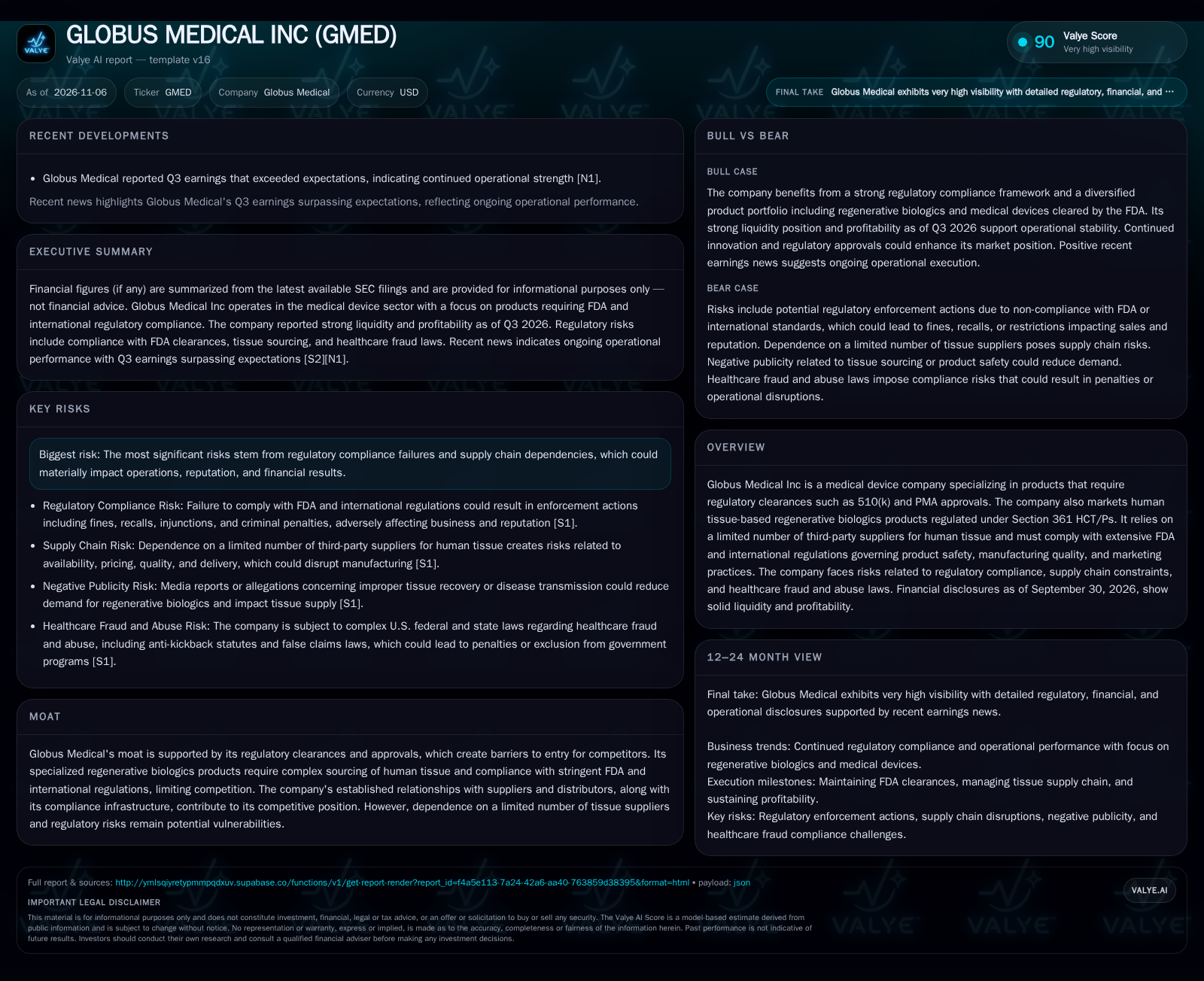
Globus Medical’s high-margin device and regenerative biologics business is underpinned by rigorous regulatory clearances and a reported liquidity position, but its fortunes are closely tied to supply chain reliability, ongoing compliance, and market perceptions around tissue sourcing.
Globus Medical’s strong Q3 2026 results and high liquidity underscore its operational execution in regulated medical devices and biologics. However, supply chain dependency on few tissue suppliers and the constant risk of regulatory or reputational setbacks could swing prospects quickly. The company’s ability to sustain growth will hinge on execution in compliance, innovation, and supplier management as much as on market expansion.
Globus Medical’s latest quarter reinforces its standing as a profitable, well-capitalized player in the medical device and regenerative biologics space. Its combination of FDA-cleared technologies and human tissue-based products positions it for ongoing growth, but the company’s fortunes could pivot on factors beyond the balance sheet. Regulatory scrutiny, supply chain concentration, and public perceptions around tissue sourcing all have the potential to meaningfully impact operational and financial outcomes. Understanding the interplay between these drivers is key to evaluating Globus Medical’s future trajectory.
Recent Performance and the Levers Behind Globus Medical’s Resilience
For the nine months ending September 30, 2026, Globus Medical generated $763.7 million in revenue and $141.2 million in net income, translating to basic EPS of $1.05 and a current ratio of 4.3, with $441.3 million in cash and equivalents [S2]. This financial strength provides operational flexibility and room to absorb shocks, invest in R&D, or pursue strategic initiatives. The company’s Q3 earnings also surpassed expectations, suggesting ongoing execution momentum [N1]. However, the report highlights persistent dependencies and regulatory exposures: Globus Medical must maintain compliance with complex FDA and international rules, and its regenerative biologics segment relies on a small number of human tissue suppliers [S1]. These facts set the stage for both the company’s current robustness and its most salient vulnerabilities.
Beyond the headline financial metrics, a deeper examination of Globus Medical’s operational resilience reveals the critical role of regulatory timing in shaping cash flow and investment cycles. Regulatory approvals, especially for novel biologics, often involve unpredictable durations that can delay revenue recognition and extend capital deployment periods. This uncertainty necessitates a reported liquidity position buffer, which the company appears to maintain, but also imposes discipline on R&D prioritization and go-to-market strategies. Moreover, the interplay between regulatory compliance costs and supplier reliability can create compound risks that require integrated risk management frameworks rather than siloed operational responses.
How Margin, Volume, and Compliance Shape Globus Medical’s Profit Engine
Globus Medical earns revenue from a blend of regulated medical devices and regenerative biologics, each with distinct economics. Device sales, often characterized by high gross margins and recurring replacement or upgrade cycles, are typically sold to hospitals, ambulatory surgical centers, and physicians. Regenerative biologics—especially those based on human tissue—can command premium pricing but entail higher sourcing costs and more complex logistics.
The company's cost structure features significant fixed elements in regulatory compliance, R&D, and quality assurance. Variable costs are concentrated in manufacturing, tissue procurement, and distribution. This mix suggests meaningful operating leverage: incremental sales, especially in devices, can disproportionately boost profitability once core compliance and R&D costs are covered. However, tissue-based biologics introduce unique variable costs and supply risks, as sourcing disruptions or pricing pressure from suppliers could erode margins quickly.
The company reported cash and liquidity metrics for the period; these figures do not by themselves establish operating runway, investment capacity, financial flexibility, or financing capacity. [S2] The challenge is managing capital allocation efficiently while navigating the unpredictable timing of product clearances, reimbursement changes, and supply chain events.
The company’s operating leverage dynamic is nuanced by the regulatory-driven fixed cost base, which can act as both a barrier and a bottleneck. While fixed compliance and quality assurance expenses create scale advantages, they also limit flexibility in rapidly adjusting cost structures in response to market fluctuations or supply shocks. Variable costs tied to tissue procurement introduce volatility that can disproportionately affect margins in biologics compared to devices. Consequently, margin expansion depends not only on volume growth but also on strategic supplier negotiations and potential vertical integration to mitigate pricing pressures and supply disruptions.
Barriers to Entry and the Fragility of Supply-Driven Moats
Globus Medical’s regulatory clearances (including 510(k)s and PMAs) and established compliance infrastructure create real barriers for new entrants in both devices and regenerative biologics. The complexity of FDA and international rules, particularly for human tissue-based products, limits the ability of smaller or less sophisticated companies to compete at scale.
Yet, the moat has vulnerabilities. The company’s dependence on a small cadre of tissue suppliers exposes it to supply concentration risk—any disruption, pricing dispute, or reputational incident at a supplier could ripple through Globus Medical’s biologics business. Negative publicity around tissue recovery or disease transmission could not only reduce demand but also trigger regulatory or supply-side scrutiny [S1].
Competition comes from large diversified medtech firms with deep regulatory expertise, as well as niche players specializing in biologics or orthopedic implants. While product breadth and compliance know-how are competitive advantages, customer switching costs may be moderate outside of deeply integrated device platforms or surgeon-preference-driven products. The question is whether Globus can maintain differentiation through innovation and reliability as regulatory, supply, and reputational risks intensify.
The regulatory moat, while formidable, is inherently fragile due to evolving standards and enforcement rigor that can shift the competitive landscape swiftly. As regulatory agencies intensify scrutiny on human tissue sourcing ethics and safety, companies like Globus Medical must continuously invest in compliance innovation and transparency to maintain trust. Additionally, the moderate switching costs in certain device categories imply that maintaining differentiation through sustained innovation and service quality is essential to prevent erosion of market share, especially as competitors leverage scale or new technologies to challenge incumbents.
Unlocking Value Through Regulatory Wins and Supply Chain Stability
A favorable scenario for Globus Medical involves continued successful navigation of FDA and international regulatory processes, resulting in timely clearances for new devices and biologics. If the company can expand its regenerative biologics portfolio—possibly with new indications or tissue types—while maintaining flawless compliance and avoiding negative supply events, it could capture greater share in high-margin segments.
Innovation could further strengthen relationships with surgeons and providers, reinforcing product pull-through and potentially enabling premium pricing. Evidence for this scenario would include sustained above-market revenue growth, successful product launches with rapid adoption, and stable or expanding gross margins, all while avoiding significant recalls or regulatory setbacks.
Most Likely Outcome: Steady Execution Amid Persistent Risks
The most plausible trajectory is one of continued moderate growth, with Globus Medical leveraging its regulatory expertise and product breadth to defend and incrementally expand share in established device and biologics markets. Regulatory and supply chain risks likely manifest as episodic headwinds—potentially causing periodic margin or revenue volatility—but the company’s scale and compliance systems generally allow it to manage through such events.
This scenario would be confirmed by consistent top-line growth in line with market trends, stable profitability, and periodic regulatory or supply-related disclosures that are managed without major operational disruption. Watchpoints include the company’s ability to maintain current supplier relationships, avoid negative publicity, and secure timely product approvals.
When Regulatory or Supply Shocks Derail Momentum
A negative turn could be triggered by a significant regulatory enforcement action—such as an FDA warning letter, product recall, or international compliance failure—that disrupts sales, triggers costly remediation, or damages the company’s reputation. Alternatively, a supply shock from one of its limited tissue suppliers (whether due to quality, pricing, or negative media attention) could constrain biologics production, force expensive spot procurement, or even result in lost sales.
This adverse scenario would likely be accompanied by declining revenue from biologics, margin compression due to higher procurement or compliance costs, and potentially negative headlines impacting customer trust. Evidence would include regulatory filings disclosing enforcement actions, adverse supplier developments, or sharp changes in gross margin and revenue mix.
What Will Prove Out Globus Medical’s Resilience and Market Advantage?
Frequency and outcome of FDA and international regulatory inspections, warning letters, or product recalls—if disclosed—would help gauge compliance execution.
The stability, pricing, and quality of third-party tissue supply arrangements, especially any changes in supplier concentration or contractual terms.
Gross margin trends by segment (devices vs. regenerative biologics), if reported, to indicate sourcing cost pressures or pricing power.
Revenue growth attributable to new product launches or expanded indications, as evidence of innovation and regulatory agility.
Publicity events or media coverage related to tissue sourcing, recovery methods, or disease transmission risks.
Any disclosed changes in healthcare fraud and abuse compliance posture, including settlements or government investigations.
Capital allocation decisions—such as R&D investment rates or acquisitions—that could shift the company’s growth or risk profile.
Customer retention or switching patterns, particularly in key hospital and surgeon accounts, if disclosed.
Disclaimer: This is research-only, informational analysis and not investment advice. It may include AI-generated interpretation and general industry context. Always verify important details using primary sources.

Comments