
Chesapeake Utilities: Stability and Strain in a Diversified Energy Portfolio
Chesapeake Utilities Corp blends the predictability of regulated energy distribution with the volatility of unregulated propane and energy services.
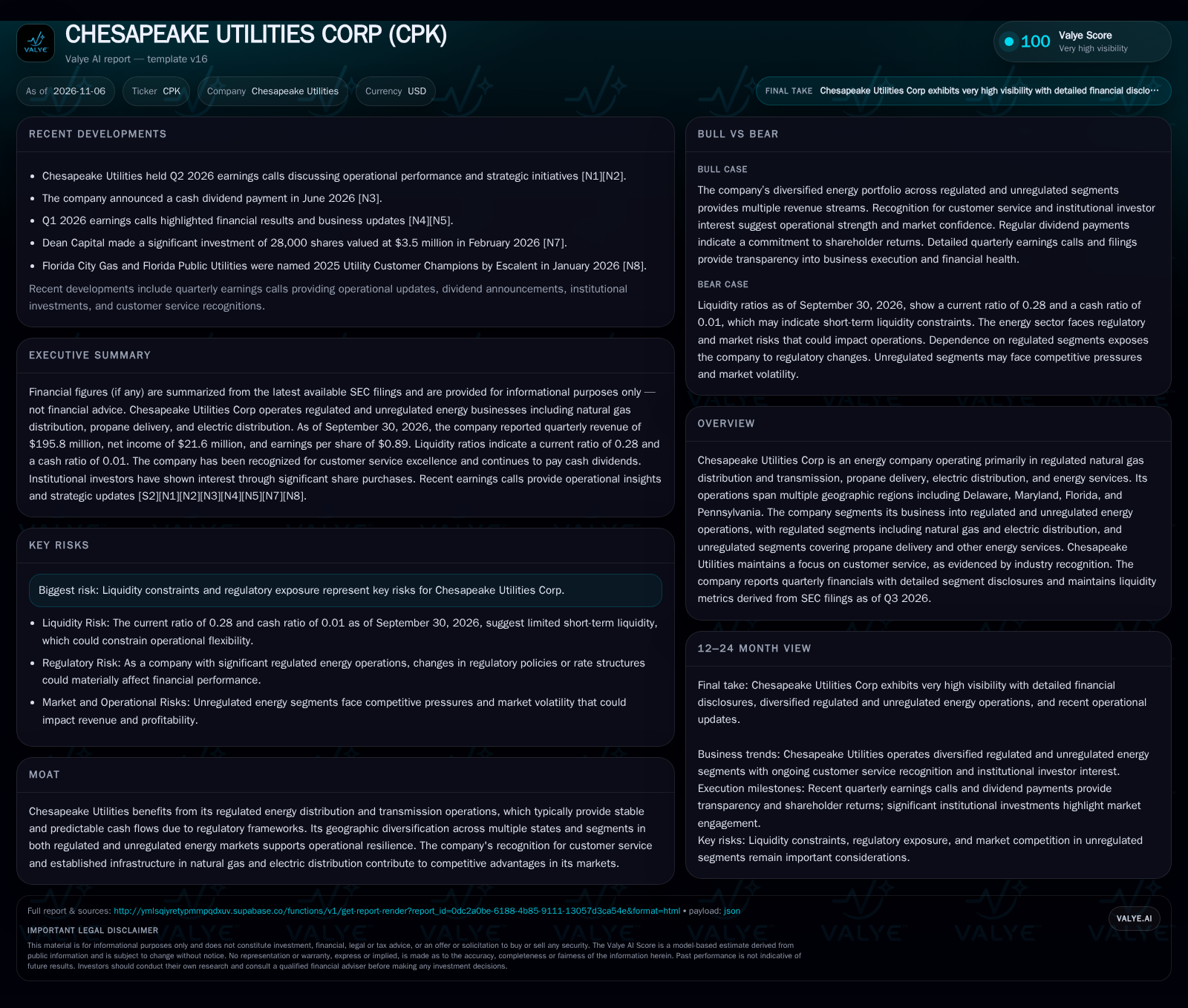
Chesapeake Utilities reported Q3 2026 revenue of $195.8 million and net income of $21.6 million, but a current ratio of just 0.28 raises questions about short-term liquidity. The company’s regulated utility operations provide stable cash flow, while unregulated segments add growth potential and volatility. Watch for evidence of funding flexibility, regulatory rate outcomes, and margin trends across segments. [S2] [N1] [N2] [N3] [N4] [N5] [N7] [N8]
Chesapeake Utilities Corp stands at a strategic crossroads, balancing the relative safety of regulated energy distribution with the growth—and risk—of unregulated businesses like propane delivery and energy services. This tension between stable cash flows and tight liquidity will define how Chesapeake navigates regulatory decisions, market competition, and capital allocation over the next several years. [S2] [N1] [N2] [N3] [N4] [N5] [N7] [N8]
Q3 2026 Snapshot: Profitable Operations Amid Liquidity Compression
Chesapeake Utilities reported revenue of $195.8 million and net income of $21.6 million for the quarter ending September 30, 2026. Earnings per share stood at $0.89 for both basic and diluted shares. Despite this profitability, Chesapeake reported current assets of $203.4 million against current liabilities of $713.8 million, resulting in a current ratio of just 0.28 and a cash ratio of 0.01. These metrics highlight a sharp shortfall in near-term liquidity. On the qualitative front, the company’s Florida City Gas and Florida Public Utilities subsidiaries were named 2025 Utility Customer Champions, and institutional investors such as Dean Capital have recently increased their holdings, reflecting operational credibility and market engagement. [S2] [N7] [N8]
Revenue Streams and Cost Structures in a Hybrid Utility Model
Chesapeake Utilities generates revenue from both regulated and unregulated businesses. The regulated segments—natural gas and electric distribution—typically provide stable, predictable cash flows due to cost-of-service rate structures approved by public utility commissions. These operations are capital-intensive, requiring ongoing infrastructure investment but offering the potential for steady returns and periodic rate adjustments to recover prudent costs and earn a regulated return on equity. In contrast, the unregulated businesses, including propane delivery and energy services, are exposed to market pricing, commodity volatility, and competitive dynamics, which can drive higher margins in favorable conditions but also greater earnings variability.
Fixed costs in distribution infrastructure create operating leverage, meaning incremental volumes can improve margins if demand grows or if regulatory frameworks allow for robust rate recovery. The cited source reports dividend-related activity; that disclosure alone does not establish dividend-policy continuity, management confidence, or a material constraint on capital flexibility.
The interplay between regulated and unregulated segments also introduces complexity in capital allocation decisions. Given the capital-intensive nature of regulated utilities, Chesapeake must prioritize investments that align with regulatory approval processes and the timing of rate cases, which can delay return realization. Conversely, unregulated segments may require more agile capital deployment to capture market opportunities or respond to competitive threats, but these investments carry higher risk and less predictable cash flow. This dynamic necessitates a nuanced capital budgeting framework that balances the certainty of regulated returns against the growth potential and volatility of unregulated ventures, with an eye toward maintaining overall potential financial flexibility.
Cost structure variability between segments further complicates margin management. Regulated businesses benefit from cost pass-through mechanisms, mitigating input cost inflation, but are vulnerable to regulatory disallowances or lag in cost recovery. Unregulated operations, lacking such protections, face direct exposure to commodity price fluctuations, labor costs, and logistics expenses, which can compress margins during adverse market conditions. Effective cost control and hedging strategies in unregulated segments become critical to stabilizing earnings, while maintaining regulatory compliance and transparent cost reporting in regulated operations is essential to securing favorable rate outcomes and sustaining investor confidence.
Market Position: Regulated Moats, Unregulated Exposure, and Regional Contest
Chesapeake Utilities’ regulated segments benefit from geographic and regulatory moats. Local distribution monopolies, coupled with regulatory oversight, insulate core natural gas and electric businesses from direct competition and provide a degree of rate-setting visibility. The company’s presence in Delaware, Maryland, Florida, and Pennsylvania diversifies regulatory exposure, but also requires adept navigation of multiple state-level policies and rate proceedings.
In unregulated segments such as propane delivery and energy services, Chesapeake faces competition from national propane distributors, local independents, and alternative fuels. These markets are more fragmented and price-sensitive, with switching costs for customers often low unless bundled service or strong customer relationships (as evidenced by recent service awards) provide retention advantages. The risk of substitution is most acute in unregulated businesses, where electrification trends, renewable adoption, and commodity price swings could erode margins or volumes. Larger, better-capitalized utilities and energy service companies also represent a competitive threat, particularly if Chesapeake’s balance sheet constraints limit its ability to invest in growth or customer experience.
If Regulatory Outcomes Align and Funding Secured, Margin Expansion Is Plausible
A favorable scenario for Chesapeake Utilities would involve successful rate cases in its regulated markets, allowing the company to recover costs, fund infrastructure upgrades, and earn a competitive return on equity.
In this scenario, the company could leverage its customer service reputation to defend market share in both regulated and unregulated segments, while incremental volume growth or efficiency gains enhance operating leverage. Confirmation would come through regulatory filings showing approved rate increases, announcements of new or extended credit facilities, and improving current/cash ratios in future filings. Sustained margin improvement in unregulated segments, as disclosed in segment financials, would further support the upside.
Stable Core but Limited Flexibility: Incremental Growth with Ongoing Liquidity Management
The most plausible path for Chesapeake Utilities is continued steady performance in regulated segments, with revenue and net income tracking historical patterns but limited by slow-moving rate adjustments and regulatory lag. Unregulated businesses may contribute modest growth, but margin volatility and competitive pressure cap upside.
The company reported profitability for the period. However, lack of significant improvement in liquidity or margin growth in unregulated segments would indicate that the company remains in a holding pattern, with limited scope for transformative investments or aggressive expansion.
Liquidity Squeeze Meets Regulatory or Market Shock
A negative chain of events could be triggered by a combination of adverse regulatory outcomes (e.g., rate case denials, cost disallowances) and tightening credit markets, which would exacerbate existing liquidity constraints. If Chesapeake faces unexpected operational shocks—such as infrastructure failures, commodity price spikes, or customer attrition in unregulated segments—the cash shortfall could force a cut to the dividend, asset sales, or expensive emergency financing.
Evidence confirming this scenario would include further deterioration in current or cash ratios, negative working capital trends, dividend suspension or reduction announcements, and disclosures of distressed or high-cost financing. Regulatory filings showing unfavorable rate decisions or heightened scrutiny would amplify downside risks, as would margin compression or volume declines in the company’s propane and energy services operations.
Tracking Chesapeake’s Resilience: Milestones That Will Shape the Thesis
Approval or outcome of pending and upcoming rate cases in Delaware, Maryland, Florida, and Pennsylvania—these will materially impact revenue visibility and return on equity in regulated segments.
Segment-level margin trends, particularly in unregulated propane and energy services—expansion or contraction here will signal the success or vulnerability of growth efforts.
Retention and customer growth rates in both regulated and unregulated segments—if disclosed, these would test the strength of recent customer service recognition.
Volume and pricing trends for natural gas, electric, and propane businesses—disclosed changes would provide insight into demand elasticity and competitive positioning.
Any announced or completed M&A activity, joint ventures, or strategic partnerships—these may signal shifts in capital allocation priorities or attempts to address scale and funding challenges.
Disclaimer: This is research-only, informational analysis and not investment advice. It may include AI-generated interpretation and general industry context. Always verify important details using primary sources.

Comments