
Blue Ridge Bankshares: Navigating Post-Consent Order Recovery Amid Persistent Profitability Challenges
Blue Ridge Bankshares has exited regulatory oversight and implemented cost-cutting, yet Q3 2026’s net loss underscores ongoing difficulties in achieving sustainable profitability. The company’s opaque sector profile, analyst attention, and recent stock price reactions highlight both the potential for operational turnaround and the risks of limited disclosure.
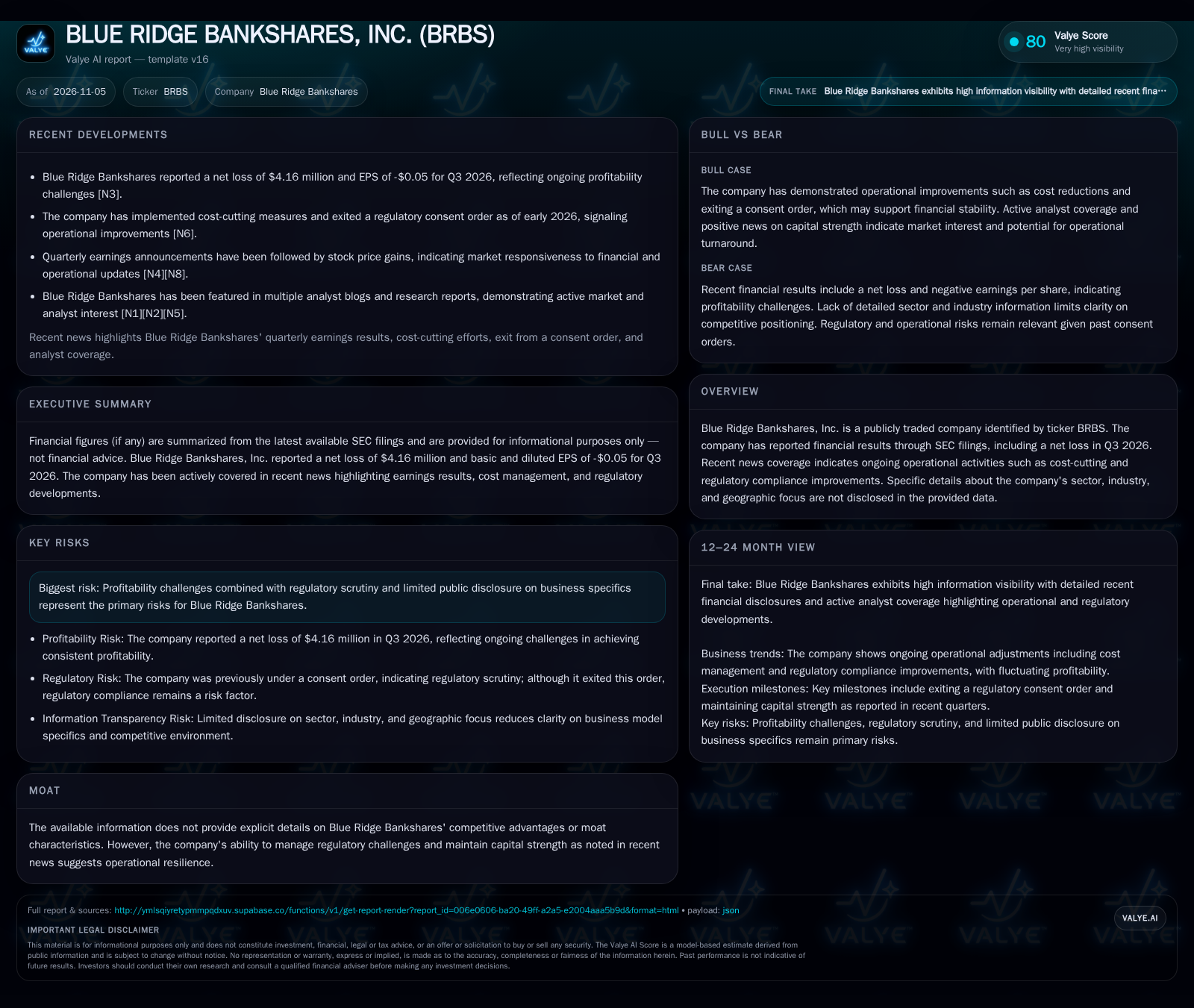
Blue Ridge Bankshares posted a $4.16 million net loss in Q3 2026, despite recent cost reductions and the milestone of exiting a consent order earlier in 2026. The company’s sector and business specifics remain undisclosed, complicating competitive analysis. Stock price gains following earnings and active analyst coverage suggest market sensitivity to operational updates, but persistent profitability issues and a lack of transparency remain the core risks.[S2] [N4] [N6] [N8]
Blue Ridge Bankshares, Inc. (BRBS) is at a pivotal juncture: recent operational improvements, such as cost reductions and the exit from a consent order, have not yet translated into profitability, as shown by a $4.16 million net loss in Q3 2026. This tension—between signs of regulatory progress and continued financial underperformance—defines the company’s current state. With sector and business model details undisclosed, investors face real ambiguity regarding Blue Ridge’s competitive position and future trajectory, despite heightened analyst attention and notable stock price moves following earnings announcements.
Recent Financial and Regulatory Milestones Reshape the Near-Term Outlook
Blue Ridge Bankshares reported a net loss of $4.16 million for Q3 2026, continuing a pattern of earnings volatility and underscoring persistent profitability challenges.[S2] This loss follows a period where the company implemented cost-cutting measures and, in early 2026, exited a consent order—a regulatory restriction that likely constrained operational flexibility and growth initiatives prior to its removal.[N6] Despite these operational advances, the lack of sector and industry disclosure limits visibility into the underlying drivers of performance and how Blue Ridge’s business model compares to peers. Market reactions to recent earnings—characterized by stock price gains—suggest investors are sensitive to both financial results and signs of operational or regulatory progress.[N4] [N8]
How Cost Structure and Revenue Model Shape Earnings Volatility
Without explicit disclosure on sector or revenue streams, the precise mechanics of Blue Ridge Bankshares’ business model remain opaque. If Blue Ridge operates as a traditional bank holding company, typical drivers would include net interest income, fee-based services, and possibly mortgage or commercial lending. In such models, profitability is heavily influenced by net interest margin, loan loss provisions, and operating leverage from fixed costs such as compliance, technology, and personnel. The recent focus on cost-cutting suggests high operating expenses have been a drag on earnings. Absent a sector disclosure, it is unclear whether these efforts address structural inefficiencies or are temporary measures in response to regulatory scrutiny. The company’s exit from a consent order may reduce compliance costs and allow for greater focus on growth or margin improvement, but the Q3 2026 loss demonstrates that cost controls alone have not restored profitability.[S2] [N6]
Capital and funding needs are likely central, especially if Blue Ridge is subject to banking regulations requiring minimum capital ratios. The company reported cash and liquidity metrics for the period; these figures do not by themselves establish operating runway, investment capacity, financial flexibility, or financing capacity.
Competitive Standing Obscured by Limited Disclosure and Regulatory History
Blue Ridge Bankshares’ lack of sector, industry, and geographic specificity in public disclosures creates a significant blind spot in assessing its competitive landscape. If the company is a regional bank, it would typically compete with community banks, credit unions, and larger banking franchises, where scale, digital adoption, and credit risk management are key differentiators. Exiting a consent order may help rehabilitate the company’s reputation and restore customer or depositor confidence, but any residual stigma could still affect business development or funding costs.
Active analyst coverage and market attention can support visibility, but do not by themselves constitute a moat. Without evidence of unique technology, customer relationships, or cost advantages, Blue Ridge’s long-term differentiation remains uncertain. The company’s past regulatory issues may have eroded trust with counterparties, and until consistent profitability is restored, Blue Ridge may remain at a competitive disadvantage relative to more stable peers.
Operational Turnaround Catalyzed by Cost Discipline and Regulatory Freedom
A plausible upside scenario hinges on Blue Ridge leveraging its exit from regulatory oversight to drive operational improvements and restore profitability. The company could capitalize on reduced compliance burdens to invest in technology, broaden its product set, or selectively grow its loan book if it operates in banking. Cost-cutting, if structural rather than superficial, may create operating leverage as revenue stabilizes or grows. If Blue Ridge can demonstrate two or more consecutive quarters of profitability, coupled with evidence of stable or improving asset quality (if applicable), this would validate the effectiveness of recent operational changes and potentially re-rate the stock.
Confirmation would come from clear disclosures of sector focus, improved earnings consistency, and positive analyst revisions. Falsification would be signaled by continued net losses, rising non-interest expenses, or any recurrence of regulatory scrutiny.
Earnings Recovery Remains Elusive Amid Cost Pressures and Limited Visibility
The most plausible outcome is that Blue Ridge Bankshares continues to face intermittent profitability, with cost reductions partially offsetting revenue headwinds but not yet delivering sustained earnings growth. The company may remain in a transitional phase—out from under regulatory orders, but still contending with the aftereffects of past oversight, potential customer attrition, and legacy cost structure. Analyst coverage and periodic stock price rallies may persist around earnings events, but without concrete disclosures or a clear competitive edge, the company’s valuation is likely to remain discounted relative to more transparent and consistently profitable peers.
Base-case confirmation would involve ongoing, if modest, improvement in quarterly losses and gradual operational normalization. Falsification would be a return to regulatory action, widening losses, or any capital impairment event.
Prolonged Losses and Renewed Regulatory Risk Threaten Franchise Value
In a downside scenario, Blue Ridge fails to stem losses, either due to structural revenue weakness, ineffective cost management, or renewed regulatory scrutiny. Prolonged unprofitability could erode capital, restrict lending or investment capacity (if a bank), and increase vulnerability to adverse economic shocks. If customer or depositor confidence is not fully restored post-consent order, franchise value could deteriorate further, leading to market share loss or even pressure for asset sales or consolidation.
Signals confirming this scenario would include mounting quarterly losses, negative analyst revisions, further regulatory comments or penalties, or any disclosure of capital shortfalls. A reversal in stock price momentum following earnings would also suggest waning investor confidence.
Milestones That Will Shape Blue Ridge Bankshares’ Recovery Narrative
Quarterly net income or loss: Sustained improvement or return to profitability would support a turnaround thesis; continued losses would undermine it.
Disclosure of sector, industry, and geographic focus: Concrete information would help clarify business model, peer set, and risk profile.
Expense trends: Progress in reducing non-interest expenses, if disclosed, would be a key indicator of operational discipline.
New regulatory developments: Any recurrence of consent orders, enforcement actions, or material compliance events would be critical.
Capital adequacy (if disclosed): Trends in capital ratios or equity base would help assess resilience to ongoing losses.
Analyst estimate revisions: Upward revisions post-earnings would signal rising confidence; downward trends would indicate skepticism.
Stock price reaction to future earnings: Continued positive response would suggest market belief in turnaround; negative reactions could flag disappointment.
Evidence of franchise growth (loan, deposit, or customer metrics, if disclosed): Expansion or contraction would clarify competitive momentum.
Disclaimer: This is research-only, informational analysis and not investment advice. It may include AI-generated interpretation and general industry context. Always verify important details using primary sources.

Comments