
Tucows at a Crossroads: Domain Strengths, Fiber Capital Demands, and the Stakes of Liquidity
Tucows’ established domain business provides recurring revenue, but persistent losses and a stretched balance sheet highlight the challenges of scaling capital-intensive fiber operations. Recent asset transfers and market sentiment signal that the company’s next phase will hinge on execution, funding flexibility, and its ability to extract value from both legacy and growth segments.
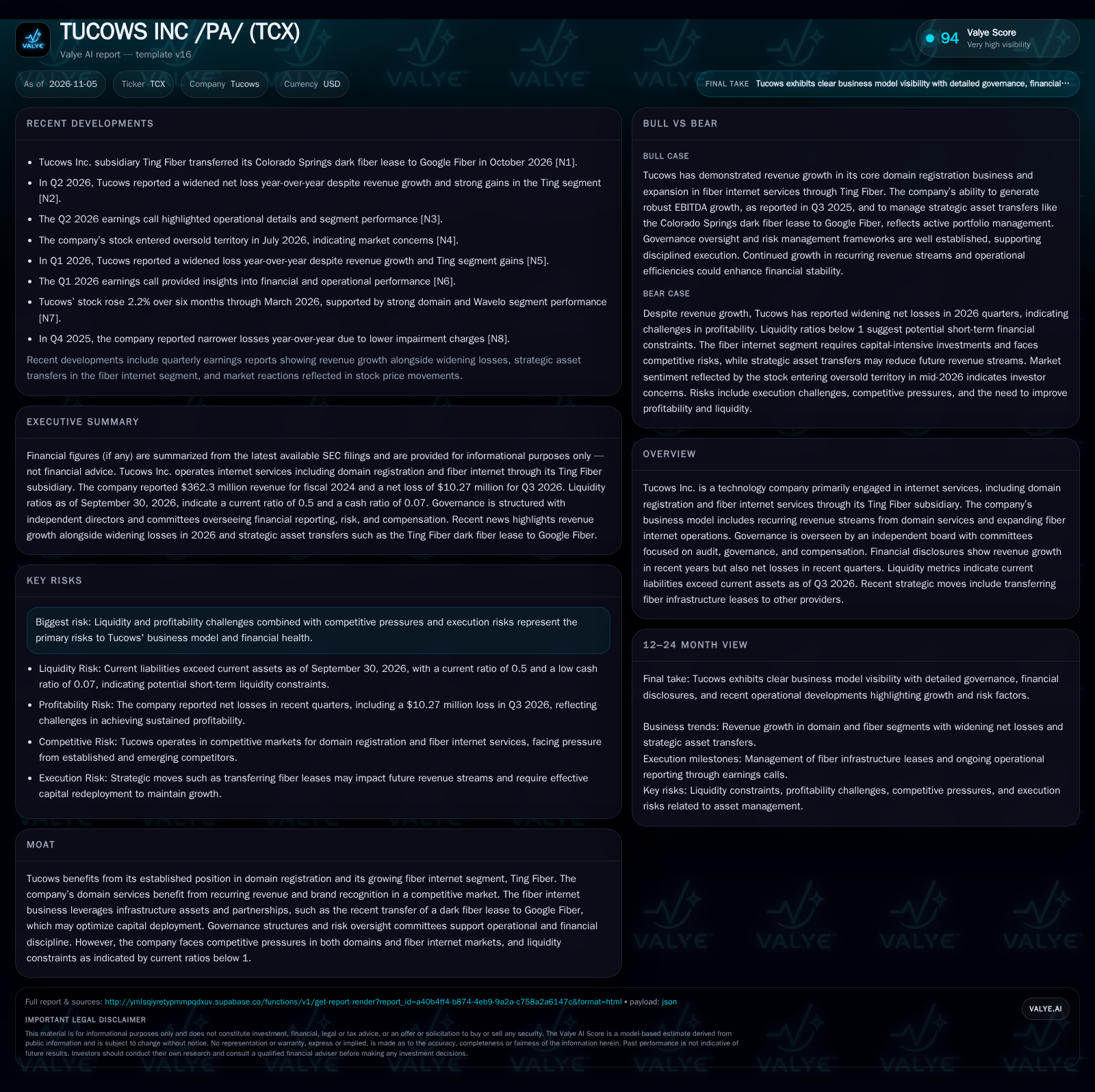
Tucows continues to generate robust revenue from its core domain registration business while expanding through Ting Fiber’s internet operations. The recent transfer of a dark fiber lease to Google Fiber underscores ongoing portfolio optimization, but also raises questions about future revenue streams and capital allocation priorities. The company’s ability to balance recurring domain income with the high demands of fiber infrastructure will be pivotal for its outlook. [S2] [N1]
Tucows Inc. stands at a strategic juncture: its legacy as a domain registration provider delivers recurring revenues and brand recognition, but the company’s push into fiber internet—while generating segment growth—has not yet translated into sustained profitability. Recent financials reveal widening net losses and a balance sheet under pressure, while the transfer of a Ting Fiber asset to Google Fiber hints at both tactical repositioning and the capital intensity of fiber buildouts.
Recent Results Spotlight Losses, Asset Transfers, and Tight Liquidity
Tucows reported $362.3 million in revenue for fiscal year 2024, but net losses have continued, with a $10.27 million loss posted for Q3 2026. These losses occur despite revenue growth and segment gains from Ting Fiber, suggesting that operating leverage from new investments has not yet materialized at the bottom line. [S1] [S2]
Liquidity is a pressing issue: as of September 30, 2026, current assets ($178.68 million) were significantly below current liabilities ($359.52 million), resulting in a current ratio of 0.5 and a cash ratio of just 0.07. This signals limited room for error in meeting short-term obligations. [S2]
Strategically, Ting Fiber transferred its Colorado Springs dark fiber lease to Google Fiber in October 2026. This move demonstrates active portfolio management but may also reduce the company’s ability to capture recurring infrastructure revenue in that market. [N1]
Market sentiment has reflected these pressures, with Tucows’ stock entering oversold territory in mid-2026, pointing to investor concern over the trajectory of losses and balance sheet risk. [N4]
Revenue Streams, Cost Structures, and the Capital Intensity of Expansion
Tucows’ business model relies on recurring revenues from two main sources: domain registration and fiber internet services. The domain segment typically benefits from multi-year customer relationships, with modest churn and predictable renewal cycles. Gross margins in this segment are generally stable due to the low incremental cost of servicing existing domains and the company’s long-standing position in the market.
The fiber internet business, operated under Ting Fiber, is fundamentally different: it is capital-intensive, requiring large upfront investments in network buildout and ongoing maintenance. While fiber can deliver higher ARPU (average revenue per user) and attract sticky residential and business customers, breakeven is often delayed by slow adoption curves and the need to reach scale in each market. Operating leverage is theoretically high if fixed infrastructure costs can be spread over a growing subscriber base, but this requires sustained capital and time.
The transfer of fiber assets, as seen with the Colorado Springs lease, may optimize near-term cash flows or reduce future capex, but could also limit long-term revenue capture if Tucows is unable to leverage the infrastructure itself. The interplay between recurring domain income and the heavy investment cycle of fiber will determine the company’s ability to generate free cash flow and support future growth. [N1]
Domain Incumbency vs. Fiber Disruption: Competitive Landscape and Strategic Tensions
In domain registration, Tucows competes with large, well-capitalized players and aggregators. Its established customer base and operational scale provide some insulation, but pricing remains competitive and switching friction is moderate; customers can move domains with relative ease if service or price is not compelling.
The fiber internet market is crowded and highly localized. Incumbent cable and telecom operators, regional fiber specialists, and new entrants—often backed by significant capital—are all vying for share. Tucows’ ability to differentiate hinges on speed of deployment, customer service, and the scale of its network relative to local competitors. The recent transfer of a fiber lease to Google Fiber, a major entrant with substantial resources, illustrates the intensity of competition and the difficulty of sustaining a proprietary infrastructure advantage. [N1]
Without significant scale or unique service bundling, Tucows’ fiber business faces the risk of being out-invested or bypassed by deeper-pocketed rivals. On the domain side, retention and upselling are key, but margin pressure from commoditization remains a persistent headwind.
Unlocking Operating Leverage Through Scale and Strategic Asset Management
A favorable scenario would see Tucows leveraging its recurring domain revenues to fund and scale Ting Fiber until it reaches critical mass in select markets. If fiber adoption accelerates and network utilization improves, fixed costs could be spread across a larger customer base, driving margin expansion and a path to profitability.
Strategic asset transfers—such as the lease deal with Google Fiber—could free up capital for higher-return projects or reduce exposure to unprofitable geographies, allowing management to redeploy resources more efficiently. If these moves are paired with disciplined cost control and steady domain cash flow, Tucows could achieve self-funded growth without diluting shareholders or taking on excessive debt.
Confirmation would come from a narrowing of net losses despite ongoing investment, improved cash flow from operations, and evidence of rising ARPU or subscriber growth in fiber markets. A shift in market sentiment—reflected in stock price recovery—would further support the case that the company’s asset management and operational focus are yielding tangible financial improvements.
Balancing Recurring Domain Cash Flows With Fiber Investment Headwinds
The most plausible outlook is that Tucows will continue to generate steady, if modest, cash flow from its domain business while its fiber segment remains in investment mode. Losses may persist or widen as fiber buildouts and customer acquisition costs stay high, only partially offset by recurring domain income.
Periodic asset sales or lease transfers, like the Colorado Springs transaction, may provide intermittent cash infusions but could also cap long-term growth potential if too many infrastructure assets are divested. Governance oversight and risk management may help avoid worst-case scenarios, but with liquidity ratios below 1, the company’s room to maneuver is limited unless external financing or improved fiber economics materialize.
Evidence supporting this scenario would include continued revenue growth paired with ongoing net losses, weak but reported liquidity position, and no material acceleration in fiber profitability. Investor sentiment may remain cautious, as reflected in muted or volatile stock performance.
Liquidity Squeeze and Competitive Setbacks Threaten Ongoing Operations
In a negative outcome, persistent net losses and tight liquidity could force Tucows to curtail fiber expansion, sell additional infrastructure at distressed prices, or seek dilutive external funding. If recurring domain revenues erode—due to customer churn or aggressive competitor pricing—the company’s ability to subsidize its fiber ambitions would be further constrained.
Should larger fiber competitors accelerate deployments or offer superior bundled services, Ting Fiber could lose market share before reaching scale, leading to stranded assets and further write-downs.
Confirmation of this scenario would include further deterioration of liquidity metrics, accelerated asset sales, sharper net losses, and possible changes to governance or management structure aimed at crisis management.
Milestones That Will Determine Tucows’ Financial and Strategic Trajectory
Quarterly trends in net losses and cash from operations—continued improvement or further deterioration will clarify the sustainability of current strategies.
Fiber ARPU growth and subscriber additions (if disclosed) would help test whether Ting Fiber is achieving the scale required for operating leverage.
Details on future asset transfers, lease agreements, or divestitures—frequency and terms will reveal management’s capital allocation priorities.
Domain customer churn rates and renewal trends (if disclosed) would signal the health and stickiness of the legacy business.
Changes in competitive activity—such as new market entries by major fiber players or domain pricing wars—could dramatically alter the risk/reward profile.
Management commentary on capital expenditure plans and financing options will shed light on how Tucows plans to bridge the gap between recurring income and growth investments.
Board or governance changes, particularly in response to financial pressures, could indicate either proactive risk management or emerging distress.
Disclaimer: This is research-only, informational analysis and not investment advice. It may include AI-generated interpretation and general industry context. Always verify important details using primary sources.

Comments