
Strawberry Fields REIT: Legal Risks and Regulatory Dynamics in Skilled Nursing Property Economics
Strawberry Fields REIT operates in the highly regulated and operationally demanding skilled nursing facility real estate sector, facing net losses, ongoing legal risk, and the challenges of managing compliance and portfolio growth. The company’s future hinges on its ability to navigate regulatory headwinds, stabilize financial performance, and leverage its specialized asset base.
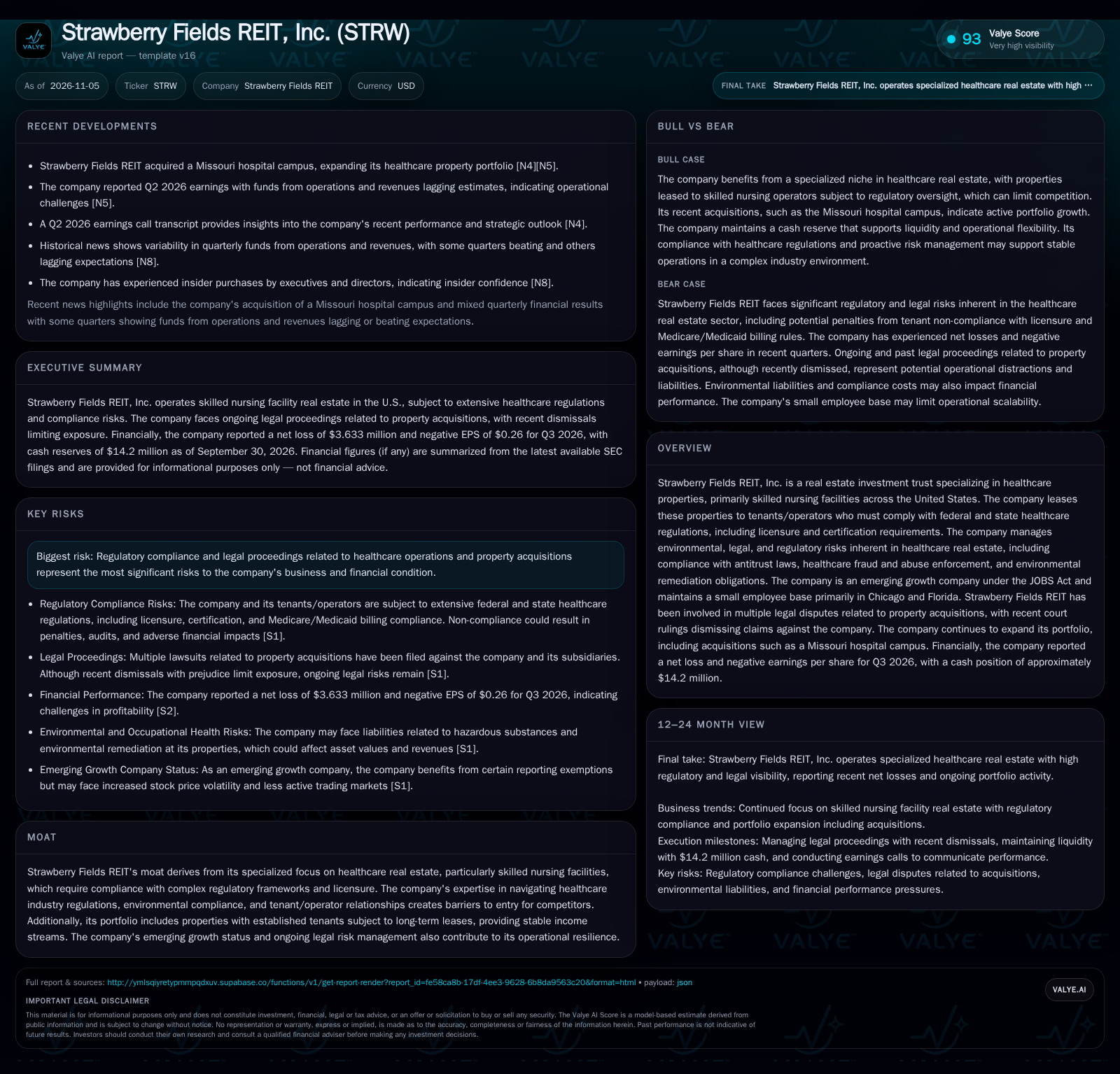
Strawberry Fields REIT specializes in leasing skilled nursing facilities under triple-net structures, reporting a net loss and negative EPS in Q3 2026. The company continues to expand its portfolio amidst persistent regulatory and legal risks, with recent court dismissals mitigating some exposure. Its economics depend on tenant stability, regulatory compliance, and managing environmental liabilities.
Strawberry Fields REIT, Inc. sits at the intersection of healthcare operations and real estate, specializing in skilled nursing facility assets leased to third-party operators. The company’s model, based on long-term triple-net leases, aims for stable cash flow insulated from direct healthcare operating risks. However, persistent net losses, regulatory complexity, legal proceedings, and environmental liabilities create a challenging landscape. Whether Strawberry Fields can realize its vision of dividend growth and asset appreciation depends on managing these headwinds, diversifying its portfolio, and achieving consistent tenant performance.
Performance Trends and Recent Legal Updates Inform Near-Term Prospects
Strawberry Fields REIT reported a net loss of $3.633 million and basic/diluted EPS of -$0.26 for the quarter ended September 30, 2026, continuing a trend of profitability challenges. The company held $14.2 million in cash and equivalents at period-end, providing some liquidity but not erasing concerns about sustained operating losses [S2]. As of that date, the REIT’s portfolio comprised 134 healthcare properties with 15,655 licensed beds, leased primarily under triple-net structures, and generating approximately $144.1 million in annualized base rent [S2].
Legal risk has been a persistent theme, with Strawberry Fields involved in multiple lawsuits related to healthcare property acquisitions. Notably, several complaints were dismissed with prejudice in March 2026, reducing immediate legal exposure and potentially freeing management to focus on operations and growth [S1]. However, ongoing regulatory and compliance scrutiny, particularly concerning Medicare/Medicaid billing and licensure, remains a material risk.
Understanding Triple-Net Lease Structures in Healthcare Real Estate
Strawberry Fields REIT’s core economics rely on leasing healthcare properties—primarily skilled nursing facilities—on long-term, triple-net terms. Under this structure, tenants bear responsibility for real estate taxes, insurance, maintenance, and capital expenditures, shielding the REIT from many variable operating costs [S2]. This model theoretically supports predictable rental income and reduces volatility compared to direct healthcare operation.
However, the economics are highly sensitive to tenant quality, regulatory compliance, and broader industry trends. Tenant operators must maintain licensure and comply with Medicare/Medicaid billing standards—any lapse can disrupt rental streams via fines, shutdowns, or operator turnover. While the REIT’s cost base remains relatively fixed, rental income can be pressured by tenant distress or renegotiations.
Capital needs in this sector are twofold: acquisition-driven portfolio growth and periodic property upgrades to maintain regulatory compliance and tenant appeal. While the triple-net model reduces day-to-day capital intensity, environmental remediation and compliance upgrades can still create lumpy, sometimes unpredictable, capital expenditures. Operating leverage is moderate; rental income scales with portfolio size, but the small employee base (nine employees as of year-end 2025) suggests limited internal capacity to absorb rapid portfolio or compliance shocks [S1].
Competitive Barriers and Market Frictions in Skilled Nursing Facilities
The skilled nursing facility (SNF) segment of healthcare real estate presents significant barriers to entry. Operators and landlords must navigate a labyrinth of federal and state healthcare regulations, environmental standards, and licensure requirements. Strawberry Fields’ focus and experience in this niche—along with relationships with established operators—provide a degree of insulation from generic real estate competition [S1].
However, the sector faces counterforces. Alternative care models (such as home health and assisted living), regulatory tightening, and reimbursement pressure can erode tenant profitability and, by extension, landlord stability. Larger healthcare REITs with diversified tenant bases and stronger access to capital may also outcompete smaller players for attractive assets or offer more favorable lease terms to tenants.
Switching costs for tenants are high due to regulatory approvals and the operational disruption of relocating patients, but tenant concentration risk remains: distress or non-compliance by a major operator could have outsized effects on Strawberry Fields’ revenue base.
Portfolio Diversification and Regulatory Strategies Could Spark Recovery
A favorable scenario for Strawberry Fields REIT would see the company successfully acquiring and integrating new properties, diversifying its tenant and geographic exposure, and maintaining high occupancy and rent collection rates. If regulatory scrutiny remains manageable and tenants avoid major compliance or reimbursement setbacks, the REIT could stabilize or grow rental income while containing legal and environmental costs.
Evidence of this scenario would include consistent or improving net operating income, a return to positive EPS, successful acquisition announcements with limited legal contestation, and a declining trend in regulatory or legal settlements. Signs of tenant strength—such as reduced operator turnover or expanded lease terms—would also support this case.
Falsification would occur if newly acquired properties lead to additional legal disputes, or if tenant defaults and regulatory penalties continue to disrupt income streams despite portfolio growth.
Legal, Regulatory, and Financial Challenges Define the Core Operating Environment
The most plausible near-term trajectory is one where Strawberry Fields continues to operate at thin or negative margins, with periodic legal and regulatory costs offsetting rental income growth from acquisitions. The REIT may be able to modestly expand its portfolio, but tenant/operator distress, regulatory investigations, and environmental liabilities create ongoing financial drag.
Confirming evidence would be continued net losses or flat earnings despite portfolio growth, persistent legal expenses, and a pattern of regulatory disclosures or minor settlements. If the company maintains liquidity but does not materially reduce net losses or legal exposure, this would support the base scenario.
A shift toward positive net income, material reduction in legal costs, or evidence of durable tenant/operator compliance would challenge this outlook.
Tenant Financial Strains and Regulatory Interventions Pose Downside Risks
A negative scenario for Strawberry Fields would unfold if one or more major tenants face regulatory penalties, reimbursement cuts, or operational shutdowns, resulting in missed rent payments or renegotiations. Legal proceedings—either revived or new—could absorb management resources and lead to adverse settlements or asset impairments.
Unanticipated environmental liabilities, such as the discovery of hazardous substances requiring remediation, could trigger significant unplanned capital outlays and depress asset values. In this scenario, the company’s small staff and limited internal resources could exacerbate execution risk, especially if regulatory or legal issues escalate across multiple properties.
Evidence of this scenario would include a spike in uncollected rent, new or revived lawsuits, regulatory investigations with public penalties, or disclosures of material environmental remediation costs. Conversely, a sustained period without major legal, regulatory, or environmental events would help falsify the downside case.
Operational, Legal, and Regulatory Developments Shaping Strawberry Fields’ Trajectory
Quarterly trends in net income, EPS, and net operating income: a return to profitability or further deterioration would be thesis-defining [S2].
Aggregate occupancy rates and rent collection percentages across the portfolio—if disclosed—would clarify tenant health and revenue visibility.
Tenant/operator concentration: shifts in the share of revenue from the largest tenants may signal risk or improved diversification.
Number and severity of new legal proceedings, regulatory audits, or settlements: an uptick would indicate persistent friction.
Environmental remediation costs or property impairments: disclosures of large, unexpected outlays would test the risk thesis.
Acquisition pace and integration progress: evidence of successful, low-friction portfolio expansion would support the upside scenario.
Compliance incidents or operator turnover rates—if disclosed—would illuminate the quality of tenant relationships and regulatory management.
Maintenance of REIT status and any changes in tax or regulatory treatment impacting the triple-net model.
Disclaimer: This is research-only, informational analysis and not investment advice. It may include AI-generated interpretation and general industry context. Always verify important details using primary sources.

Comments