
American Coastal Insurance: Underwriting Growth, Catastrophe Risk, and the Stakes of Regional Expansion
Recent financial results show American Coastal Insurance delivering solid profitability and increasing policy counts, but limited disclosure leaves investors navigating uncertainty around the sustainability of underwriting margins, catastrophe exposure, and the economics of expansion beyond Florida.
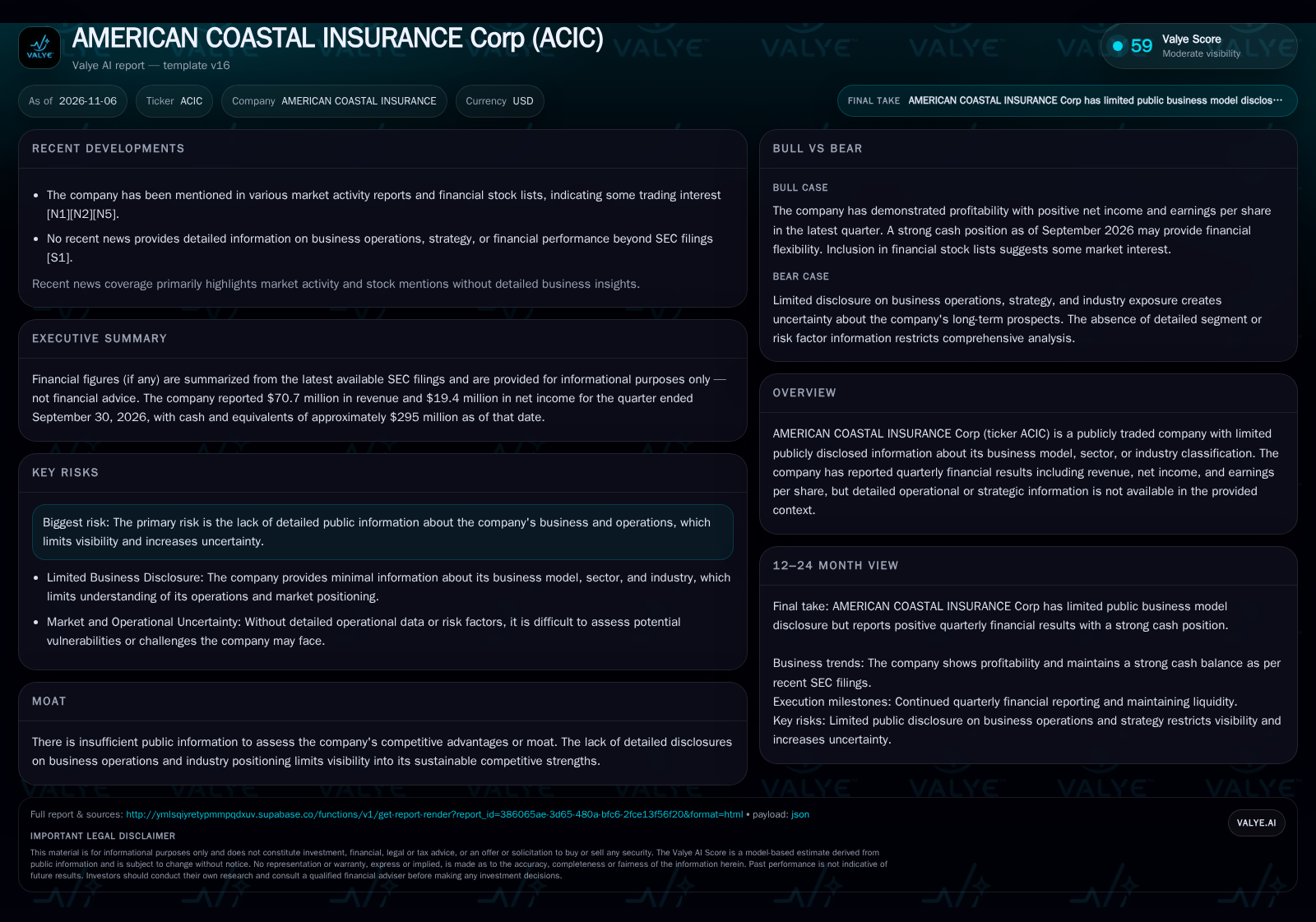
American Coastal Insurance Corp (ACIC) reported $70.7M in revenue and $19.4M in net income for Q3 2026, with policies in-force up 6.6% year-on-year and a cash balance of $294.7M. The company remains highly exposed to Florida's property insurance market but has begun expanding into new states where large carriers are retreating. Limited operational transparency raises questions about underwriting discipline, reinsurance costs, and the durability of recent profitability. Investors must weigh the potential of regional growth against persistent catastrophe and regulatory risks. [S1]
American Coastal Insurance Corp’s latest results show a profitable quarter and modest policy growth, but the company’s future is tied to complex dynamics in the regional property insurance market. With Florida as its primary focus and expansion into catastrophe-prone states underway, ACIC faces both opportunity and risk as large national insurers pull back from challenging geographies. The company’s reported cash position and recent operational gains are tempered by limited public detail on underwriting quality, reinsurance arrangements, and the true economics of its expansion strategy. For investors, understanding ACIC’s risk selection and capital management will be essential as the property insurance cycle evolves.
Profitability and Policy Growth Amid Expansion Efforts
For the quarter ending September 30, 2026, American Coastal Insurance reported $70.7 million in revenue and $19.4 million in net income, with basic EPS of $0.41 and diluted EPS of $0.40. Policies in-force increased by 6.6% year-over-year to 4,628, reflecting expansion beyond its core Florida market. As of September 30, 2026, the company held $294.7 million in cash and equivalents. These metrics demonstrate near-term profitability and suggest some traction in acquiring new business, especially as ACIC targets states where national carriers have reduced their presence due to catastrophe risk. However, the lack of detailed disclosure on loss ratios, reinsurance costs, or segment profitability leaves open questions about the sustainability and quality of reported earnings. [S1]
How Underwriting, Risk Selection, and Reinsurance Shape Returns
In property insurance, particularly in catastrophe-prone regions like Florida, profitability hinges on disciplined underwriting, accurate risk-based pricing, and effective reinsurance strategies. Premiums written and earned drive revenue, but the real economic engine is the ability to price policies that cover expected claims, operating costs, and reinsurance while generating a margin. Given ACIC’s focus on commercial property in Florida and now other high-risk states, exposure to hurricanes and severe weather events introduces significant loss volatility.
Reinsurance is a critical cost center: it can smooth earnings and protect capital, but rising reinsurance prices—common after major catastrophes—can compress margins or force insurers to retain more risk. The company reported cash and liquidity metrics for the period; these figures do not by themselves establish operating runway, investment capacity, financial flexibility, or financing capacity. Capital needs are cyclical and can spike after major events or regulatory changes, making capital management and portfolio mix central to long-term value creation.
A nuanced understanding of ACIC’s underwriting economics also requires examining the interplay between risk selection and portfolio diversification. While focusing on catastrophe-prone regions elevates loss volatility, the company’s ability to segment risks by geography, property type, and risk characteristics can materially influence loss outcomes. Effective use of granular data analytics and catastrophe modeling enables more precise pricing and risk appetite calibration, potentially mitigating the impact of tail events. However, if portfolio concentration remains high in a few hotspots or property classes, the company remains vulnerable to correlated losses, which can strain capital and reinsurance capacity.
Moreover, the cost and structure of reinsurance programs are pivotal in determining net risk retention and capital efficiency. Layered reinsurance treaties with appropriate attachment points and limits can protect against severe loss scenarios but may come at escalating premiums in hard markets. ACIC’s strategic decisions around the balance between quota share, excess of loss, and aggregate covers will influence both earnings volatility and capital requirements. If reinsurance pricing becomes prohibitively expensive or coverage terms tighten, the company may face a trade-off between retaining more risk to preserve margins or ceding risk at unfavorable rates, thereby compressing returns.
Navigating a Shifting Competitive Landscape in Catastrophe-Prone Markets
ACIC’s expansion strategy targets markets where national carriers are reducing exposure, often due to outsized catastrophe losses or regulatory friction. This creates a window for regional specialists to gain share—if they can underwrite profitably. In Florida, competition includes other regional carriers, residual market mechanisms, and surplus lines insurers. The company’s relationships with managing general agents (e.g., AmRisc) and brokers can be a double-edged sword: they can accelerate distribution and scale, but also introduce concentration and alignment risks.
Potential substitutes include risk retention groups, self-insurance, or parametric insurance products, especially as technology and data analytics improve risk modeling. ACIC’s long-term advantage would likely depend on underwriting acumen, claims management, and the ability to price risk more effectively than peers. However, the cyclical nature of property insurance, dependency on reinsurance markets, and regulatory interventions (such as rate freezes or policy moratoria) can rapidly erode competitive advantages.
Competitive positioning in catastrophe-exposed markets also depends on the insurer’s claims management capabilities and speed of recovery. Insurers with robust claims handling infrastructure and proactive catastrophe response can reduce loss adjustment expenses and improve customer retention, which in turn supports profitability and reputation. Conversely, delays or inefficiencies in claims settlement can lead to adverse loss development and regulatory scrutiny. Given that regional insurers often rely on third-party administrators or managing general agents, alignment of incentives and operational oversight are critical to maintaining underwriting discipline and controlling loss costs.
Additionally, evolving technology and data science are reshaping competitive dynamics by enabling more accurate risk assessment and dynamic pricing. Insurers that invest in predictive analytics, satellite imagery, and real-time weather data may gain an edge in underwriting and portfolio management. However, the benefits of such investments depend on the insurer’s scale, data integration capabilities, and willingness to adapt underwriting guidelines. In markets characterized by frequent catastrophes and regulatory intervention, the ability to swiftly adjust pricing and coverage terms in response to emerging risk trends can be a key differentiator.
Profitable Regional Expansion Driven by Underwriting Discipline
The most favorable scenario for ACIC involves successfully leveraging its expertise in catastrophe-exposed markets to capture profitable business as national carriers retrench. If the company can maintain underwriting discipline—carefully selecting risks, pricing adequately for catastrophe exposure, and managing expenses—it could grow its policy base and revenue while preserving or expanding margins. Continued stability in reinsurance costs and relatively benign catastrophe activity would support this scenario.
Evidence that would confirm this trajectory includes sustained growth in policies in-force, stable or improving combined ratios (if disclosed), and the absence of outsized catastrophe losses relative to peers. Additional expansion into new states, accompanied by profitable results, would further validate the strategy. Conversely, a spike in loss ratios, reinsurance cost pressures, or loss of key distribution relationships would challenge the upside case.
Moderate Growth Amid Cyclical Volatility and Regulatory Challenges
The most plausible outcome is that ACIC continues to grow modestly, with results fluctuating based on weather events, reinsurance market cycles, and regulatory actions in its target states. The company may sustain profitability in most years, but occasional large losses from hurricanes or regulatory interventions could dent earnings and force capital raises or portfolio rebalancing. Expansion into new states may provide incremental growth, but also exposes ACIC to unfamiliar regulatory and competitive environments.
This scenario would be confirmed by continued but variable growth in revenue and policy counts, periodic swings in quarterly earnings, and disclosures of occasional adverse development from catastrophes. Watchpoints would include any sharp increases in reinsurance costs, regulatory rate actions, or sudden changes in policy retention or cancellation rates.
Major Catastrophe Losses or Regulatory Shocks Strain Capital and Earnings
The adverse scenario features a major hurricane or series of catastrophes driving claims well above expectations, overwhelming reinsurance protections and resulting in large underwriting losses. Alternatively, regulatory changes—such as mandated rate caps, claims-handling restrictions, or new capital requirements—could compress margins and force ACIC to raise additional capital or retrench from certain markets.
This scenario would be evidenced by a sharp deterioration in loss and combined ratios (if disclosed), a material decline in cash or book value, and possible reductions in policies in-force as the company tightens underwriting or exits lines of business. Downgrades in financial strength ratings or negative regulatory actions would also be red flags.
Signals That Will Clarify American Coastal’s Expansion and Risk Management Thesis
Disclosure of combined ratio, loss ratio, and expense ratio trends for the core portfolio—if disclosed—would illuminate underwriting performance and cost discipline.
Updates on reinsurance program structure, retention levels, and pricing changes would help assess exposure to catastrophe volatility and margin compression.
Geographic mix of premiums and policies in-force, especially the pace and profitability of expansion into states beyond Florida, would test the regional growth thesis.
Trends in policies in-force, new business acquisition, and retention/cancellation rates would reveal the sustainability of recent growth.
Material catastrophe loss disclosures or reserve development would provide insight into risk modeling accuracy and claims management.
Regulatory filings, rate approval outcomes, or commentary on legislative changes impacting property insurers in Florida and other target states would be material.
Shifts in investment income or portfolio composition, as well as any significant realized gains/losses, would affect overall earnings quality.
Any changes in relationships with key distribution partners or managing general agents would impact future premium flow and risk selection.
Disclaimer: This is research-only, informational analysis and not investment advice. It may include AI-generated interpretation and general industry context. Always verify important details using primary sources.

Comments