
BKV Corp’s Integrated Gas and Power Platform: Scale, Carbon Strategy, and the Stakes of Expansion
Recent acquisitions and power buildout ambitions have transformed BKV Corp into a scaled, vertically integrated natural gas and power producer with a differentiated carbon capture strategy. The company’s ability to convert operational scale and CCUS innovation into stable margins and risk-managed growth will determine its long-term competitive position.
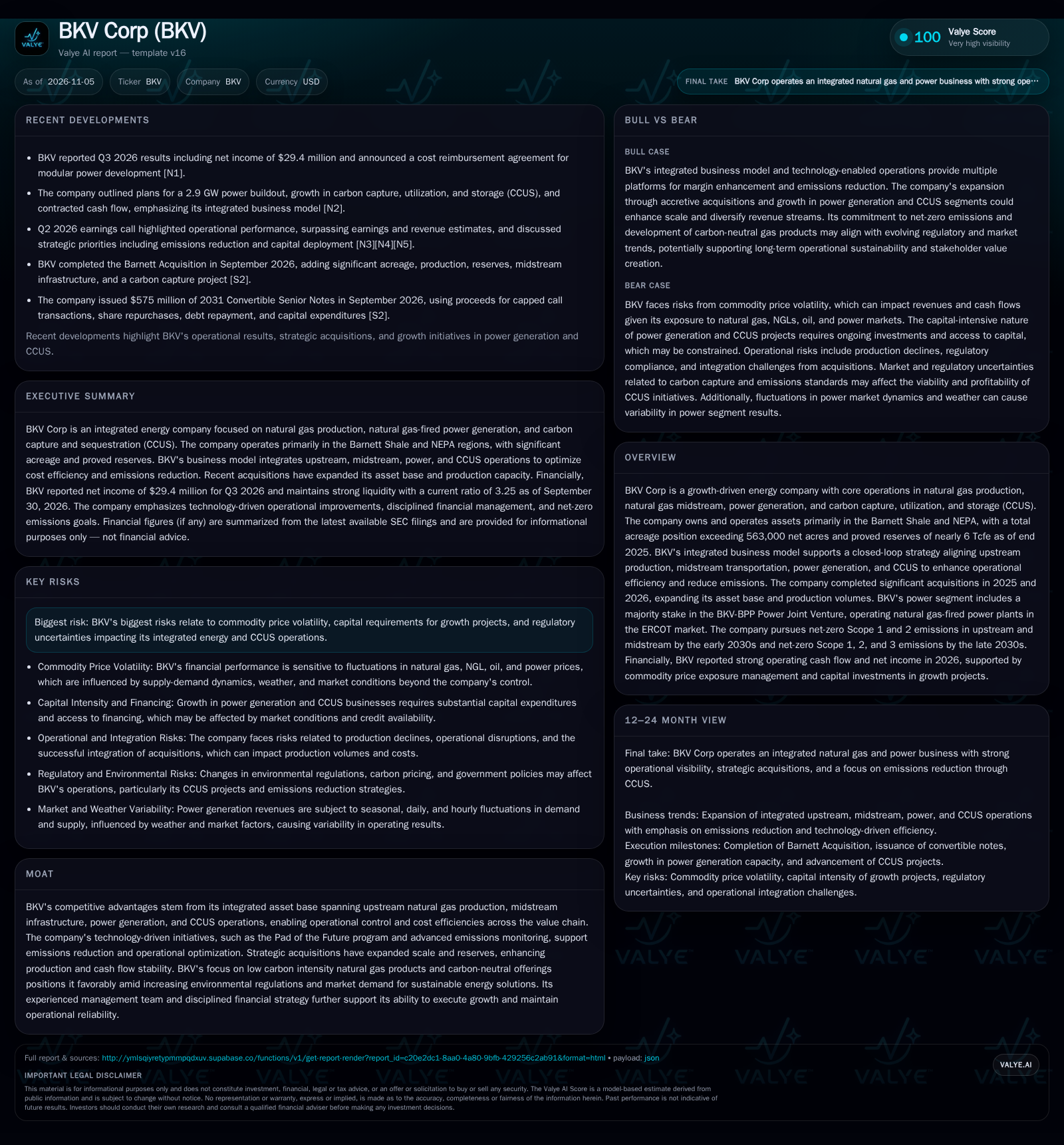
BKV Corp has rapidly expanded its upstream and power footprint through major acquisitions and is executing on a 2.9 GW power buildout plan while investing in carbon capture and carbon-neutral gas products. With a reported balance sheet position and integrated operations, the company’s future hinges on managing commodity volatility, capital intensity, and execution on CCUS and power market opportunities. The interplay between scale, emissions reduction, and market demand for low-carbon energy will shape the next phase of BKV’s value proposition. [S1] [S2] [N1] [N2]
BKV Corp’s recent acquisition spree and aggressive power market expansion have redefined its profile from a regional gas producer to a vertically integrated energy platform with ambitions in carbon management. With nearly 6 Tcfe of proved reserves, a majority stake in gas-fired power assets, and first-mover initiatives in carbon capture and carbon-neutral gas, BKV is positioned at the intersection of traditional energy and the low-carbon transition. The company’s success will depend on translating scale and operational integration into sustainable margins, while managing capital intensity, commodity risk, and the practical realities of CCUS commercialization.
Recent Acquisitions and Power Expansion Reshape BKV’s Operating Profile
BKV Corp executed two major acquisitions in the past 14 months: Bedrock Production, LLC in September 2025 (adding 96,000 net acres, 1 Tcfe of reserves, and 100+ MMcfe/d of production), and the Barnett Acquisition in September 2026 (an additional 117,000 net acres, 65 MMcfe/d of production, 0.35 Tcfe PDP reserves, 1,000 operated wells, new midstream infrastructure, and a CCUS project) [S1] [S2]. These moves have scaled BKV’s upstream footprint to over 563,000 net acres and nearly 6 Tcfe of proved reserves as of end 2025 [S1].
In parallel, BKV’s power segment (75% of the BKV-BPP JV) delivered 2,317 GWh in Q3 2026 with a capacity factor near 70% in the ERCOT market [S1] [S2]. The company is progressing on a 2.9 GW modular power development plan and expanding CCUS activities, including multiple sequestration projects [N1] [N2].
BKV raised $575 million via 2031 convertible notes in September 2026, allocating proceeds to share repurchases, debt reduction, and growth capex, and reported $619.6 million in cash with a current ratio of 3.25 as of September 30, 2026 [S2]. These actions have positioned BKV with increased financial resources for ongoing integration and investment.
How Integration and Capital Allocation Could Drive Margins and Growth
BKV’s economics hinge on its integrated value chain: upstream (gas production), midstream (transportation), power (gas-fired generation), and CCUS. This structure allows for potential cost efficiencies (e.g., self-supplied fuel for power plants, optimized midstream costs) and margin capture across the chain, especially if commodity price differentials or midstream bottlenecks emerge. The ability to bundle low-carbon gas with carbon credits into 'Carbon Sequestered Gas' introduces a potential premium product, but market willingness to pay for such attributes remains to be fully proven [S1].
Natural gas production and power generation are both capital-intensive and exposed to commodity and market volatility. BKV’s reported capex for the first nine months of 2026 was $268.8 million, and its net cash from operations was $346.2 million, highlighting the need for ongoing reinvestment to sustain and grow volumes [S2].
Operating leverage is plausible as BKV fills out its expanded asset base and ramps modular power projects, but cost discipline and integration efficiency will be critical. The company’s CCUS segment is in early commercialization; if CCUS can scale with attractive economics and regulatory support, it could diversify cash flows and reduce carbon-related compliance costs. However, CCUS projects typically require significant upfront capital and can face long permitting and ramp-up timelines.
Vertical Integration and Carbon Strategy as Potential Differentiators—But Counterforces Remain
BKV’s integrated model—combining upstream, midstream, power, and CCUS assets—offers potential operational control and cost advantages compared to pure-play E&Ps or merchant power generators. This could allow BKV to monetize gas across multiple channels and capture higher margins when commodity or power spreads are favorable. The company’s push into carbon-neutral gas and CCUS may also appeal to customers and regulators seeking lower emissions solutions.
However, the competitive landscape is formidable. Large utilities, diversified energy majors, and specialized CCUS developers are all pursuing variants of the same low-carbon strategy. The ERCOT market, while providing access to scale, is highly competitive and exposed to weather-driven volatility and policy uncertainty. CCUS, while a possible moat if scaled, is not yet a proven commercial differentiator and depends on evolving regulatory frameworks and customer adoption.
Switching costs for power offtakers and gas buyers are generally low unless BKV can demonstrate superior reliability, price stability, or carbon advantages. The company’s ability to leverage technology (e.g., emissions monitoring, Pad of the Future) and close the loop on Scope 1-3 emissions may support differentiation, but these advantages will need to be realized at commercial scale to be defensible.
If Scale and CCUS Innovation Translate to Premium Margins
The bullish scenario for BKV is that its integrated platform enables operational synergies and cost advantages, while its CCUS and carbon-neutral gas offerings command a premium in markets increasingly focused on emissions. If power buildout proceeds on schedule, capacity factors remain high, and ERCOT pricing supports attractive spreads, BKV could see sustained margin expansion and diversified cash flows.
Confirmation would come from: (1) evidence of premium pricing or long-term contracts for 'Carbon Sequestered Gas' or CCUS services; (2) further announcements of successful integration and ramp-up of acquired assets; (3) regulatory or customer adoption of low-carbon fuels leading to higher realized prices; and (4) CCUS projects achieving scale with visible cash flow contribution.
This scenario would be challenged if CCUS uptake remains slow, power market oversupply erodes spreads, or integration costs outstrip initial estimates.
Operational Integration and Market Volatility Define the Near-Term Reality
The most plausible near-term outcome is that BKV’s expanded platform delivers higher production and power output, but faces ongoing exposure to commodity and power price volatility, integration costs, and the gradual ramp-up of CCUS. Margins remain sensitive to gas and ERCOT price movements, and capital intensity stays elevated as modular power and CCUS projects are built out.
Confirmation would include: (1) steady production volumes and capacity utilization in power; (2) manageable integration and operating costs; (3) incremental progress on CCUS commercialization without material earnings contribution in the immediate term; (4) continued capital discipline and liquidity management. Negative surprises—integration delays, cost overruns, or unexpected regulatory headwinds—would tilt the scenario toward downside.
Absent a step-change in CCUS economics or market pricing for low-carbon gas, BKV’s financial profile is likely to resemble that of a scaled, but capital-intensive, integrated gas and power operator.
Commodity Shocks, Integration Setbacks, or CCUS Disappointment Could Pressure the Model
The adverse scenario materializes if one or more of the following occur: (1) a sustained drop in natural gas prices or unfavorable ERCOT power market dynamics compress margins; (2) operational or integration challenges from recent acquisitions lead to unanticipated costs or production shortfalls; (3) CCUS projects fail to scale, face regulatory setbacks, or prove uneconomic, resulting in stranded capital; or (4) capital markets tighten, limiting BKV’s ability to fund ongoing investments.
Downside confirmation would be seen in: (a) sharp declines in cash from operations or rising leverage; (b) asset impairments or write-downs related to CCUS or acquired properties; (c) missed project milestones or cost overruns in power or CCUS buildout; and (d) lack of customer or regulatory traction for carbon-neutral gas.
This scenario would likely force BKV to retrench, delay growth capex, or pursue asset sales to preserve liquidity.
Milestones and External Forces That Will Shape BKV’s Integrated Energy Thesis
Volume and margin trends in both gas production (MMcfe/d) and power generation (GWh, capacity factor) will test whether recent acquisitions are translating into operational and financial scale.
Integration costs, timelines, and realized synergies from Bedrock, Barnett, and other acquisitions—if disclosed—will reveal whether BKV is capturing value or facing hidden friction.
Uptake, pricing, and contract structures for 'Carbon Sequestered Gas' and CCUS services: evidence of premium pricing, contracted volumes, or regulatory adoption would help test the carbon strategy.
Progress against the 2.9 GW power buildout plan, including project on-time delivery, capex discipline, and accretive returns, is critical for long-term cash flow growth.
CCUS project ramp-up: milestones for additional sequestration sites, injection volumes, and regulatory approvals will determine the pace and scale of this segment.
Commodity and power price sensitivity: realized prices, hedging effectiveness, and exposure to ERCOT volatility will directly impact margins and cash flow stability.
Regulatory changes affecting carbon pricing, CCUS eligibility, or gas-fired power economics could alter the risk/reward calculus for BKV’s integrated model.
Disclaimer: This is research-only, informational analysis and not investment advice. It may include AI-generated interpretation and general industry context. Always verify important details using primary sources.

Comments