
Assurant’s Insurance Platform: Segment Leverage, Profit Momentum, and the Structural Stakes of Lifestyle and Housing Exposure
Assurant’s Q3 2026 results highlight robust profitability and segment strength in lifestyle and housing insurance, underpinned by a reported liquidity position. Yet, the company’s true resilience will depend on its ability to sustain underwriting discipline, manage claims volatility, and adapt to evolving competitive and regulatory landscapes.
Assurant delivered increased net income and revenue in Q3 2026, with operational outperformance in its lifestyle and housing segments and a reported cash position. The company’s multi-segment model provides diversification, but its future trajectory will hinge on claims management, product mix, and its ability to navigate competitive and regulatory pressures.
Assurant, Inc. is demonstrating strong operational execution and financial momentum, with Q3 2026 results showing both profit growth and segmental strength in its core lifestyle and housing insurance businesses. The next phases for Assurant will test its risk management discipline and strategic agility as external pressures mount.
Assurant’s Q3 2026: Profitability, Segment Strength, and Market Recognition
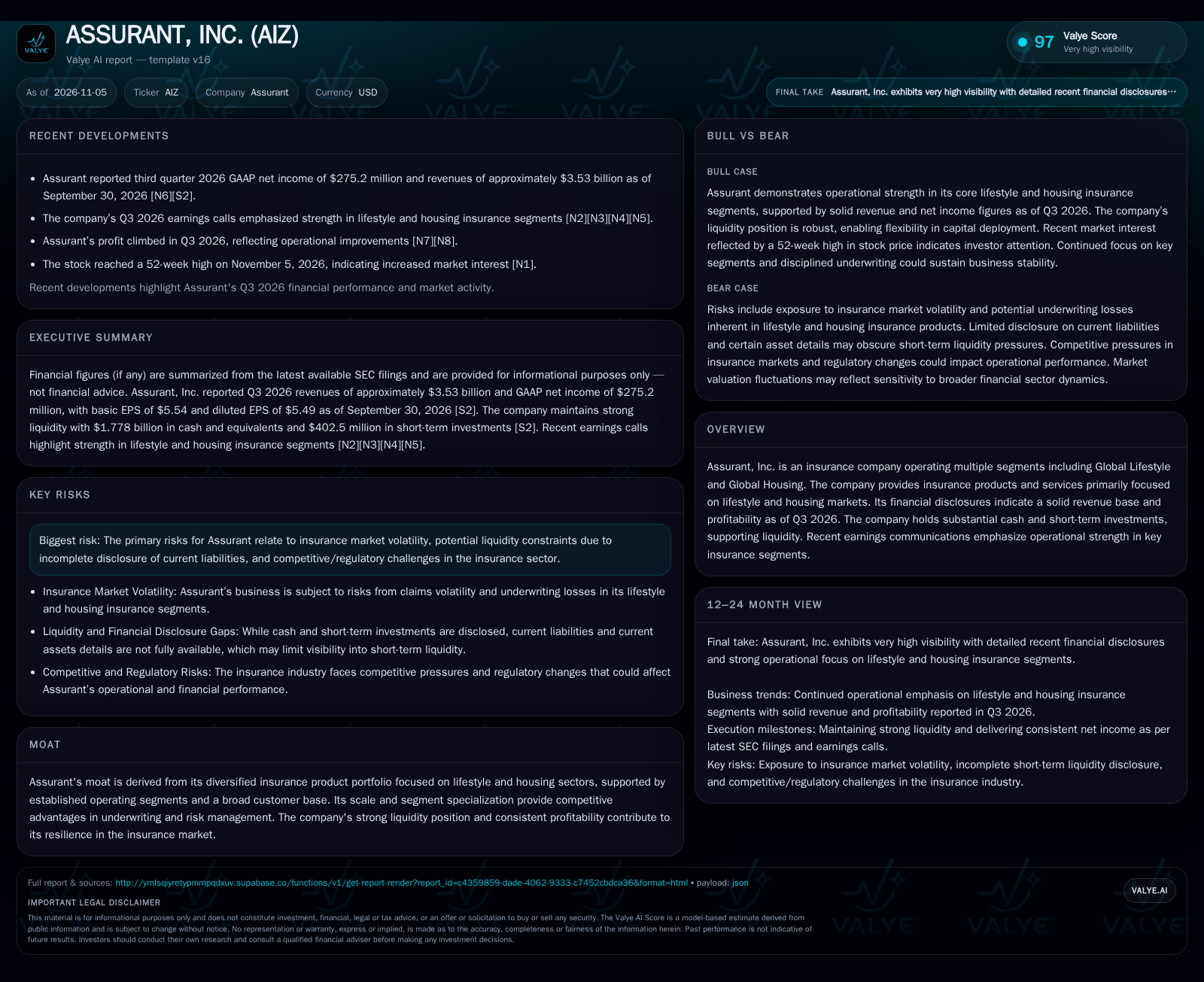
Assurant reported Q3 2026 revenues of approximately $3.53 billion and GAAP net income of $275.2 million, translating to basic earnings per share of $5.54 and diluted EPS of $5.49 [S2] [N6]. This marks a notable climb in profitability, with the company’s performance outpacing analyst expectations [N7] [N8]. Cash and cash equivalents stood at $1.778 billion, supplemented by $402.5 million in short-term investments as of September 30, 2026 [S2]. Operational commentary and earnings call transcripts highlighted particular strength in the lifestyle and housing insurance segments [N2] [N3] [N4] [N5], which are the company’s primary areas of focus. Additionally, Assurant’s stock reached a 52-week high following the earnings release, indicating heightened market interest and possibly reflecting investor confidence in the company’s current trajectory [N1].
How Assurant’s Multi-Segment Model Generates Value—and What Could Shift the Economics
Assurant’s business model centers on underwriting and servicing insurance products across its Global Lifestyle and Global Housing segments. Revenue is driven by premiums for risk assumed, fees for administrative services, and in some cases, investment income on float. In lifestyle insurance (encompassing mobile device protection, warranties, and related services), growth often hinges on partnerships with OEMs, retailers, and carriers, with revenue scaling as coverage volumes rise. The housing segment, which includes renters and lender-placed insurance, is sensitive to property market cycles, claims frequency, and regulatory mandates.
The company’s current scale supports fixed-cost leverage in technology, compliance, and distribution, while variable costs are dominated by claims and commissions. If claims experience deteriorates—due to weather, macroeconomic stress, or product mix shifts—margins could compress quickly. Conversely, disciplined underwriting and favorable product mix (e.g., more fee-based or low-volatility offerings) could enable stable or expanding margins. The company reported cash and liquidity metrics for the period; these figures do not by themselves establish operating runway, investment capacity, financial flexibility, or financing capacity. [S2]
Assurant’s economic profile is thus a balance between scale-driven efficiency, risk selection, and the mix of capital-intensive versus fee-based business. The degree to which the company can shift toward less volatile, higher-ROE segments may determine long-term value creation.
Where Assurant Stands in the Insurance Landscape: Diversification, Specialization, and Counterforces
Assurant’s core competitive advantage lies in its dual focus: niche specialization in lifestyle insurance (such as mobile and device protection) and scale in U.S. housing-related coverage. This diversification helps smooth earnings volatility relative to mono-line insurers. Its established partnerships and distribution relationships with consumer-facing companies can create switching frictions and recurring business, though the durability of these advantages depends on contract renewal rates, partner satisfaction, and the ability to keep pace with evolving digital platforms.
Counterforces are significant. The insurance industry is intensely competitive, with both legacy carriers and insurtech entrants vying for share—often by undercutting on price or offering more flexible digital products. Regulatory changes, especially in property insurance markets, can alter required capital, product design, or pricing flexibility. In lifestyle insurance, technology shifts (e.g., embedded device protection by manufacturers) could erode third-party insurer relevance. Assurant’s breadth gives it scale, but the company must continually invest in underwriting, technology, and customer experience to sustain its edge.
If Assurant Maintains Claims Discipline and Expands Fee-Based Offerings, Margin Expansion Could Follow
A favorable trajectory for Assurant would involve continued outperformance in its core segments, with claims ratios remaining stable or improving due to disciplined underwriting and favorable macro conditions. Expansion of fee-based or service-oriented offerings within lifestyle insurance—such as device management platforms or warranty administration—could lift margins by reducing claims volatility and capital intensity.
Confirmation of this scenario would show up in sustained or rising operating margins, stable or lower combined ratios, and incremental growth in revenue from non-risk-bearing services. Additional evidence would include new or expanded partnerships with major consumer brands, product launches in high-growth niches (e.g., connected home or auto), and management commentary emphasizing a shift toward capital-light revenue streams. Conversely, a spike in claims costs, loss of major partners, or a stall in service-fee revenue would challenge this thesis.
Earnings Stability Depends on Balanced Underwriting and Incremental Growth in Core Segments
The most plausible path for Assurant is one of incremental growth and earnings stability, anchored by steady performance in both lifestyle and housing insurance. Premium volumes may track modestly higher, reflecting ongoing partner relationships and cross-sell opportunities, while claims experience stays within historical norms. Regulatory and competitive pressures are present but manageable, allowing the company to maintain its current margin profile.
In this scenario, evidence would include revenue growth roughly in line with industry norms, a combined ratio remaining in a stable band, and periodic commentary on prudent underwriting and retention of key partner relationships. Falsification would come from a sharp deterioration in claims ratios, regulatory-driven product disruptions, or a material loss of distribution partners.
Adverse Claims Experience or Regulatory Shocks Could Compress Margins and Test Liquidity
A negative trajectory for Assurant would be triggered by a spike in claims—whether due to severe weather, macroeconomic downturns increasing defaults and claims in housing, or higher-than-expected device replacement rates in lifestyle insurance. Such events would erode underwriting margins and could pressure capital buffers, especially if capital markets are less receptive to insurance-sector risk.
Regulatory shocks—such as mandated pricing caps, capital requirement hikes, or adverse changes in insurance law—could also compress profitability or force business model adjustments. In this scenario, evidence would include a rising combined ratio, declining net income, negative management commentary on claims trends, or reduced liquidity as measured by cash burn or asset sales. If the company is forced to curtail dividends or raise capital, this would further support the downside case.
Factors That Will Clarify Assurant’s True Resilience and Growth Potential
Combined ratio trends in both Global Lifestyle and Global Housing segments—if disclosed—would directly indicate claims discipline and underwriting quality.
Revenue and profit mix between risk-bearing insurance products and fee-based/service offerings; a rising share of the latter would suggest improving margin resilience.
Partner retention and new contract wins in lifestyle insurance, especially with major OEMs, carriers, and retailers.
Claims severity and frequency data, particularly in response to macroeconomic or weather-driven shocks.
Regulatory developments affecting capital requirements, product design, or pricing flexibility in core markets.
Liquidity and capital buffer trends, beyond headline cash and short-term investment figures—especially if the company reports on stress scenarios or draws on credit facilities.
Product innovation and digital platform adoption rates, which would indicate the company’s ability to compete with insurtechs and adapt to consumer preferences.
Management commentary on underwriting discipline, risk appetite, and capital allocation priorities in future earnings calls.
Disclaimer: This is research-only, informational analysis and not investment advice. It may include AI-generated interpretation and general industry context. Always verify important details using primary sources.

Comments