
Adicet Bio: Liquidity Strength Supports Platform Ambitions, but Clinical and Funding Risks Remain Central
Yet, persistent net losses and the inherent uncertainties of clinical milestones and capital markets will determine whether the company can translate platform potential into durable value.
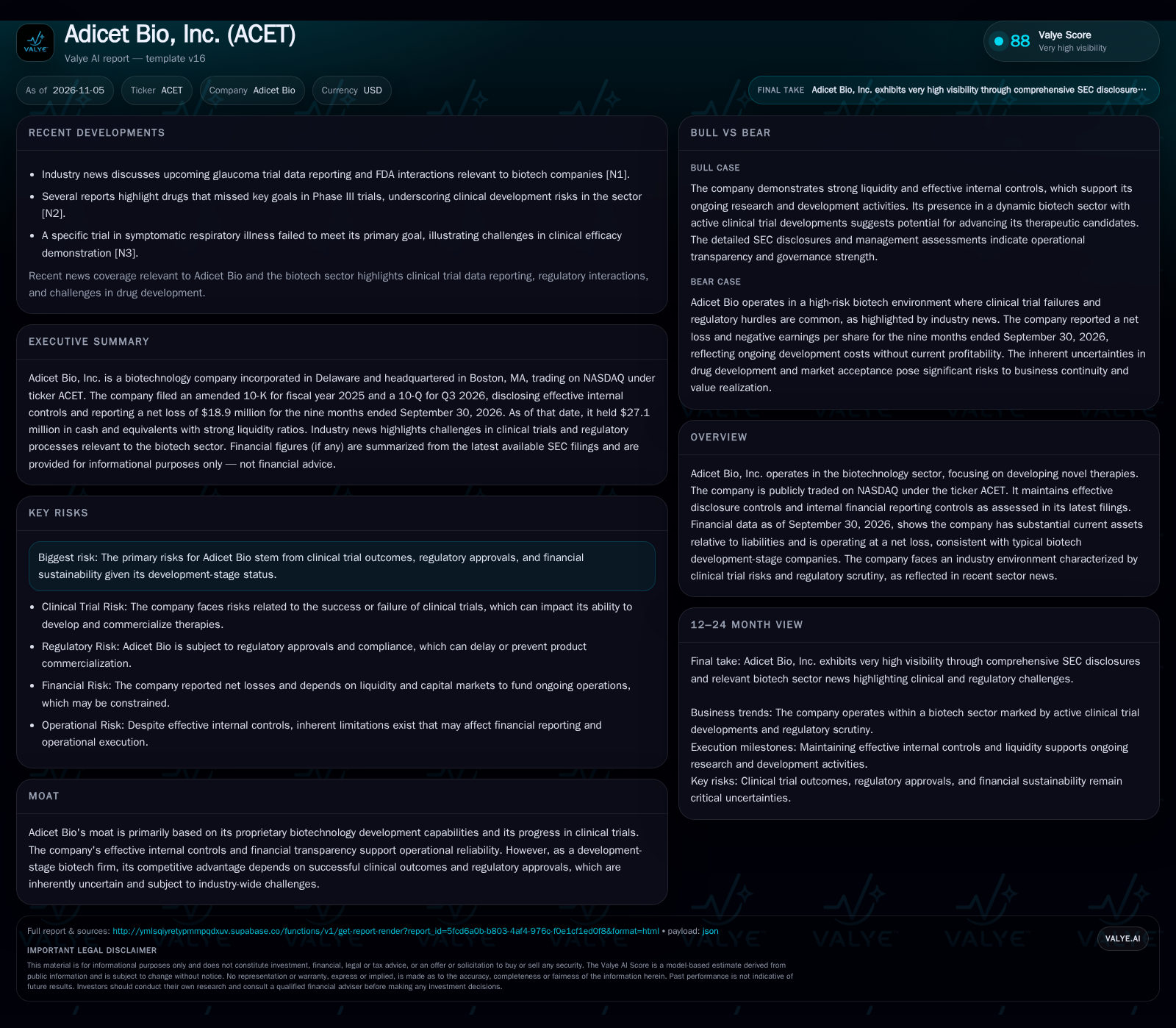
However, the company’s net losses and reliance on future clinical and regulatory success highlight the continued risks common to development-stage biotechs. Sustainable value creation will depend on clinical trial outcomes, regulatory progress, and access to capital markets.
Ultimately, Adicet Bio’s trajectory will be shaped less by its present balance sheet than by its ability to achieve clinical progress and secure additional funding as it moves therapies through the pipeline.
Recent Financial Position and Governance Set the Stage for Next-Phase Execution
As of September 30, 2026, Adicet Bio reported $27.1 million in cash and equivalents, current assets totaling $103.4 million, and current liabilities of $17.0 million, resulting in a current ratio of 6.09 and a cash ratio of 1.6 [S2]. The company reported cash and liquidity metrics for the period; these figures do not by themselves establish operating runway, investment capacity, financial flexibility, or financing capacity. The company posted a net loss of $18.9 million for the nine months ended September 30, 2026, translating to a basic and diluted EPS of -$1.76 per share [S2]. Governance disclosures indicate management assessed both disclosure controls and internal controls over financial reporting as effective at year-end 2025, with no material changes other than a previously disclosed remediation plan [S1]. These facts establish a foundation of operational transparency and governance, but also highlight the persistent cash burn and need for future capital typical of pre-commercial biotechs.
While the reported liquidity ratios suggest a strong short-term financial position, it is important to consider the qualitative aspects of cash management and capital allocation strategy. The interplay between cash burn rate and the timing of clinical milestones will critically influence the actual runway. If clinical progress accelerates, capital requirements may increase disproportionately due to larger-scale trials or manufacturing scale-up. Conversely, delays or setbacks could extend the runway but at the cost of longer periods without revenue generation.
How Adicet Bio’s Platform Could Translate R&D Spend Into Future Revenue
Adicet Bio’s primary economic engine is the development of novel biotechnological therapies, a sector where value is typically created through a high-risk, high-reward innovation cycle. At this stage, the company’s cost structure is dominated by R&D and general administrative expenses, with little to no recurring product revenue. Fixed costs are significant relative to variable costs, given the need to maintain research infrastructure and clinical trial activity regardless of short-term results. Operating leverage can be substantial if a lead asset progresses through late-stage trials and commercialization, as incremental sales can yield high margins once fixed costs are covered.
Revenue generation in biotech generally hinges on successful clinical development, regulatory approval, and subsequent commercialization—either directly or through licensing partnerships with larger pharmaceutical companies. Pricing power, if achieved, is often gated by clinical differentiation, therapeutic area, and competition from incumbent or emerging modalities.
The translation of R&D expenditures into sustainable revenue streams is contingent on the successful navigation of several sequential risk layers. Early-stage investment primarily funds discovery and preclinical validation, which inherently carry high attrition rates. As candidates advance, the cost per incremental data point rises substantially, emphasizing the importance of efficient trial design and patient recruitment strategies to optimize resource deployment. Furthermore, the eventual revenue model may depend on diverse pathways including direct commercialization, strategic partnerships, or milestone-based licensing, each with distinct margin profiles and capital intensity. The scalability of manufacturing processes and supply chain robustness will also materially affect unit economics once products reach the market.
Differentiation in a Crowded Biotech Landscape: Platform, Partnerships, and Execution
Adicet Bio operates in a highly competitive field, facing both established pharmaceutical giants and a broad array of innovative biotech peers. The company's potential moat stems from proprietary technology platforms and the advancement of unique therapeutic candidates, which, if clinically validated, could create barriers to entry. However, the durability of any competitive advantage depends on clinical data, intellectual property protection, and the speed of development relative to other companies targeting similar indications.
Counterforces are substantial: first-mover advantages can be eroded by rapid innovation cycles, and the threat of technological substitution looms large as new modalities (such as gene editing or next-generation cell therapies) emerge. Strategic partnerships or licensing deals with larger players may be critical for scaling commercialization or accessing broader distribution. Ultimately, Adicet Bio’s competitive position will be defined by its ability to deliver differentiated clinical outcomes and to execute on business development in a dynamic, risk-heavy sector.
In assessing competitive positioning, the durability of intellectual property rights and freedom to operate are critical factors that influence long-term value capture. Even with a differentiated platform, the risk of patent challenges or emerging alternative technologies can erode exclusivity and pricing power. Additionally, the speed and agility of clinical development relative to peers can create temporal advantages or disadvantages that affect market entry timing. The ability to forge and maintain strategic alliances, especially with established pharmaceutical firms, can provide not only capital but also access to commercialization expertise and established distribution networks, which are often decisive in crowded therapeutic landscapes. Operational execution, including regulatory strategy and manufacturing scale-up, further compounds competitive differentiation.
Clinical Milestones and Strategic Partnerships Could Unlock Nonlinear Value
The most favorable scenario for Adicet Bio involves successful advancement of its lead candidates through key clinical milestones, resulting in compelling efficacy and safety data that attract regulatory attention and potential industry partners. Positive trial outcomes could validate the company’s technology platform, enabling lucrative licensing deals or co-development agreements with pharmaceutical majors, and potentially unlocking non-dilutive milestone payments or upfront capital.
Confirmation of this scenario would come from public disclosure of positive mid- or late-stage clinical trial results, major partnership announcements, or regulatory designations (such as Fast Track or Breakthrough Therapy status). Additional evidence would be an influx of non-dilutive funding or a significant re-rating of the company’s valuation by the market. Falsification would arise from failed clinical endpoints, regulatory setbacks, or inability to secure partnerships despite positive data.
Sustained R&D Investment with Incremental Pipeline Progress and Recurring Capital Needs
The most plausible scenario is that Adicet Bio continues to invest in its development pipeline, achieving incremental clinical progress but without a near-term breakthrough or major partnership.
Evidence supporting this scenario would include continued net losses, gradual advancement of clinical programs through early- to mid-stage trials, and periodic capital raises or at-the-market offerings. Falsification would occur if the company either exhausts its cash without securing additional funding or achieves a major clinical or commercial breakthrough sooner than anticipated.
Clinical Setbacks or Financing Constraints Could Force Strategic Retrenchment
The adverse scenario involves clinical failures, regulatory setbacks, or an inability to access additional capital, leading to a potential halt or scaling back of operations. Given the company’s current net loss and cash burn, a series of negative trial results or a tightening of capital markets could precipitate difficult cost-cutting decisions, program discontinuations, or even consideration of strategic alternatives such as asset sales or mergers.
Confirmation of this scenario would come from public announcements of failed trials, negative regulatory feedback, missed clinical milestones, or warnings regarding going-concern risks. Falsification would be indicated by successful capital raises, positive clinical updates, or new partnership deals that extend the company’s runway.
Milestones That Will Determine If Adicet Bio’s Platform Can Deliver Lasting Value
Updates on the progress and results of lead clinical trials, especially any public disclosure of efficacy or safety data.
Announcements of new strategic partnerships, licensing agreements, or major non-dilutive funding events.
Changes in cash and equivalents balance and disclosed runway, particularly following any financing activity.
Regulatory developments such as FDA designations, feedback on submissions, or advancement to next trial phases.
If disclosed, pipeline prioritization decisions or program discontinuations that signal resource allocation shifts.
Evidence of successful equity or debt raises, or at-the-market offerings, to extend operational runway.
Public statements regarding anticipated timelines for key clinical or regulatory milestones.
If disclosed, updates on intellectual property positions or competitive landscape shifts that could affect long-term differentiation.
Disclaimer: This is research-only, informational analysis and not investment advice. It may include AI-generated interpretation and general industry context. Always verify important details using primary sources.

Comments