
Zeta Network Group: Mining Ambitions, Structural Headwinds, and the Stakes of Diversification
Zeta Network Group’s pivot into large-scale cryptocurrency mining and AI-driven entertainment brings capital intensity, operational risk, and exposure to digital asset volatility.
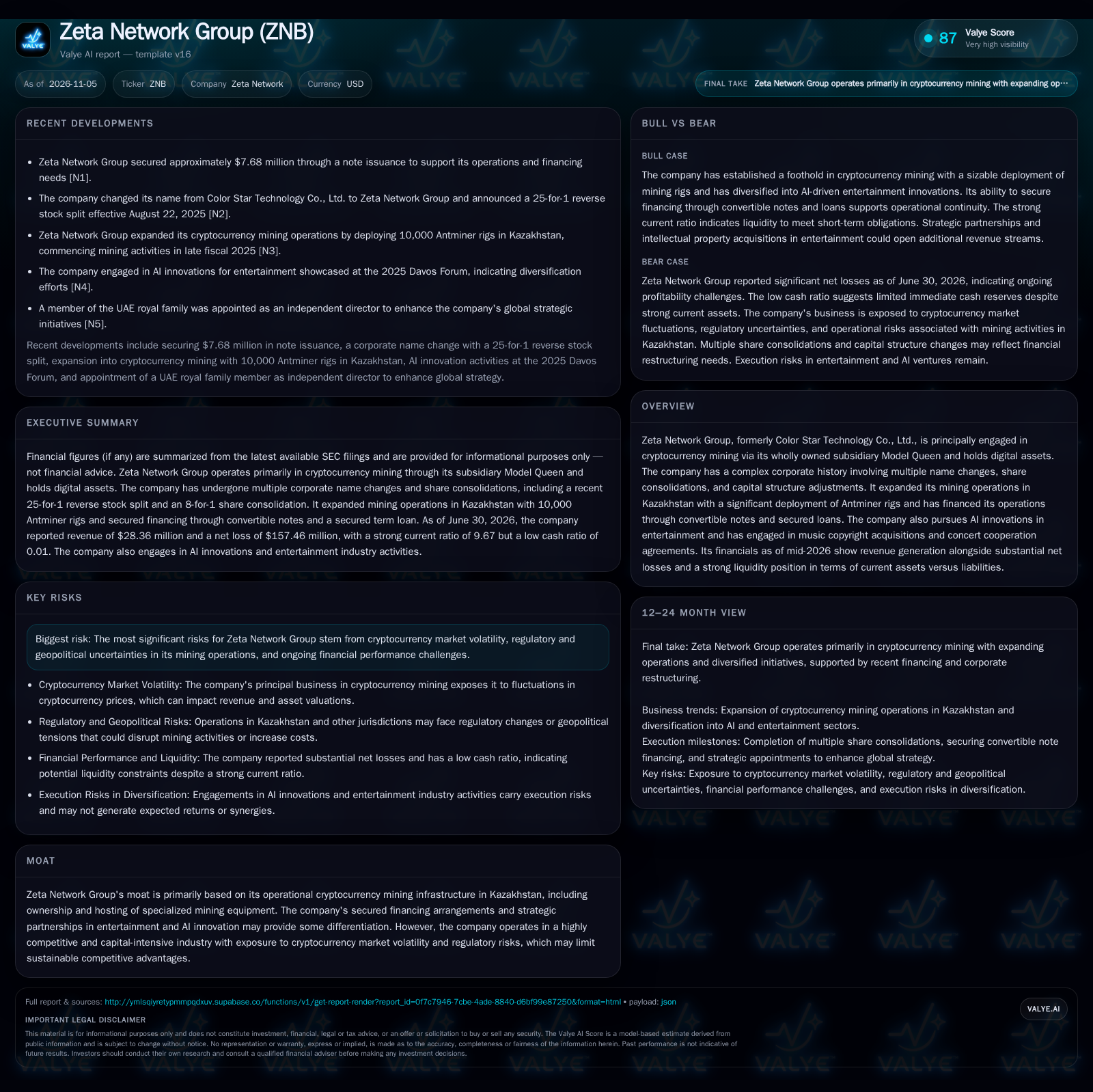
Zeta Network Group has rapidly expanded its cryptocurrency mining operations with 10,000 Antminer rigs in Kazakhstan, financed through convertible notes and a secured term loan, but continues to report substantial losses and a reported cash ratio. The company’s complex capital structure, repeated share consolidations, and foray into AI entertainment underscore a high-risk, high-reward profile. Execution in mining and diversification will determine whether Zeta can convert its asset base and partnerships into sustainable profitability. [S1] [S2] [N2]
Zeta Network Group’s transformation from Color Star Technology into a cryptocurrency mining and digital asset holding company has been marked by ambitious infrastructure expansion and aggressive financial restructuring.With 10,000 Antminer rigs deployed in Kazakhstan and a series of capital raises, Zeta has built scale in mining, but the economics remain daunting: losses dwarf revenue, and immediate cash reserves are razor-thin despite a reported current ratio. The company’s push into AI entertainment further complicates the risk-reward equation. Investors must weigh the potential for operational leverage and asset monetization against the structural headwinds of volatility, regulatory uncertainty, and persistent financial losses. [S1] [S2] [N2]
Recent Expansion, Financial Restructuring, and Persistent Losses: The Current Landscape
Zeta Network Group reported $28.36 million in revenue and a net loss of $157.46 million for the period ending June 30, 2026. This stark loss, with basic and diluted EPS of -$927.59 per share, points to underlying cost pressures or asset write-downs that are not offset by top-line growth. [S1]
The company has completed two major share consolidations within a year—a 25-for-1 reverse split in August 2025 and an 8-for-1 consolidation in July 2026—reflecting ongoing efforts to stabilize the share base, comply with listing requirements, or support new capital infusions. [N2] [S2]
Operationally, Zeta’s primary business is cryptocurrency mining, now anchored by 10,000 Antminer rigs in Kazakhstan. This mining fleet was financed through a mix of cash, restricted shares, and a $31.6 million secured term loan, which matures in July 2028. [S1] [S2]
Despite a current ratio of 9.67, the company’s cash ratio is 0.01, indicating that nearly all current assets are tied up in non-cash forms—such as digital assets, receivables, or inventory—rather than liquid cash. [S1]
Mining Economics, Funding Structure, and the Challenge of Turning Scale into Profits
Zeta’s core revenue engine is cryptocurrency mining, a business with high fixed costs (equipment, hosting, electricity) and variable revenue largely determined by crypto prices, network difficulty, and mining efficiency. The deployment of 10,000 Antminer rigs suggests significant hashpower, but also a substantial capital outlay and ongoing operating expense.
The $31.6 million secured term loan—restructured from a mining equipment purchase agreement—adds a fixed interest burden (5% through July 2028) and introduces quarterly repayment requirements. This, combined with convertible notes ($7.68 million issued in December 2024) and multiple equity offerings, means Zeta’s cost of capital is layered and potentially dilutive.
The mismatch between reported revenue and net losses may reflect a combination of high depreciation (mining rigs have short useful lives), electricity/hosting costs in Kazakhstan, and possibly digital asset impairments. If digital assets are not readily liquid or are marked down during crypto downturns, reported asset values may not translate into cash flow.
AI entertainment and music copyright acquisitions represent potential new revenue streams, but their contribution is not yet material. Such ventures can require substantial up-front investment and may have long gestation periods before becoming cash generative.
Navigating a Crowded Mining Space and the Uncertainties of Entertainment Diversification
In cryptocurrency mining, Zeta competes against global players with larger scale, more efficient energy sources, and often vertically integrated operations. The hosting arrangement in Kazakhstan may offer competitive electricity pricing but could expose Zeta to geopolitical and regulatory risks that larger, more diversified miners can better absorb.
Mining equipment (Antminer rigs) is largely commoditized, making cost of power, operational uptime, and access to capital the most significant differentiators. Zeta’s ability to secure financing and structure hosting agreements is a positive, but does not by itself confer a lasting moat.
The company’s move into AI-powered entertainment and music rights pits it against both established tech firms and a fragmented landscape of music and digital content owners. Without evidence of proprietary technology, exclusive content, or unique distribution channels, Zeta’s entertainment diversification is more likely to be a complement than a core competitive advantage at this stage.
The dual-class share structure may help management pursue long-term strategies without immediate market pressure, but can also deter some institutional investors and complicate future capital raises.
If Crypto Cycles Turn Favorable and Entertainment Bets Pay Off
A plausible bull case for Zeta hinges on a sustained rally in cryptocurrency prices, which would sharply increase mining revenue and potentially revalue the company’s digital asset holdings. If mining operations run near full uptime and energy costs remain stable or decrease, operating leverage could swing the bottom line toward profitability even at current scale.
Successful execution in AI entertainment—such as commercializing new IP, monetizing concert partnerships, or leveraging AI for content creation—could diversify revenue and reduce dependence on crypto cycles. Early evidence would include disclosed licensing deals, recurring digital content sales, or partnerships with recognized industry players.
Confirmation of this scenario would come from a narrowing of net losses, positive operating cash flow, and disclosures of material entertainment-related revenue. Sustained or increased mining output, coupled with rising crypto prices, would also support the bull case.
Falsification would be signaled by continued steep losses despite rising crypto prices, operational disruptions in Kazakhstan, or entertainment ventures failing to generate material sales.
Structural Losses Persist, with Periodic Capital Raises and Incremental Diversification
The most likely outcome is that Zeta continues to operate at scale in cryptocurrency mining, posting periodic revenue gains during favorable crypto cycles but struggling to offset high fixed costs, depreciation, and financing expenses. Net losses remain substantial unless there is either a step-change in crypto prices or a meaningful reduction in cost structure.
Entertainment and AI diversification remain early-stage, with incremental progress but no immediate impact on the company’s financial trajectory. Occasional capital raises (convertible notes, equity offerings) are used to fund ongoing operations and service debt, leading to further dilution.
This scenario would be confirmed by stable or slightly rising revenue, persistent net losses, and regular financing activity. Absence of material entertainment revenue or further share consolidations would reinforce the view that core profitability remains elusive.
Falsification would require either a rapid improvement in the bottom line (suggesting operational leverage or cost discipline) or clear, recurring revenue from new business lines.
Pressure from Cash Burn, Market Volatility, and Regulatory Disruptions
In a negative scenario, crypto prices decline or remain volatile, compressing mining margins and forcing Zeta to sell digital assets at a loss or take further impairments. High fixed costs and debt service obligations exacerbate negative cash flow, exhausting non-cash current assets and forcing distressed financings or asset sales.
Operational risks in Kazakhstan—such as regulatory crackdowns, energy shortages, or geopolitical instability—could disrupt mining operations or increase hosting costs, further eroding profitability.
Entertainment and AI ventures fail to scale, consuming management bandwidth and capital without yielding significant revenue. Shareholder dilution accelerates with additional equity offerings or unfavorable debt terms.
Confirmation would come from further share consolidations, deepening net losses, asset write-downs, or disclosures of operational interruptions in mining. Missed debt repayments or going concern warnings would signal acute financial distress.
Testing the Zeta Thesis: Operational, Financial, and Strategic Markers to Track
Mining output (total hash rate, mined coins, uptime) and realized pricing, if disclosed, would directly indicate whether scale is translating into revenue and margin improvement.
Quarterly changes in digital asset holdings and their valuation would help assess exposure to crypto price swings and potential impairment risk.
Operating cash flow and free cash flow metrics, if provided, would clarify whether reported assets are generating sustainable liquidity versus accounting-only gains.
Updates on the Kazakhstan hosting agreement—such as changes in power costs, regulatory challenges, or operational disruptions—would signal risk to mining continuity.
Disclosures of new entertainment or AI partnerships, licensing deals, or recurring digital content revenue would help validate the diversification strategy.
Announced or completed capital raises (equity, debt, convertible notes) and changes in share count would indicate ongoing funding needs and potential dilution.
Evidence of cost discipline or restructuring—such as reductions in SG&A, improved asset utilization, or renegotiated debt terms—would support a path toward profitability.
Disclaimer: This is research-only, informational analysis and not investment advice. It may include AI-generated interpretation and general industry context. Always verify important details using primary sources.

Comments