
Rainmaker Worldwide: Exclusive U.S. Distribution Rights Amid Severe Liquidity Stress in Decentralized Water Solutions
Rainmaker Worldwide Inc.
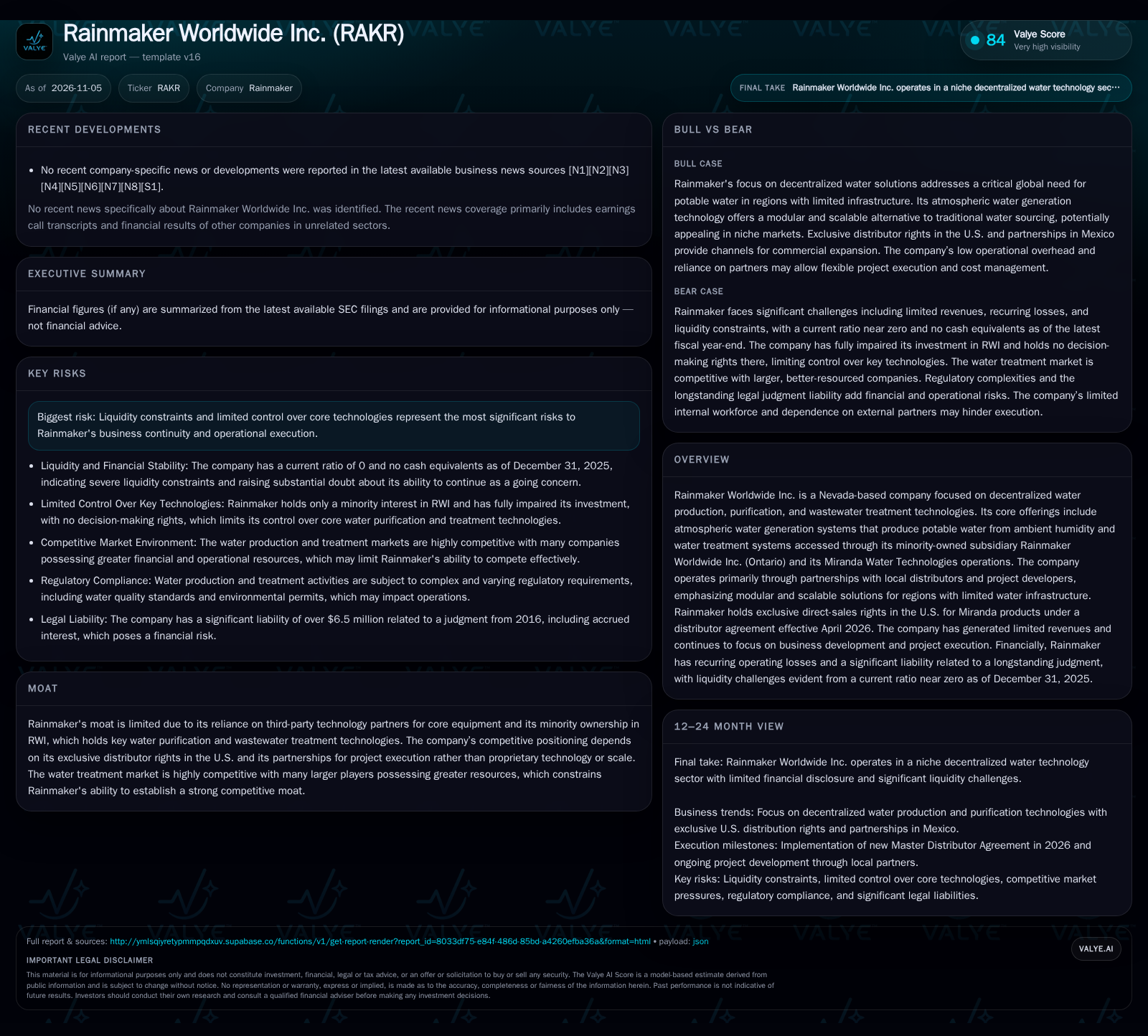
Rainmaker Worldwide Inc. is focused on modular, decentralized water production and purification systems, recently securing exclusive U.S. distributor rights for Miranda Water Technologies products. However, ongoing operating losses, a current ratio of zero, no cash as of year-end 2025, and a large outstanding legal judgment create substantial doubt about its ability to operate as a going concern. The company's minority stake in its primary technology partner further limits strategic flexibility and margin capture, while execution relies on external partners in highly competitive, capital-intensive markets. [S1]
Rainmaker Worldwide Inc. is attempting to carve a niche in the decentralized water production and treatment sector by leveraging modular atmospheric water generation (AWG) technology and exclusive U.S. distribution rights for Miranda Water Technologies. With a current ratio of zero, no cash on hand, and a significant unresolved legal liability, Rainmaker's operational future hinges on its ability to convert distribution agreements and local partnerships into actual, cash-generating deployments—an outcome far from assured in a capital- and execution-intensive market. [S1]
Exclusive Distribution Rights and Financial Distress Define Present Reality
Rainmaker Worldwide Inc. secured exclusive direct-sales rights in the U.S. for Miranda Water Technologies products via a Master Distributor Agreement effective April 30, 2026. This provides a clear commercial pathway in the U.S. market, a significant milestone for a company with a history of limited revenue generation. However, the company ended 2025 with current assets of just $53, current liabilities exceeding $13.3 million, and zero cash or cash equivalents. Its current ratio is effectively zero, and Rainmaker remains encumbered by a $6.5 million liability from a longstanding legal judgment. Net losses for 2025 totaled $1.3 million. [S1]
Modular Water Solutions: Asset-Light Model with Structural Margin Constraints
Rainmaker’s business model centers on distributing decentralized atmospheric water generation (AWG) and water treatment systems, designed for modular deployment in areas lacking robust water infrastructure. The company does not manufacture its own equipment; instead, it relies on technology partners such as Miranda Water Technologies (RWI), in which it holds only a minority stake. This structure reduces capital intensity but also limits Rainmaker’s margin capture and control over product development, pricing, and supply chain reliability.
Revenue is likely realized through equipment sales, commissions, or distributor margins, with installation, operation, and maintenance handled by local partners or end customers. This model allows for scalability in theory but exposes Rainmaker to execution risk, as its income depends on third-party project development cycles and the ability of partners to finance and complete deployments. The asset-light approach reduces fixed costs but makes it difficult to generate operating leverage without significant volume growth. With limited internal workforce and recurring operating losses, the company faces a persistent funding gap that could only be bridged by external capital infusions or a dramatic uptick in sales—neither of which is assured given current balance-sheet realities. [S1]
Limited Moat in a Crowded, Capital-Intensive Water Technology Landscape
Rainmaker operates in a highly competitive water production and treatment market, where many established players possess far greater financial, technological, and operational resources. Its main differentiator is the exclusive U.S. distributor agreement with Miranda Water Technologies, but this advantage is circumscribed by contract limitations—other distributors may also operate in the same territory. The company’s reliance on third-party technology, with no proprietary manufacturing or significant intellectual property, sharply limits its ability to build a durable moat.
Competitors in decentralized water solutions typically compete on cost, energy efficiency, regulatory compliance, and the ability to finance and execute large-scale projects. Rainmaker’s modular, scalable systems could appeal to niche markets or regions with acute water scarcity, but its lack of direct manufacturing, limited technology control, and dependence on external partners for both product and project execution constrain its ability to outcompete larger, vertically integrated rivals. The company’s minority interest in RWI further weakens its strategic position, as it cannot dictate technology development or supply chain priorities. [S1]
Unlocking Commercial Scale Through Strategic Partnerships and Niche Deployments
A favorable outcome for Rainmaker would require rapid conversion of its exclusive U.S. distribution rights into revenue-generating deployments, particularly in regions where traditional water infrastructure is lacking or unreliable. If the company can leverage its modular AWG and water purification technologies to secure contracts with municipalities, NGOs, or private developers—especially in water-stressed environments—it could demonstrate the commercial viability of its asset-light model.
Success would likely hinge on Rainmaker’s ability to attract external financing or strategic partners willing to fund initial deployments, allowing the company to overcome its acute liquidity constraints. Evidence confirming this scenario would include: announcements of sizable orders or pilot projects in the U.S., third-party financing or investment partnerships, and a reversal of negative operating cash flow. Falsification would come from continued absence of meaningful revenue, failure to secure new contracts, or inability to demonstrate project execution at scale.
Operational Survival Hinges on Incremental Project Wins and Bridge Financing
The most plausible near-term trajectory is one of incremental, project-by-project progress, with Rainmaker attempting to secure small-scale deployments through its new U.S. distribution rights and existing Mexican partnerships. Revenue growth, if any, is likely to be modest and inconsistent, given the company’s lack of internal resources and the need to rely on partners for project development and financing.
Sustained operating losses and negative cash flow are likely to persist absent an external capital infusion or a material uptick in sales. Business continuity will depend on Rainmaker’s ability to negotiate bridge financing, restructure liabilities, or attract new equity investment. Confirmation of this scenario would be small contract wins, continued disclosures of working capital shortfalls, and further reliance on consulting agreements or external service providers. Falsification would occur if the company failed to announce any new projects or if liquidity constraints forced suspension of operations.
Liquidity Shock, Legal Risks, and Loss of Technology Access Could Force Dissolution
A negative scenario could unfold if Rainmaker is unable to secure bridge financing or new investment, leading to an acute liquidity crisis that renders it incapable of meeting immediate obligations. The unresolved $6.5 million legal judgment poses a material risk of enforcement action, which could further deplete resources or trigger bankruptcy proceedings.
If Rainmaker’s minority ownership and lack of decision-making rights in RWI result in loss of access to key technologies—either through contract termination or partner restructuring—the company could lose its core value proposition. Confirmation of this downside would be explicit disclosures of default, legal enforcement actions, or loss of distribution rights. Falsification would require clear evidence of new funding, liability resolution, or protected access to technology platforms.
Milestones That Will Determine Rainmaker's Viability in the Decentralized Water Market
Announcement and execution of initial U.S.-based deployments under the Miranda Master Distributor Agreement—size, customer type, and revenue impact would help test the commercial ramp.
Resolution, settlement, or restructuring of the $6.5 million legal judgment, as this liability materially impacts solvency.
Evidence of expanded or renewed technology access agreements with Miranda/RWI or new technology partners, especially in light of Rainmaker’s minority stake.
Updates on revenue generation, especially recurring or multi-project contracts, which would validate the asset-light distribution model.
Any change in the terms or exclusivity of the U.S. distribution agreement, which could affect competitive positioning.
A useful metric would be the pipeline of committed projects (if disclosed), as this would indicate revenue visibility and execution momentum.
Disclosure of operating cash flow trends or working capital improvements, which would help assess ongoing business viability.
Disclaimer: This is research-only, informational analysis and not investment advice. It may include AI-generated interpretation and general industry context. Always verify important details using primary sources.

Comments