
Vaxart’s Oral Vaccine Ambitions: R&D Investment, Government Funding, and Commercialization Prospects
Vaxart, Inc. continues to advance its oral vaccine platform, reporting $10.62 million in quarterly revenue—mostly from government contracts—while absorbing substantial R&D expenses and operating losses.
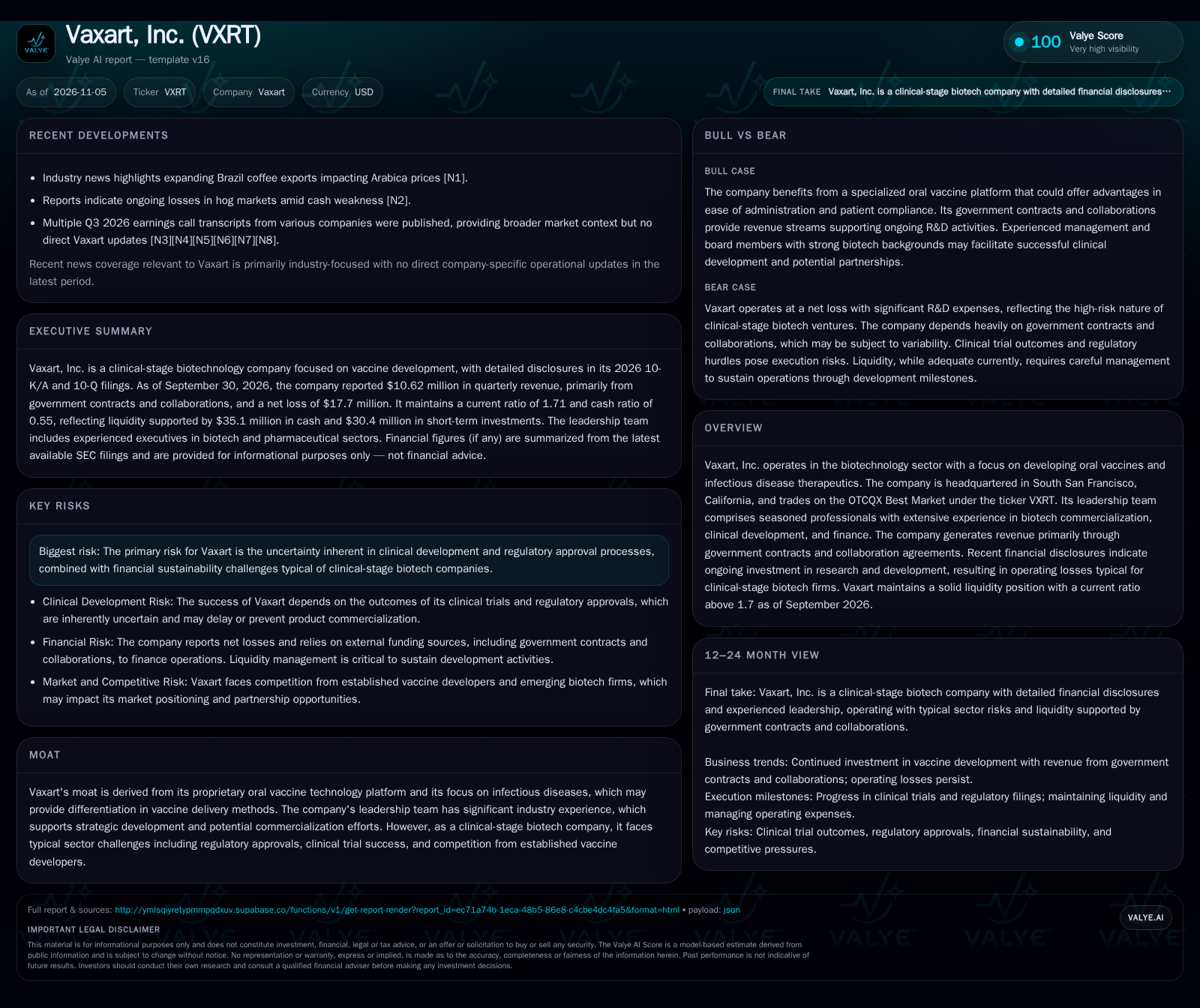
Vaxart remains a clinical-stage biotech focused on oral vaccines, with Q3 2026 revenue of $10.62 million driven by government and collaboration deals. The company’s trajectory depends on clinical milestones, continued external funding, and differentiation in a crowded vaccine market. [S2]
Vaxart, Inc. is pressing forward with its oral vaccine technology, leveraging government contracts and collaborations to fund ongoing research and development. The company’s Q3 2026 results reflect the classic clinical-stage biotech profile: meaningful external revenue, high R&D spend, and a net loss. The company’s differentiation in oral vaccine delivery may offer strategic advantages, but execution and funding risks remain central.
Recent Financial Results Reflect Heavy Dependence on External Funding and R&D Commitments
For the quarter ended September 30, 2026, Vaxart reported total revenue of $10.62 million, with $7.55 million sourced from government contracts and $2.92 million from collaborations. These external sources remain the lifeblood of the company's operating model at this stage. Operating expenses reached $27.9 million, of which $22.8 million was allocated to research and development—a clear signal that the company is still investing heavily in its pipeline. The resulting net loss of $17.7 million is consistent with the sector norm for clinical-stage biotech firms. As of September 30, Vaxart held $35.1 million in cash and $30.4 million in short-term investments, with a current ratio of 1.71. The company reported cash and liquidity metrics for the period; these figures do not by themselves establish operating runway, investment capacity, financial flexibility, or financing capacity. [S2]
Economics of Oral Vaccine Platform: Balancing Scale Opportunities with Fixed Cost Challenges
Vaxart’s business model is predicated on developing and commercializing oral vaccines, which—if successful—could offer meaningful advantages in distribution, patient compliance, and potentially manufacturing costs compared to injectable alternatives. However, as a clinical-stage company, its current economics are dominated by fixed R&D and administrative expenses, with minimal product revenue. The company’s reported revenue comes primarily from government contracts and collaborations, which are typically milestone- or cost-reimbursement based and may not be recurring or predictable.
Should any of Vaxart’s candidates achieve regulatory approval, the economics could shift rapidly: oral administration could enable broader access and lower logistical costs, potentially supporting higher gross margins and rapid volume adoption. However, this scenario is contingent on successful clinical outcomes and market acceptance. Until then, the company’s cash burn rate and dependence on external funding remain defining features. Capital needs are likely to persist, particularly for late-stage trials and potential scale-up for manufacturing and distribution.
Beyond the immediate cost structure, the scalability of oral vaccine production introduces nuanced economic considerations. Manufacturing oral vaccines at commercial scale may involve different capital expenditures and operational complexities compared to traditional injectables, including formulation stability, delivery device integration, and quality control specific to mucosal immunization. These factors could influence the fixed versus variable cost balance over time, potentially enabling economies of scale if the platform gains broad adoption. However, initial scale-up risks and validation requirements may delay cost reductions, requiring sustained investment before margin expansion becomes feasible.
From a market dynamics perspective, oral vaccines may open new distribution channels and reduce dependency on healthcare professional administration, which could reshape downstream cost structures and payer models. If oral vaccines facilitate self-administration or mass vaccination campaigns with lower logistical overhead, payers might reassess reimbursement frameworks, impacting pricing strategies and revenue potential. However, this assumes regulatory acceptance and payer willingness to adapt, which are contingent on demonstrated efficacy, safety, and comparative effectiveness versus established injectable vaccines. The interplay between clinical outcomes and health economics will thus be critical in determining the platform’s commercial viability.
Vaxart’s Delivery Approach Confronts Established Competitors and Regulatory Hurdles
Vaxart’s core differentiation lies in its proprietary oral vaccine technology, which could address key pain points in traditional vaccine delivery—such as the need for cold-chain logistics and needle administration. If proven, this could reduce barriers to mass immunization, particularly in resource-limited settings.
However, the vaccine market is crowded, with established pharmaceutical giants, emerging biotech firms, and academic partnerships all competing for regulatory approvals and commercial share. Many competitors benefit from robust pipelines, global distribution networks, and established payer relationships. In addition, regulatory agencies may require more extensive data to approve novel delivery mechanisms, potentially slowing time to market. The company’s reliance on government and partner funding also puts it at a disadvantage compared to well-capitalized peers who can self-fund late-stage trials and commercialization.
Regulatory acceptance of novel vaccine delivery methods often entails heightened scrutiny, requiring comprehensive data on immunogenicity, safety, and real-world effectiveness. Vaxart’s oral platform will need to address potential concerns about mucosal immune response durability and consistency across diverse populations. Additionally, the company must anticipate evolving regulatory standards that may differ across global markets, impacting the timing and cost of approvals. Competitors with injectable vaccines benefit from well-established regulatory pathways, which may accelerate their market entry and entrenchment, posing a timing and market share risk for oral vaccine developers.
Moreover, the competitive landscape includes not only direct vaccine developers but also alternative prophylactic technologies such as monoclonal antibodies and next-generation adjuvants, which vie for similar indications and funding. Vaxart’s ability to differentiate on convenience and cost must be balanced against these alternatives’ clinical benefits and market traction. Strategic partnerships or licensing agreements could mitigate some competitive disadvantages by leveraging established commercial infrastructure, but securing such alliances depends on demonstrable clinical advantages and intellectual property strength. The company’s positioning will thus require careful navigation of both scientific validation and business development dynamics.
Clinical Breakthroughs and New Partnerships May Trigger Funding and Valuation Growth
A favorable scenario for Vaxart would involve one or more of its oral vaccine candidates demonstrating clear clinical superiority or unique population health benefits in pivotal trials. This could attract additional government contracts, non-dilutive grants, or major pharmaceutical partnerships, providing both funding and commercial validation.
Confirmation of this scenario would come from positive topline clinical trial data, regulatory fast-track designations, and the announcement of new or expanded government and commercial agreements. In this context, Vaxart could see an accelerated path to market, improved negotiating leverage, and the potential for premium pricing or broad adoption—especially if its oral delivery technology is shown to materially lower costs or improve uptake.
Ongoing R&D Advances Coupled with Intermittent Funding Extend Commercialization Timeline
The most plausible trajectory for Vaxart is a continuation of incremental R&D progress, punctuated by periodic government and collaboration funding. This would support ongoing clinical trials and platform development but likely entail sustained operating losses and recurring capital raises.
Evidence supporting this scenario would include steady (but not breakout) clinical progress, renewal or extension of existing contracts, and stable expense levels. Falsification would be signaled by a significant positive or negative inflection in trial outcomes, a major partnership announcement, or a sudden drop-off in external funding. In this middle path, Vaxart remains a high-risk, high-upside clinical-stage biotech with its valuation and liquidity tightly tethered to milestone execution and capital market conditions.
Negative Clinical Outcomes or Funding Gaps Could Lead to Restructuring or Alternative Strategies
A negative turn could arise if Vaxart’s lead programs experience clinical setbacks, regulatory delays, or safety concerns, eroding confidence among government and private funders. Given the company’s reliance on external funding, any disruption in contract renewals or grant awards could rapidly deplete its liquidity, particularly if paired with persistent operating losses.
Evidence supporting this scenario would include disappointing clinical trial results, failure to secure new contracts or partnerships, rapid cash burn without replenishment, or management signaling a review of strategic alternatives. In this case, the company could be forced to scale back R&D, pursue asset sales, or seek a merger or acquisition under distressed terms.
Upcoming Milestones and External Events Will Influence Vaxart’s Vaccine Platform Development
Progress and readouts from ongoing and planned clinical trials, especially for lead oral vaccine candidates, would help validate the platform’s potential.
The announcement of new or renewed government contracts, grants, or collaboration agreements would signal continued external funding support.
Trends in quarterly R&D spending and operating expenses may indicate management’s capital discipline and the pace of development.
Disclosures or commentary on cash runway and planned capital raises would help assess financial sustainability through key milestones.
Regulatory feedback, including fast-track designations, approvals, or requests for additional data, would clarify development timelines and commercial prospects.
Evidence of expanded pharmaceutical partnerships or licensing deals would provide third-party validation and potential non-dilutive funding.
A useful metric would be the timing and terms of any future equity or debt financings, as these will affect dilution and long-term viability.
Updates, if disclosed, on manufacturing readiness or commercialization planning would help test the company’s preparedness for a potential product launch.
Disclaimer: This is research-only, informational analysis and not investment advice. It may include AI-generated interpretation and general industry context. Always verify important details using primary sources.

Comments