
Kura Sushi USA: Automation Ambitions, Structural Costs, and the Stakes of Operational Resilience
Kura Sushi USA’s technology-forward dining model differentiates its customer experience but exposes the business to unique operational and financial risks. Recent earnings volatility, persistent net losses, and the demands of long-term leases underscore the importance of execution in automation reliability, labor management, and regulatory compliance.
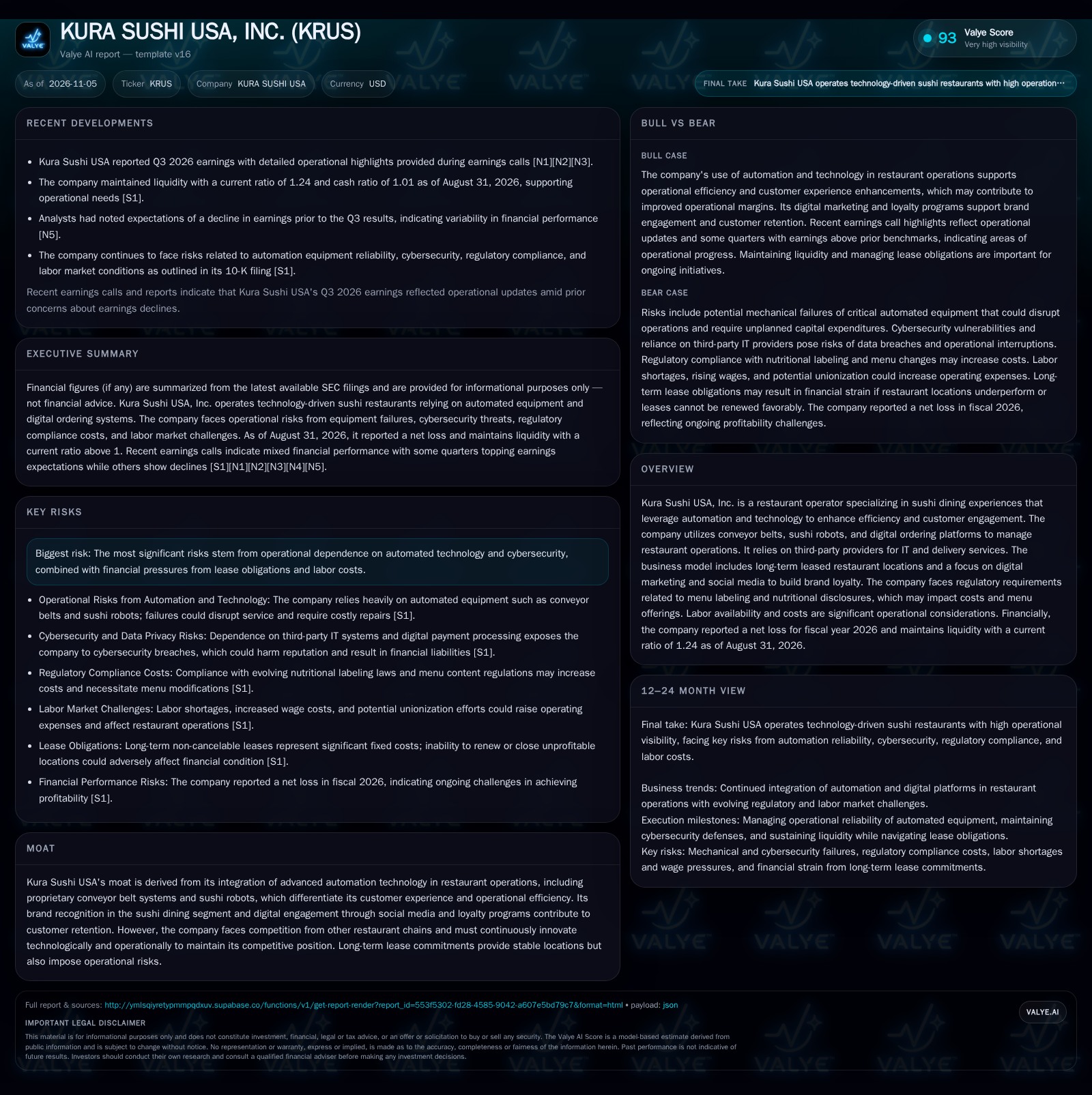
Kura Sushi USA leverages automation to drive operational efficiency and brand distinction, but net losses in FY26, persistent fixed lease expenses, and operational risks from technology and labor highlight thin margins for error. Execution in automation uptime, labor cost control, and regulatory adaptation will shape future profitability and growth potential. [S1] [N1] [N2] [N3] [N4] [N5]
Kura Sushi USA stands out for its deep integration of automation in the dining experience, using robotics and conveyor systems to deliver sushi with efficiency and novelty. However, the company’s model brings a double edge: while automation can control variable costs and enhance customer appeal, it also creates exposure to mechanical failures, high fixed lease obligations, and complex labor dynamics. The company’s future hinges on its ability to sustain automation uptime, manage labor and regulatory burdens, and translate operational innovation into consistent profitability.
Recent Financial Performance and Operational Leverage in Focus
Kura Sushi USA reported a net loss of $4.645 million for the fiscal year ending August 31, 2026, with basic and diluted EPS of -$0.38, underscoring ongoing profitability challenges [S1]. Despite this, the company’s Q3 2026 earnings topped analyst estimates, reflecting operational improvements or cost controls in that period, though earnings volatility remains pronounced [N1] [N2] [N3] [N4] [N5]. The company reported cash and liquidity metrics for the period; these figures do not by themselves establish operating runway, investment capacity, financial flexibility, or financing capacity. [S1] The reliance on technology-driven operations and long-term, non-cancelable leases further amplifies both upside potential and downside risk, making execution in automation and cost management central to the thesis.
Automation-Driven Model: Efficiency Gains Versus Fixed-Cost Drag
Kura Sushi USA’s economics are shaped by its heavy investment in restaurant automation—sushi robots, conveyor belts, and digital ordering systems—designed to reduce labor intensity and enhance throughput. If automation delivers consistent uptime, the model could enable higher table turns, lower labor cost per cover, and differentiated customer experiences. However, these benefits are counterbalanced by substantial fixed costs, particularly from long-term, non-cancelable leases and capital outlays for automated equipment. The company’s labor cost exposure remains material, as automation does not fully eliminate the need for skilled back-of-house and service staff, and labor shortages or wage inflation could erode margins. Variable costs include ingredients, utilities, and ongoing maintenance of complex machinery, while regulatory compliance with nutritional labeling and menu disclosures adds a further layer of cost and complexity. Operating leverage is high: incremental sales can drive margin expansion if cost structures are controlled, but underperformance can rapidly translate into losses given the fixed-cost base.
The capital intensity inherent in Kura Sushi USA’s automation-driven model also introduces a nuanced risk-reward dynamic. While upfront investments in robotics and conveyor systems can reduce variable labor costs, the depreciation and maintenance expenses associated with such equipment add a persistent fixed-cost burden. This dynamic means that the company’s break-even sales volume is higher than in more labor-reliant restaurant models. Furthermore, the scalability of automation may be constrained by the physical and technological complexity of installations, potentially limiting rapid geographic expansion or adaptation to local market preferences. Consequently, the company must carefully balance capital expenditure pacing with market demand to avoid overextension or underutilization of assets.
From a cost structure perspective, automation can shift the company’s expense profile toward greater fixed costs and lower variable costs, increasing operating leverage. This shift implies that small fluctuations in sales volume can have amplified effects on profitability—both positively and negatively. Therefore, managing demand volatility through marketing initiatives, menu innovation, and customer experience enhancements becomes critical. Additionally, the interplay between automation and labor is complex: while automation reduces some manual tasks, it simultaneously creates demand for higher-skilled technicians and supervisors to maintain and optimize the systems. This labor composition shift may expose the company to wage inflation in specialized roles, partially offsetting automation’s cost benefits.
Technology as Differentiator—But Not a Moat Against All Comers
Kura Sushi USA’s brand is built around a highly automated, interactive dining experience, setting it apart from traditional sushi and casual dining competitors. Proprietary conveyor systems and sushi robots provide a novelty factor and potential efficiency gains, while digital ordering and social media engagement drive customer loyalty. However, these advantages are not insurmountable: other restaurant chains can adopt similar technologies, and the capital intensity of automation could limit rapid expansion or adaptation. The company also contends with a crowded competitive landscape, including traditional sushi bars, fast casual concepts, and other tech-enabled dining formats. Switching costs for customers are moderate—while the experience is unique, alternative dining options abound, and novelty may fade if automation becomes industry standard. Continuous innovation in automation, menu, and digital engagement is necessary to preserve differentiation, while operational resilience in the face of equipment failures and cybersecurity threats is essential to avoid reputation-damaging disruptions.
If Automation Reliability and Brand Engagement Drive Margin Expansion
A favorable scenario unfolds if Kura Sushi USA achieves consistently high automation uptime, controls labor and ingredient costs, and leverages digital marketing to drive strong foot traffic and repeat visits. In this outcome, operating leverage works in the company’s favor: fixed-cost absorption improves as same-store sales rise, and lower variable labor costs relative to peers expand restaurant-level margins. Robust social media engagement and loyalty program participation could further stabilize traffic and enable modest menu price increases without sacrificing volume. Evidence supporting this scenario would include sustained positive same-store sales growth, narrowing or reversing net losses, and improved restaurant-level margin disclosures (if provided). Additionally, a reduction in equipment downtime incidents, positive guest satisfaction scores, and favorable lease renegotiations would confirm that automation and brand positioning are translating into durable economic gains.
In scenarios where the company successfully integrates automation with data-driven customer insights, there is potential to unlock additional revenue streams beyond traditional dine-in sales. For example, leveraging digital ordering platforms and loyalty programs could enable personalized promotions, dynamic pricing, or targeted upselling, increasing average check sizes. Moreover, the data collected through automated systems can inform operational improvements, such as optimizing inventory management to reduce waste or adjusting staffing levels in real time to match demand patterns. These capabilities could enhance both top-line growth and cost efficiency, reinforcing the margin expansion thesis. However, realizing these benefits requires robust IT infrastructure and analytics capabilities, as well as sustained customer engagement with digital channels.
Brand engagement driven by automation novelty also depends on maintaining a high-quality customer experience. If the company can ensure minimal service disruptions and continuously refresh its technology and menu offerings, it may sustain customer interest and loyalty. This continuous innovation cycle could create a virtuous feedback loop, where positive guest experiences lead to word-of-mouth promotion and higher repeat visitation rates. However, the company must remain vigilant against complacency, as competitors adopting similar automation technologies could erode differentiation. Strategic investments in proprietary technology enhancements and exclusive digital content or experiences may be necessary to preserve a competitive edge and justify potential price premiums.
Structural Costs Keep Profitability Elusive Despite Operational Advances
The most plausible trajectory is one in which Kura Sushi USA continues to demonstrate operational improvements—periodic quarters of earnings outperformance, incremental automation upgrades, and steady customer engagement—but remains challenged by the weight of fixed lease expenses, equipment maintenance, and labor market volatility. Confirming evidence would include persistent net losses or only marginal improvement in EPS, continued reliance on leasebacked expansion, and ongoing regulatory and labor cost headwinds. Falsification would come from a clear inflection to sustained profitability, successful renegotiation of lease terms, or a structural shift in cost base that materially improves margins.
Mechanical Failures, Labor Shocks, or Regulatory Costs Trigger Margin Compression
The adverse scenario materializes if Kura Sushi USA experiences significant automation breakdowns, cybersecurity incidents, or acute labor shortages/wage spikes, leading to service disruptions, reputational harm, and unplanned capital or operating expenditures. If equipment failures increase, restaurants may face downtime or revert to higher-cost manual operations, undermining the core efficiency thesis. Simultaneously, regulatory changes (e.g., stricter menu labeling or wage mandates) could drive up compliance costs, while inflexible long-term leases limit the ability to exit underperforming locations. Evidence confirming this scenario would include a rise in reported service interruptions, significant one-time equipment repair/replacement charges, negative guest feedback, or a spike in labor/operating expenses. Prolonged net losses, liquidity drawdowns, or the closure of locations under lease pressure would further validate a downside trajectory.
Signals That Will Clarify the Automation-Driven Restaurant Thesis
Sustained improvement or deterioration in same-store sales growth would directly test whether automation and digital engagement are attracting and retaining guests.
Trends in net income and EPS—particularly a shift toward break-even or profitability—would indicate whether operational efficiency gains are outpacing fixed cost drag.
Frequency and severity of automation equipment failures (if disclosed) would provide insight into operational resilience and the risk of costly service disruptions.
Changes in labor costs as a percentage of revenue, or disclosures on wage pressures and staffing shortages, would reveal if automation is effectively mitigating labor market risks.
Updates on lease renegotiations, closures, or new site economics would clarify the flexibility and risk profile of the restaurant footprint.
Regulatory developments affecting menu labeling, nutritional disclosures, or wage requirements could materially alter the cost structure.
Metrics on loyalty program participation, digital ordering adoption, or guest satisfaction (if provided) would illuminate the sustainability of the brand’s differentiation.
Disclaimer: This is research-only, informational analysis and not investment advice. It may include AI-generated interpretation and general industry context. Always verify important details using primary sources.

Comments