
Concentra Group: Employer-Focused Health Services Scale Profitably as Occupational Care Evolves
With robust profitability and a network tailored to employer needs, Concentra Group Holdings Parent, Inc. demonstrates operational momentum in occupational health. The company’s financial results point to both scale and stability, yet its trajectory will hinge on the durability of employer partnerships amid regulatory, economic, and competitive crosscurrents.
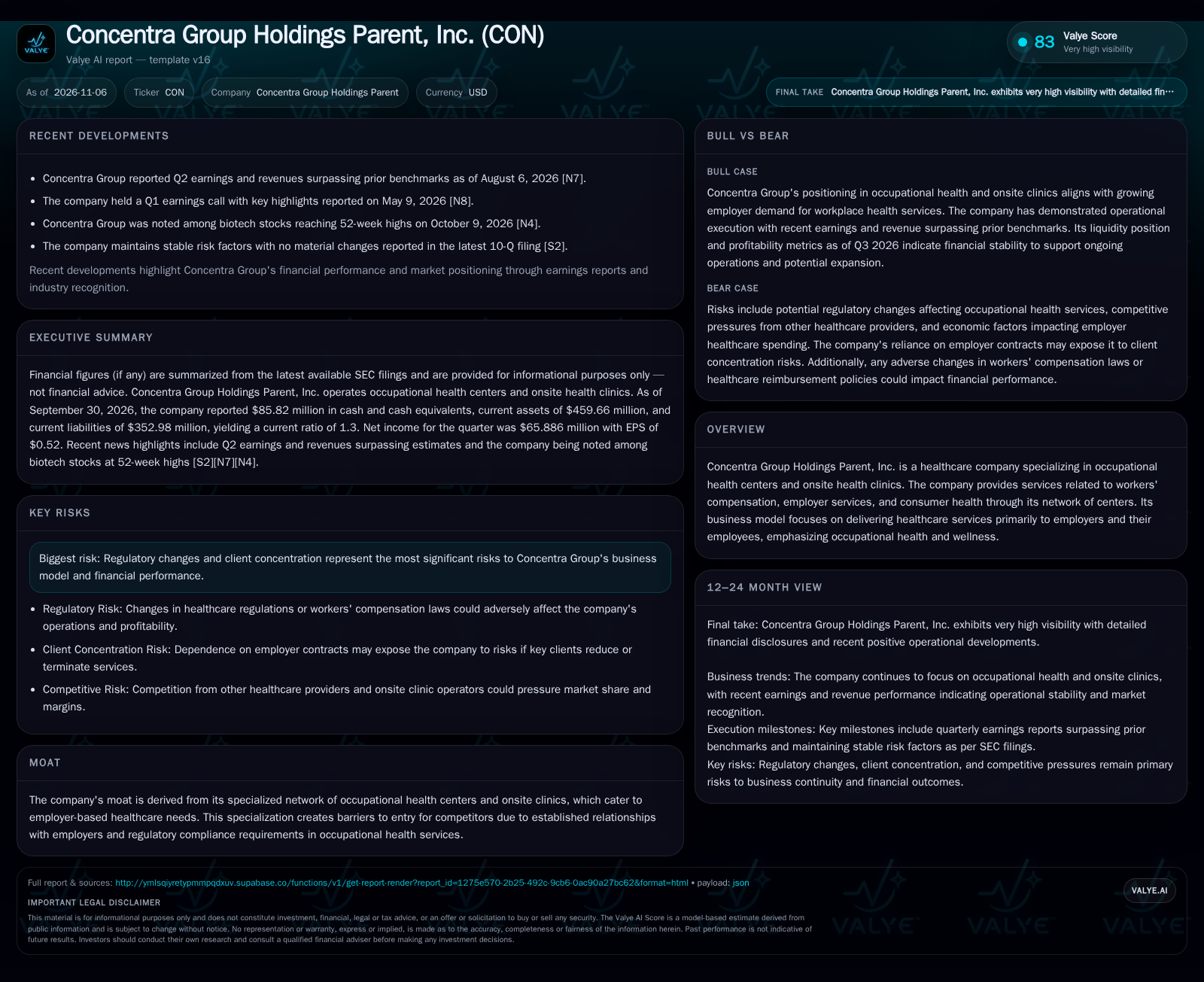
Concentra Group Holdings Parent, Inc. provides occupational health and onsite clinic services to employers, delivering strong Q3 2026 profitability and exceeding recent earnings expectations. Its specialized network and employer focus underpin a defensible position, but future outperformance will depend on maintaining contract renewals, adapting to regulatory changes, and fending off competition from broader healthcare providers.
Concentra Group Holdings Parent, Inc. stands out in the occupational health sector by combining a focused service network with consistent profitability. Its recent quarterly results, including net income of $65.9 million and earnings per share of $0.52, underscore both operational scale and financial discipline [S2]. As employer health needs evolve and regulatory pressures mount, Concentra’s future will be defined by its ability to deepen employer relationships, defend its niche against broader healthcare competitors, and adapt to changing reimbursement and compliance landscapes.
Q3 Earnings Strength and Financial Profile Highlight Core Momentum
Concentra Group reported net income of $65.9 million and EPS of $0.52 for the quarter ending September 30, 2026, signaling robust profitability at scale [S2]. The company’s current assets totaled $459.66 million, with current liabilities at $352.98 million—yielding a current ratio of 1.3 and a cash ratio of 0.24 [S2]. While these figures point to a stable operating base, they do not indicate surplus liquidity, suggesting a balanced but not unusually conservative financial posture. Additionally, Q2 and Q3 2026 earnings and revenues outperformed estimates, evidencing positive demand and possible operating leverage [N7]. The company’s risk disclosures remain unchanged, implying operational continuity without new material threats [S2].
How Concentra Converts Employer Needs into Profitable Volume
Concentra’s revenue engine is built around employer contracts for occupational health services, including workers’ compensation, pre-employment screenings, and wellness programs delivered via a network of health centers and onsite clinics. This model can create recurring demand as long as employer relationships are retained and workplace health remains a regulatory or competitive priority. Margins in this sector typically benefit from high volumes and standardized protocols, with significant fixed-cost leverage from physical clinics and clinician staff. Variable costs scale with patient visits, but high utilization can drive incremental profitability. The capital intensity is moderate: expansion requires investment in new centers or onsite clinics, but organic growth can be achieved by increasing throughput at existing locations. Cash conversion is generally strong in occupational health, though payment cycles may depend on employer or insurer reimbursement terms. The main economic vulnerability lies in client concentration—large employers can negotiate terms, and contract losses can create stepwise revenue declines.
The employer-centric model also introduces nuanced contract negotiation dynamics that impact profitability. Since large employers often seek bundled services or volume discounts, Concentra must balance competitive pricing with maintaining margin integrity. Contract terms may include performance-based incentives or penalties tied to clinical outcomes or employee satisfaction metrics, which can either enhance revenue stability or introduce variability depending on execution. Additionally, the company’s ability to integrate data analytics to demonstrate value—such as reduced workplace injury rates or faster return-to-work timelines—could strengthen contract renewals and justify premium pricing. However, failure to meet evolving employer expectations on service quality or innovation could increase churn risk and pressure margins.
Specialization vs. Scale: Where Concentra’s Moat Could Hold
Concentra’s competitive edge is rooted in its specialization: a broad network of occupational health centers and an established reputation in employer healthcare. This creates switching frictions for large organizations that value regulatory compliance, integrated record-keeping, and predictable service. Barriers to entry in occupational health include the need for clinical infrastructure, regulatory know-how, and established employer relationships. However, Concentra faces competition from hospital systems expanding into employer services, urgent care chains, and telemedicine providers offering remote occupational health assessments. While its niche focus provides defensibility, the question is whether specialized scale can resist margin pressure as larger healthcare systems expand their service offerings and as digital health solutions become more accepted for basic occupational care. If Concentra can continually adapt its offering to employer demands—such as integrating telehealth or data analytics—the moat could strengthen; otherwise, commoditization risk may rise.
The competitive landscape also features evolving technological disruptions that could reshape occupational health delivery. Digital health platforms offering AI-driven risk assessments, remote monitoring, and virtual injury management present both threats and opportunities. If Concentra can effectively incorporate these technologies, it may enhance clinical efficiency and client engagement, thereby reinforcing its moat. Conversely, lagging digital adoption could render its physical clinic network less attractive relative to more agile competitors. Moreover, partnerships or alliances with insurers and third-party administrators could influence market positioning by expanding service integration or creating referral synergies. The interplay between scale economies and specialized expertise will thus be critical in sustaining competitive advantage amid these shifting dynamics.
Expanding Employer Partnerships and Service Breadth Could Accelerate Growth
A favorable scenario would see Concentra leveraging its existing employer relationships to win new multi-site contracts, expand into adjacent health services (such as mental health or chronic disease management), and increase utilization at its clinics. If regulatory trends continue to mandate or incentivize employer-provided health services, demand could rise further. Operationally, higher throughput at existing centers would drive margin expansion due to fixed-cost leverage. Confirmation of this scenario would come from sustained above-consensus earnings, announcements of major new employer contracts, increases in same-center volumes, and evidence of service line expansion. Conversely, if growth in employer contracts stalls or utilization rates plateau, the upside case would weaken.
Sustaining Core Employer Health Services Amid Incremental Competition
The most plausible near-term path is that Concentra continues to deliver steady growth by retaining its current employer base and incrementally expanding its footprint. Revenue and profit would track the broader employment and workplace health environment, with modest gains from new contracts or incremental service adoption. Margins would remain stable, assuming clinic utilization does not decline materially and competitive pricing pressure stays contained. This scenario would be confirmed by continued quarterly earnings in line with recent performance, stable or slightly growing headcount at client organizations, and no major changes in risk disclosures. Signs that would challenge this scenario include unexpected contract losses, sharper-than-expected pricing competition, or disruptive regulatory changes.
Contract Losses or Regulatory Shocks Could Trigger Stepwise Revenue Declines
An adverse scenario would be triggered if Concentra loses one or several large employer contracts, leading to a sudden drop in clinic volume and underutilization of fixed assets. Regulatory changes—such as a loosening of employer health mandates or reimbursement pressure—could further erode demand or margins. In such a case, fixed costs would limit the company’s ability to flex expenses downward, amplifying the profit impact of lost volume. Confirmation would come from reported declines in revenue, clinic closures or consolidations, negative earnings surprises, or explicit disclosures of major contract losses. Conversely, rapid adaptation (e.g., cost-cutting or service diversification) would be necessary to mitigate this downside.
In addition to contract losses and regulatory shocks, macroeconomic factors such as a downturn in employment levels or shifts in workplace safety priorities could exacerbate volume declines. Reduced workforce size or remote work trends may lower demand for onsite occupational health services, challenging fixed-cost absorption. Furthermore, increased regulatory complexity or compliance costs—without commensurate reimbursement adjustments—could compress margins. In such scenarios, the company’s capacity to rapidly adjust its cost structure or pivot service offerings will be pivotal. Failure to do so could result in prolonged underutilization of assets and deteriorating profitability, underscoring the importance of operational agility alongside contract retention.
What Will Determine Concentra’s Ability to Sustain Employer-Focused Healthcare Leadership?
Quarterly trends in same-center volume and utilization rates—if disclosed—would indicate whether core demand is holding or eroding.
Announcements of new or renewed employer contracts, especially with national or multi-site organizations, would signal ongoing competitive strength.
Changes in regulatory landscape affecting employer health mandates or workers’ compensation requirements could materially alter demand.
Margin trends and cost structure disclosures would help assess the degree of operating leverage and vulnerability to volume shocks.
Evidence of service line expansion—such as telemedicine, behavioral health, or chronic care offerings—would show adaptability to employer and market needs.
Any disclosed customer concentration metrics or top-client exposure would clarify the risk of stepwise revenue loss.
Management commentary on competitive landscape and pricing pressure would help gauge the sustainability of current margins.
Capital allocation updates on clinic expansion, technology investments, or acquisitions would indicate growth priorities and risk appetite.
Disclaimer: This is research-only, informational analysis and not investment advice. It may include AI-generated interpretation and general industry context. Always verify important details using primary sources.

Comments