
Shoulder Innovations: Ecosystem Play in Shoulder Arthroplasty Confronts Scaling, Differentiation, and Adoption Hurdles
Shoulder Innovations leverages a clinically validated implant platform, AI-driven surgical planning, and efficient instrumentation to address the $1.7B+ shoulder arthroplasty market. Despite narrowing losses and recent commercial traction, the company must translate product advantages into durable surgeon adoption and profitable scale amid entrenched competitors and ongoing investment needs.
Shoulder Innovations is carving a niche in the shoulder surgical care market with its integrated ecosystem of advanced implants, AI-powered planning, and procedure-simplifying instrumentation. While clinical data and recent partnerships signal product strength and growing market presence, the company remains loss-making and faces the dual challenge of accelerating adoption and reaching profitability against established orthopedic players. The next phase will test whether its differentiated approach can drive sustained revenue growth and margin improvement before cash burn pressures mount.
Shoulder Innovations, Inc. is positioning itself as a specialized solution provider in the shoulder arthroplasty market—a niche with growing procedure volumes and a $1.7B U.S. addressable opportunity. The company’s integrated approach combines proprietary implants, AI-powered preoperative planning, and streamlined instrumentation to address both clinical and operational pain points. Recent financial results show narrowing net losses and revenue momentum, while a new partnership with ALM Ortho signals ongoing innovation. However, persistent losses and a competitive landscape dominated by larger orthopedic device firms mean the company’s ability to achieve profitable scale and defend its differentiation remains an open question.
Recent Results and Strategic Moves Define the Near-Term Landscape
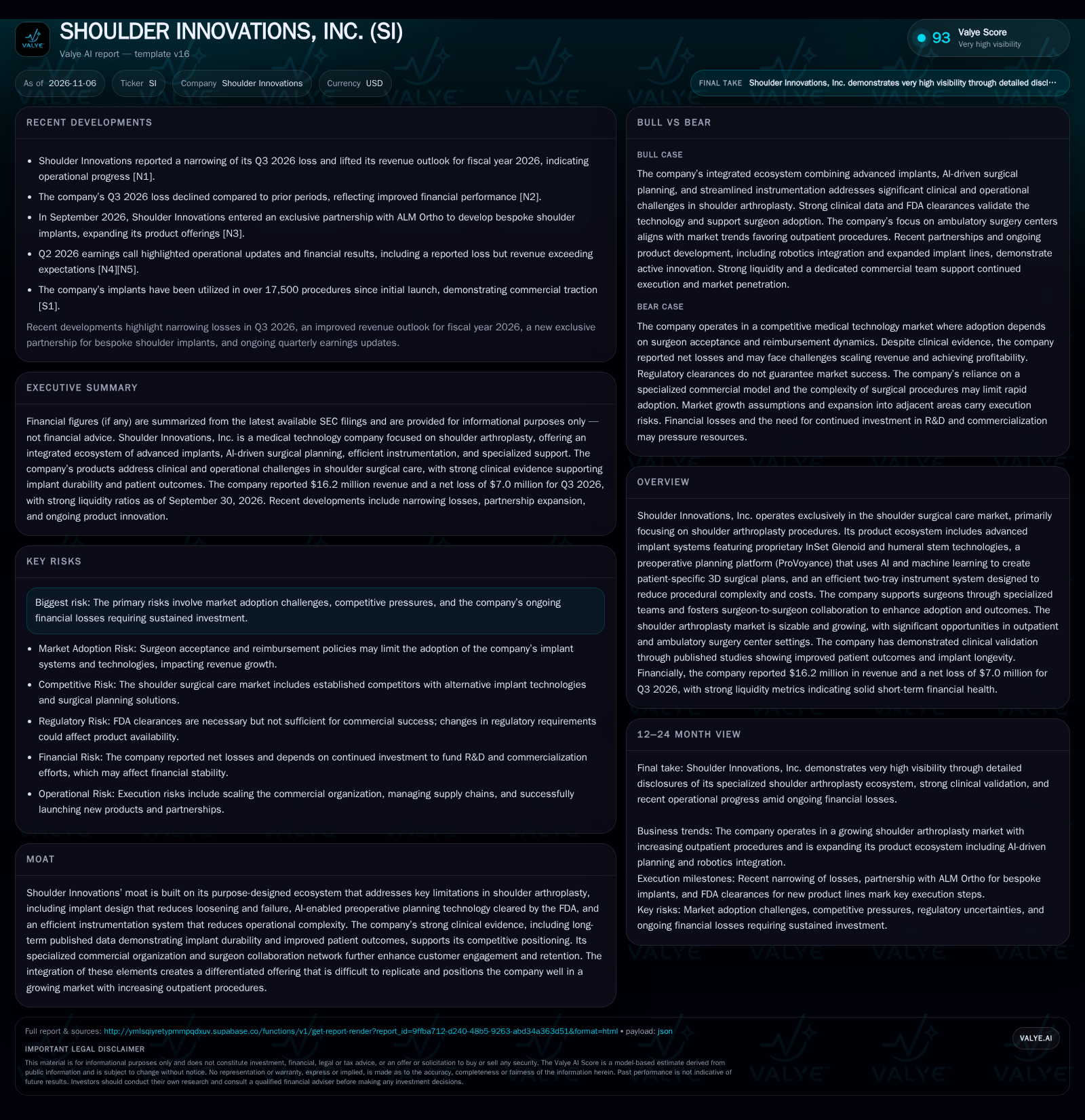
Shoulder Innovations reported $16.2 million in revenue and a net loss of $7.0 million for Q3 2026, marking a narrowing of losses and prompting an increase in its full-year revenue outlook. This signals operational improvement and a degree of commercial traction [N1] [N2]. The company’s InSet Glenoid system and ProVoyance AI/ML-enabled planning platform continue to be core differentiators, both clinically validated and FDA-cleared, with their technology now used in over 17,500 procedures since launch [S1] [S2]. In September 2026, the company entered an exclusive partnership with ALM Ortho to develop bespoke shoulder implants, aiming to further expand its product scope and deepen surgeon engagement [N3]. As of September 30, 2026, Shoulder Innovations had $36.4 million in cash and a current ratio of 10.68, indicating a reported liquidity position [S2].
How the Platform Could Drive Revenue, Margins, and Cash Flow
Shoulder Innovations’ business model depends on implant sales, software-enabled preoperative planning, and associated instrumentation. In the orthopedic device industry, revenue is typically generated through a mix of direct sales and third-party distributors, with hospitals and ambulatory surgery centers (ASCs) as primary customers. Product pricing is influenced by perceived clinical benefit, ease of use, and reimbursement rates. The company’s two-tray instrument system and AI-driven planning may enable higher procedure throughput and cost savings for providers, potentially supporting premium pricing or improved sales velocity if value is demonstrated.
Gross margins in orthopedic implants are often high due to the value placed on clinical outcomes and regulatory barriers, but are offset by R&D, sales force, and surgeon support expenses. Fixed costs include ongoing R&D (especially as the company develops expanded indications and robotics integration), regulatory compliance, and the commercial organization. Variable costs reflect manufacturing, distribution, and customer support. Operating leverage could emerge if sales volumes increase faster than fixed cost growth, but achieving this requires sustained surgeon adoption and competitive win rates.
The company reported cash and liquidity metrics for the period; these figures do not by themselves establish operating runway, investment capacity, financial flexibility, or financing capacity. The ability to reach profitability will likely hinge on scaling procedure volumes, expanding the product mix (e.g., bespoke implants, robotics), and maintaining pricing power while managing commercial investment.
Differentiation in a Crowded Orthopedic Landscape: Strengths and Vulnerabilities
The shoulder arthroplasty market is dominated by large, diversified orthopedic companies that offer broad product portfolios, established surgeon relationships, and significant commercial resources. Shoulder Innovations’ moat is constructed around its integrated platform: clinically validated InSet Glenoid implants designed for superior fixation, AI-powered ProVoyance planning, and a streamlined instrumentation system that reduces OR complexity—especially relevant for cost-sensitive ASCs.
The company’s published long-term clinical data and FDA-cleared technology provide credible barriers to entry, and the ecosystem approach may foster loyalty among high-volume surgeons. However, incumbent competitors can invest heavily in R&D, bundle products and services, and leverage existing distribution networks to defend market share or undermine new entrants. The question is whether Shoulder Innovations’ focused approach and commercial organization can drive a durable shift in surgeon preference and procurement behavior before competitors replicate or adapt similar features.
Potential substitutes include alternative implant designs, competing digital planning platforms, and emerging technologies such as robotics and AI-enabled navigation from larger rivals. The company’s exclusive partnership with ALM Ortho for bespoke implants is a strategic attempt to further differentiate, but execution risk remains given the need for broad adoption and clinical validation in real-world settings.
Unlocking Operating Leverage Through Ecosystem Adoption
A favorable trajectory would see Shoulder Innovations’ ecosystem becoming the preferred solution for a growing segment of shoulder surgeons, particularly in ASCs where efficiency and simplicity are at a premium. If the company successfully demonstrates superior clinical outcomes, fewer complications, and measurable OR efficiencies, hospitals and ASCs may increasingly standardize on its platform—driving recurring implant sales, software usage, and instrument placements.
Confirmation would come from accelerating procedure volumes, evidence of market share gains, and stable or rising gross margins despite scale. Expansion of the product pipeline—such as the integration of robotics or new indications—could further increase wallet share and entrench surgeon loyalty. The ALM Ortho partnership yielding new bespoke implant launches and adoption would also validate the strategy.
This scenario could be falsified if adoption plateaus, surgeon switching costs prove lower than expected, or clinical/economic outcomes fail to clearly outperform alternatives—leading to margin compression or stalled revenue growth.
Incremental Gains Amid Persistent Investment and Competitive Friction
The most plausible near-term outcome is continued revenue growth from deeper penetration among existing surgeon users and gradual expansion into new accounts, offset by ongoing investment in R&D, commercialization, and support. Margins may improve modestly as fixed costs are leveraged over a larger revenue base, but profitability remains elusive given the need to compete with entrenched players and fund further innovation.
Evidence supporting this view would include steady, but not accelerating, quarterly revenue increases, persistent but narrowing net losses, and incremental product launches or partnerships.
This base case could be challenged by a sudden surge in competitive pricing, regulatory setbacks, or operational missteps that constrain growth or require additional capital.
When Differentiation Isn’t Enough: Adoption Barriers and Financial Strain
A negative outcome would see Shoulder Innovations struggle to convert its clinical and technical advantages into broad market adoption. If incumbent competitors aggressively defend share through pricing, bundled offerings, or enhanced digital planning tools, the company may face stagnant or declining sales despite ongoing investment. Surgeon inertia, reimbursement headwinds, or unproven value in real-world settings could further limit uptake.
Financially, persistent losses would erode cash reserves, eventually forcing the company to seek additional capital or cut back on R&D and commercial expansion—potentially stalling the pipeline and weakening competitive position. Signs confirming this scenario would be flat or declining quarterly revenues, widening losses, or disclosures of tightened liquidity or delayed product launches.
This risk could be offset if external events—such as new reimbursement codes, competitor missteps, or positive real-world outcome data—suddenly shift the adoption curve in the company’s favor.
Milestones to Assess Shoulder Innovations’ Path to Scale and Profitability
Quarterly procedure volumes using company implants—if disclosed—would provide direct insight into adoption trajectory and market penetration.
Gross margin trends as new products launch or as volumes grow; margin expansion would indicate operating leverage and pricing power.
Revenue mix between hospitals and ASCs, and between standard versus bespoke (ALM Ortho partnership) implants, to assess success in target segments.
Net cash burn and runway projections, particularly as R&D and commercial investments continue; any shift in burn rate would be material.
Rate of new surgeon onboarding and retention, which would test the effectiveness of the specialized commercial and support organization.
Outcomes from the ALM Ortho partnership, including bespoke implant launch timing and initial adoption metrics.
Regulatory milestones—such as FDA clearances for pipeline products or expanded indications—that could open new market segments.
Competitive responses, including new launches or pricing moves from larger orthopedic device firms, which could affect the company’s growth and margin assumptions.
Disclaimer: This is research-only, informational analysis and not investment advice. It may include AI-generated interpretation and general industry context. Always verify important details using primary sources.

Comments