
Liberty Live Holdings: Leveraging Experiential Assets Amid Liquidity Headwinds and Shifting Event Dynamics
Liberty Live Holdings, an independent spin-off holding substantial stakes in Live Nation and experiential hospitality provider Quint, is showing revenue momentum driven by major sporting events and improved operational discipline. Yet, the company faces acute short-term liquidity pressures, exposure to event and economic cycles, and ongoing legal and operational dependencies as it charts a course post-spin.
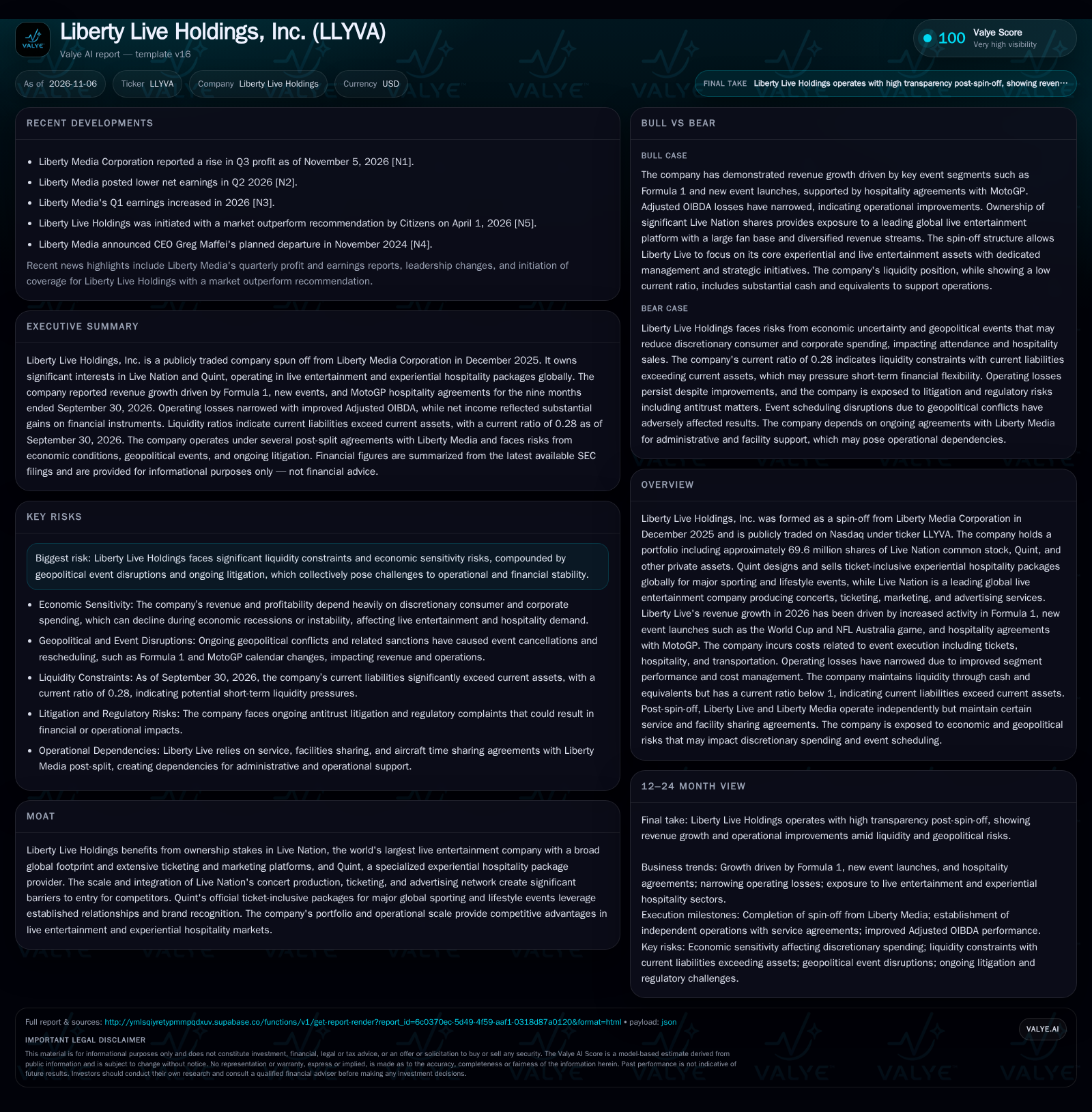
Liberty Live Holdings’ post-spin growth is fueled by marquee events like Formula 1 and new hospitality agreements, with narrowed operating losses and a significant equity position in Live Nation. The durability of revenue gains and the ability to manage liabilities and dependencies will define the company’s trajectory over the next 12-24 months. [S2]
Liberty Live Holdings, newly independent after its December 2025 spin-off from Liberty Media, is emerging as a focused play on premium live entertainment and global experiential hospitality. Its portfolio, anchored by a substantial stake in Live Nation and the event-driven Quint business, has delivered strong top-line momentum in 2026, particularly around high-profile sporting events. The core question: Can Liberty Live convert event-driven growth and asset leverage into sustainable value while navigating acute near-term liabilities and external shocks?
Recent Performance Highlights and Balance Sheet Stress Points
Liberty Live Holdings reported Q3 2026 revenue of $105.9 million, a substantial increase from $61.7 million in the prior-year period, with growth attributed mainly to Formula 1, new global events such as the World Cup and NFL Australia, and expanded MotoGP hospitality deals. Despite higher event-related costs, adjusted OIBDA loss narrowed to $2.6 million, and the Quint segment posted positive adjusted OIBDA. The company’s net income of $333.8 million for the quarter was buoyed by significant realized and unrealized gains on its financial instruments portfolio, not by core recurring operations. Critically, liquidity remains a pressure point: Liberty Live reported $492.9 million in cash and equivalents against current liabilities of $2.29 billion, resulting in a current ratio of just 0.28 and a cash ratio of 0.22 at September 30, 2026, highlighting potential vulnerability to near-term obligations. [S2]
How Liberty Live Extracts Value from Experiential and Live Event Assets
Liberty Live’s economics are driven by two principal assets: its direct ownership stake in Live Nation and its wholly owned Quint segment. Live Nation generates revenue via concert production, ticketing, sponsorships, and advertising, relying on scale, venue control, and global reach to drive margin through variable event economics and fixed infrastructure leverage. Quint specializes in premium, ticket-inclusive hospitality packages for major sporting and lifestyle events, earning revenue through bundled ticket, travel, and VIP experiences sold at high per-customer price points. The experiential model is capital-light in inventory but operationally intensive, with margins sensitive to event volume, mix, and contractual terms with event organizers.
Operating leverage is present but can swing both ways: incremental event volume (e.g., new World Cup or F1 packages) can quickly boost revenue, but event cancellations or soft discretionary demand can leave fixed costs uncovered. The company’s significant holding in Live Nation is a source of embedded optionality, as Live Nation’s scale can amplify Liberty Live’s exposure to both global event recoveries and industry disruptions. The presence of high current liabilities suggests Liberty Live may be funding operations and event commitments through a combination of advanced customer payments, payables, and possibly short-term borrowing, increasing sensitivity to cash flow timing and market shocks. [S2]
Competitive Defenses: Scale, Relationships, and Event Integration
Liberty Live’s competitive position is underpinned by its majority stake in Live Nation, the world’s largest live entertainment company, and Quint’s global hospitality platform. Live Nation’s ability to secure artists, venues, and ticketing rights at global scale creates substantial barriers for smaller entrants and new digital-only competitors. Quint’s official relationships with sporting leagues and event promoters—exemplified by recent agreements with MotoGP and major global events—provide a moat in the premium hospitality segment, where credibility and access are critical to customer willingness to pay.
However, the live events and hospitality landscape remains vulnerable to substitution by digital entertainment, streaming, and alternative leisure options, especially if macroeconomic or geopolitical shocks reduce travel and event attendance. The integration of ticketing, marketing, and hospitality also exposes Liberty Live to regulatory scrutiny, particularly around antitrust and competition law, as well as to reputational risk if event quality or safety falters. Direct competitors include global sports hospitality firms, event management companies, and regional concert/ticketing operators, though few match the combined scale of Live Nation and Quint.
Asset Leverage and Event Expansion Drive Sustainable Profitability
A favorable scenario for Liberty Live sees continued recovery and expansion in global live events, with marquee sports and entertainment assets (Formula 1, World Cup, MotoGP) delivering higher-margin hospitality volumes and new event launches broadening the revenue base. Under this outcome, Quint’s experiential packages could scale through deeper partnerships and technology-enabled customization, while Live Nation’s concert and ticketing business capitalizes on pent-up demand and pricing power.
Confirmation would come from sequential OIBDA improvements, rising Quint segment profitability, and evidence of recurring or multi-year hospitality contract wins. Further, a reduction in short-term liabilities—either through refinancing, asset sales, or improved working capital management—would alleviate liquidity risk and support a virtuous cycle of reinvestment. The durability of realized gains from financial instruments, if deployed toward core operations or strategic acquisitions, could also accelerate value creation. Material evidence would include a reported liquidity-ratio trends, positive free cash flow, and new event or contract announcements with multi-year visibility.
Event-Driven Growth Meets Financial Constraints in the Near Term
The most plausible trajectory for Liberty Live is one of continued event-driven revenue growth, punctuated by periodic volatility tied to the global event calendar and macro conditions. Reliance on short-term payables and advanced customer receipts may keep the current ratio low, forcing management to prioritize cash-generating events and potentially defer new investments or expansion.
Evidence supporting this scenario would include ongoing sequential revenue growth around major events, stable or slightly improving OIBDA margins, and maintenance—but not dramatic improvement—of liquidity ratios. If current liabilities remain high relative to assets, the company may be forced to renegotiate service agreements, tap additional financing, or consider non-core asset sales to sustain operations. The base case assumes no severe event cancellations or regulatory shocks, but also no transformative margin expansion or risk resolution.
Liquidity Crunch and Event Disruptions Trigger Operational Instability
In an adverse scenario, Liberty Live’s acute liquidity pressures are compounded by economic downturns or geopolitical shocks that suppress discretionary event spending, force event cancellations, or disrupt hospitality logistics. If key revenue-driving events underperform or are rescheduled, the company’s fixed commitments and payables could outpace incoming cash, leading to payment delays, emergency capital raises, or forced asset dispositions.
Additional triggers could include adverse litigation outcomes, regulatory fines, or the loss of critical service/facility agreements with Liberty Media. In this environment, Liberty Live could see erosion of customer and partner confidence, loss of event exclusivity, or impairment of its equity stake in Live Nation, especially if broader event industry conditions deteriorate.
Milestones That Will Define Liberty Live’s Post-Spin Value Trajectory
Sequential OIBDA margin trends at both the consolidated and Quint segment level—if disclosed—will clarify whether operational leverage is translating into sustainable profitability.
Quarterly updates on the current and cash ratios, alongside management commentary on working capital and short-term debt, will reveal the trajectory of liquidity risk.
Announcements of new multi-year or recurring hospitality agreements, especially with major global sporting events, would help test the durability of the revenue base.
Any material changes in the size or composition of current liabilities—such as refinancing, asset sales, or reductions in payables—would provide evidence on potential financial flexibility.
Progress or setbacks in litigation and regulatory proceedings, including antitrust matters, should be tracked for potential financial and operational impact.
Updates on service, facility, and administrative agreements with Liberty Media, including any renegotiation or termination, would signal shifts in operational dependencies.
Disclosure of free cash flow generation or burn, if provided, would directly address the company’s ability to self-fund operations and investments.
Disclaimer: This is research-only, informational analysis and not investment advice. It may include AI-generated interpretation and general industry context. Always verify important details using primary sources.

Comments