
Onity Group: Mortgage Servicing Concentration and Funding Moves Reshape Risk and Opportunity
As Onity Group manages a major client transition and reinforces its capital base, the company’s future will hinge on how it balances servicing volume shifts, credit risk exposure, and operational efficiency in a volatile mortgage environment.
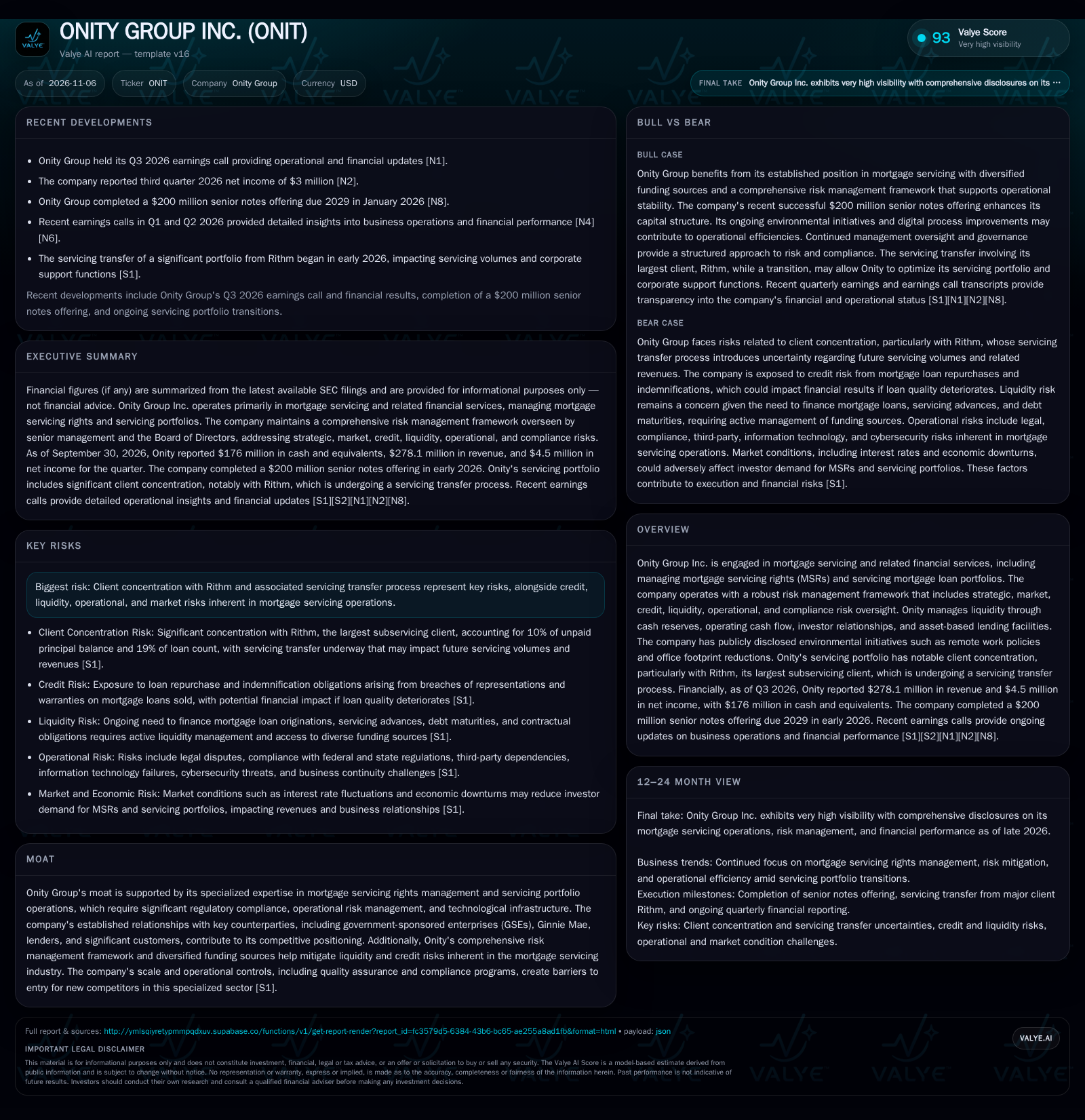
Onity Group closed a $200 million senior notes offering and reported $278.1 million in Q3 2026 revenue, but faces near-term uncertainty as a servicing transfer with its largest client, Rithm, shifts portfolio composition and revenue visibility.
Onity Group stands at a pivotal juncture in late 2026, navigating both the upside and challenges of scale in mortgage servicing. The company’s financial strength is underscored by $278.1 million in revenue and $176 million in cash as of Q3 2026, as well as the successful completion of a $200 million senior notes offering. However, a major portfolio transfer by its largest client, Rithm, will reshape servicing volumes and revenue visibility, testing the resilience of Onity’s risk management systems. As the mortgage servicing sector contends with macroeconomic and credit volatility, Onity’s ability to manage concentration risk, sustain operational efficiency, and reallocate capital will determine its trajectory over the next cycle [S1] [S2] [N2] [N8].
Portfolio Realignment and Capital Base: What the Latest Quarter Reveals
Onity Group’s Q3 2026 snapshot highlights three material developments. First, the company reported $278.1 million in revenue and $4.5 million in net income, with $176 million in cash and equivalents as of September 30, 2026 [S2]. Second, Onity completed a $200 million senior notes offering due 2029 in January 2026, augmenting its long-term funding resources [N8]. Third, the servicing transfer process involving Rithm—Onity’s largest subservicing client, responsible for 10% of unpaid principal balance and 19% of loan count—is underway and expected to impact servicing volumes and the allocation of corporate support functions [S1]. These developments matter because they directly affect the company’s revenue composition, earnings visibility, and funding flexibility as Onity adapts to a changing client roster and capital structure.
The Economics of Mortgage Servicing: Revenue Streams and Risk Absorption
Onity Group generates revenue primarily from mortgage servicing fees, ancillary income from managing mortgage servicing rights (MSRs), and potentially from float income on escrow balances. The economics of servicing are characterized by high operational leverage: fixed costs in compliance, technology, and risk management must be covered by a relatively stable fee stream. However, the withdrawal of a major client like Rithm could reduce servicing volume, potentially diluting scale economies and raising unit costs unless offset by new mandates or cost reductions.
Credit risk is a structural cost driver, as servicers can be obligated to repurchase loans or indemnify investors for breaches of representations and warranties. This risk intensifies if loan performance deteriorates or if origination quality controls are insufficient—both of which can be exacerbated in a rising rate or recessionary environment.
The company reported cash and liquidity metrics for the period; these figures do not by themselves establish operating runway, investment capacity, financial flexibility, or financing capacity. However, funding costs and access to asset-based lending facilities can shift rapidly with market conditions, introducing variability in net margins. The company’s ability to maintain or replace servicing volume and control credit costs will be central to preserving operating leverage and return on equity.
Navigating Scale, Compliance, and Client Concentration in a Crowded Servicing Market
Onity’s competitive position is shaped by its operational expertise, regulatory compliance infrastructure, and established relationships with government-sponsored entities and lenders [S1]. These factors create barriers to entry in mortgage servicing, where scale is critical for absorbing fixed compliance costs and meeting stringent oversight requirements.
However, the sector is fragmented, with competition from large bank servicers, non-bank servicers, and fintech entrants. Client concentration with Rithm exposes Onity to revenue volatility and negotiating leverage loss if that business is not replaced. While Onity’s risk management framework and funding diversity are strengths, the loss of a key client could erode its relative cost position, making it more vulnerable to aggressive pricing or client poaching by peers.
Technology adoption and process automation are increasingly important as servicers seek to drive down costs and respond to regulatory scrutiny. The question is whether Onity can redeploy its operational resources and capital to attract new business or expand wallet share with other clients as the Rithm portfolio transitions out.
Reallocating Capacity and Capital: How Onity Could Turn Transition into Opportunity
A favorable scenario for Onity hinges on successfully managing the Rithm portfolio transition while redeploying freed capacity and capital to win new mandates or deepen relationships with existing clients.
If Onity is able to replace lost servicing volume at similar or better margins—either through new subservicing contracts, direct MSR acquisitions, or strategic partnerships—operating leverage could be preserved or even improved. Confirmation would come from stabilization or growth in total servicing unpaid principal balance, new client announcements, and sustained or rising servicing fee revenue despite the Rithm runoff.
Falsification of this scenario would be evident if Onity fails to backfill lost volume, experiences margin compression due to fixed cost deleveraging, or sees a sustained drop in servicing-related earnings.
Balancing Retention and Reinvestment as the Portfolio Shifts
The most plausible outcome is a transitional period in which Onity absorbs lower servicing volumes and revenue as the Rithm transfer progresses, partially offset by operational cost reductions and incremental new business wins. Revenue and earnings may decline modestly in the near term, but the company’s risk management systems and funding flexibility help limit downside volatility [S1] [S2].
Over time, Onity may gradually reallocate resources to pursue new client opportunities or expand in niche servicing segments, but competitive intensity and elevated funding costs could constrain margin recovery. Evidence confirming this scenario would include a measured drop in servicing volume and fee income, stable or slightly compressed margins, and continued investment in compliance and technology. Falsification would require either a rapid rebound in new servicing mandates (tilting toward the upside) or an inability to contain costs and credit risk (tilting toward the downside).
Concentration Risk Realized: When Portfolio Losses Compound Earnings Pressure
The adverse scenario materializes if Onity is unable to replace the Rithm portfolio, resulting in a structural decline in servicing volume, loss of scale economies, and persistent margin pressure. This could be compounded by increased credit costs if loan performance deteriorates or if indemnification obligations spike. In this environment, fixed operational costs may become burdensome, and competitive pricing pressure could erode profitability further.
Downside confirmation would be a pronounced and sustained drop in servicing revenue, rising cost ratios, and evidence of higher credit loss provisions or indemnification payouts.
Thesis Tests: What Will Determine Onity’s Post-Transition Trajectory?
Quarterly changes in total servicing unpaid principal balance and loan count, especially as the Rithm transfer progresses, will be critical to monitor.
Servicing fee income trends and margin evolution: a useful metric would be segment-level disclosures if provided.
Updates on new subservicing mandates, MSR acquisitions, or client wins that indicate Onity’s ability to backfill lost volume.
Credit risk metrics, such as repurchase obligations, indemnification payouts, or loan quality indicators, if disclosed.
Operating cost ratios and evidence of successful cost containment as servicing volumes fluctuate.
Management commentary in earnings calls on strategy for redeploying capital and operational capacity post-Rithm.
Any regulatory or compliance developments that could affect operational flexibility or capital requirements.
Disclaimer: This is research-only, informational analysis and not investment advice. It may include AI-generated interpretation and general industry context. Always verify important details using primary sources.

Comments