
Global Indemnity Group: Underwriting Discipline, Capital Strength, and the Test of E&S Market Cyclicality
Global Indemnity Group, LLC enters a leadership transition with stable underwriting results, strong capital, and a mixed premium growth picture—raising questions about how well the company can sustain profitability and find growth in a competitive, cyclical excess and surplus lines insurance market.
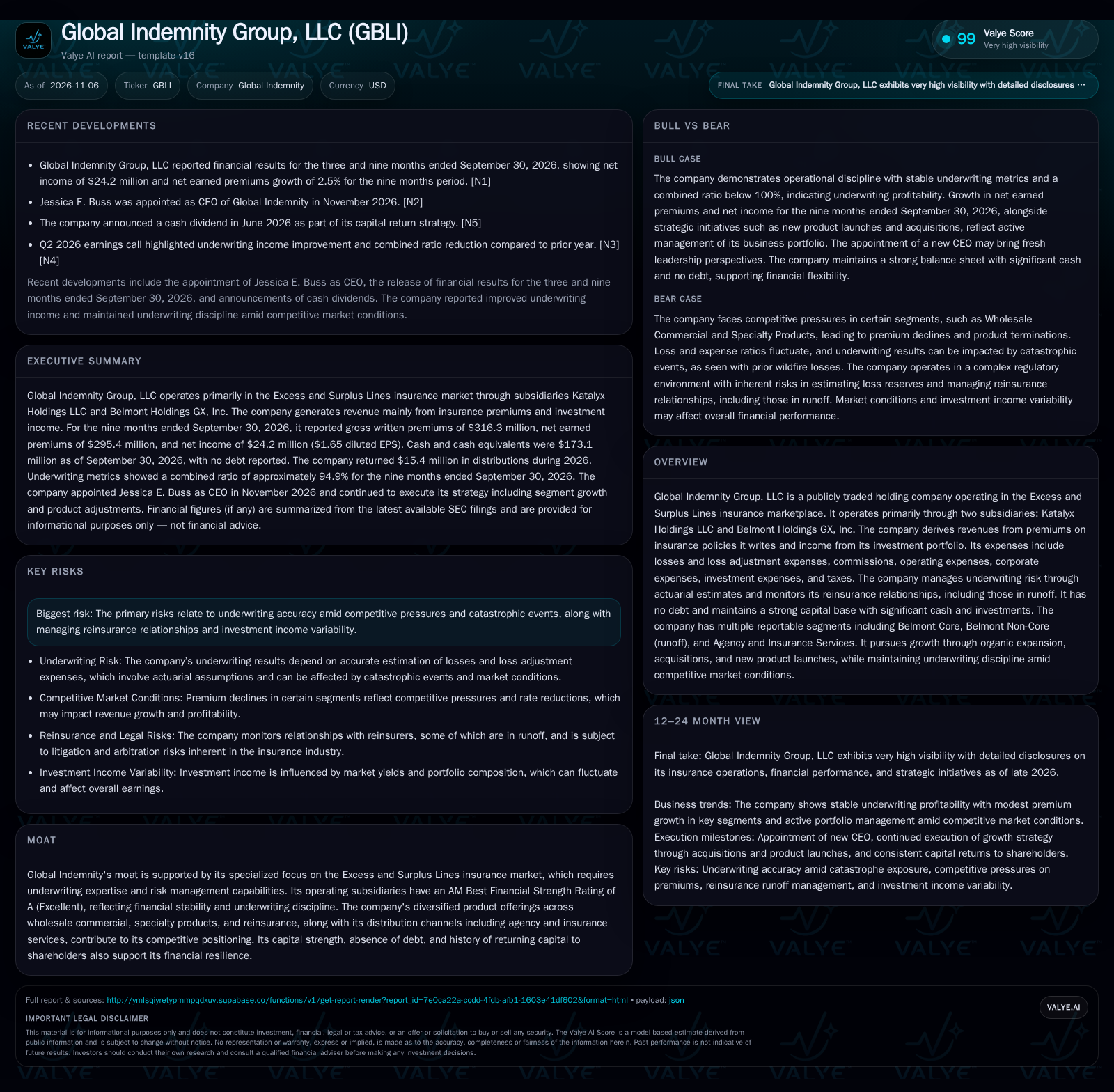
Global Indemnity Group, LLC reported a 2.5% increase in net earned premiums and improved underwriting income for the first nine months of 2026, while maintaining a combined ratio below 95% and holding $173.1 million in cash with no debt. Segment-level trends remain mixed: Belmont Core’s premiums declined, offset by growth in niche lines and assumed E&S reinsurance. The appointment of Jessica E. Buss as CEO signals potential strategic shifts. The company’s ability to navigate competitive pressures and capitalize on E&S market dislocation will determine whether its disciplined model can translate into sustainable growth and shareholder returns. [S2] [N1] [N2]
Yet, the E&S landscape is shifting, with competitive pressures causing premium declines in core segments even as specialty niches and reinsurance show growth. The appointment of a new CEO in late 2026 adds an element of uncertainty and potential for change. The central question is whether Global Indemnity’s disciplined, capital-strong model can consistently capture profitable growth in a market defined by cyclicality and aggressive competition. [S2] [N1] [N2]
Premium Growth, Underwriting Profitability, and a Leadership Transition: The 2026 Operating Snapshot
For the first nine months of 2026, Global Indemnity reported net earned premium growth of 2.5% to $295.4 million and net income of $24.2 million, with a combined ratio of 94.9%—demonstrating underwriting profitability despite market headwinds. The company’s cash position stood at $173.1 million with no debt, underscoring financial stability. However, gross written premiums in the flagship Belmont Core segment fell 5.5% in the most recent quarter, largely due to declines in Wholesale Commercial lines amidst competitive pressures and softening property rates. Offsetting this, niche areas such as Vacant Express, Collectibles, and assumed E&S reinsurance posted growth. Notably, Jessica E. Buss was appointed CEO in November 2026, introducing the potential for strategic recalibration. [S2] [N1] [N2]
How Global Indemnity Generates Profits: E&S Insurance Economics and Capital Leverage
Global Indemnity’s core business model revolves around writing excess and surplus (E&S) lines insurance, where premiums are set to reflect higher or more complex risks that standard carriers decline to cover. Revenue is primarily derived from premiums written and investment income. The company’s profitability depends on disciplined underwriting—balancing risk selection, pricing accuracy, and expense control—since margins are determined by the combined ratio (the sum of loss and expense ratios). A sub-100% combined ratio, such as the current 94.9%, signals that underwriting operations are adding to profits rather than eroding them. [S2]
The company reported cash and liquidity metrics for the period; these figures do not by themselves establish operating runway, investment capacity, financial flexibility, or financing capacity. The investment portfolio is a secondary profit engine, but its yield is subject to interest rate environments and asset allocation decisions. Operating leverage exists insofar as premium growth can outpace fixed costs, but this is constrained by the need for prudent risk management and the cyclical nature of E&S pricing. Expense ratios over 40% suggest meaningful fixed and variable costs, and improvement here could enhance margins if premium growth resumes. [S2]
Within segments, economics vary: core wholesale commercial lines face intense competition and price compression, while niche products (Vacant Express, Collectibles) and assumed E&S reinsurance may offer higher margins if underwriting is disciplined and claims volatility is managed. Product terminations in Specialty Products indicate active pruning of unprofitable business, a positive for future loss ratio stability but a headwind for top-line growth in the near term. [S2]
Specialization, Rating Strength, and the Challenge of E&S Market Competition
Global Indemnity’s competitive positioning is grounded in its focus on the E&S marketplace, where underwriting expertise and agility are essential. The company benefits from an A (Excellent) AM Best rating, supporting credibility with brokers and clients. Its multi-segment approach—spanning wholesale commercial, specialty products, collectibles, and reinsurance—offers diversification, but premium declines in core lines highlight vulnerability to market cycles and aggressive pricing from both traditional insurers and E&S specialists.
Competitive threats in the E&S space include both large national carriers expanding into specialty risks and nimble MGAs (managing general agents) leveraging technology and analytics for risk selection. The absence of debt and a robust capital base afford Global Indemnity flexibility to withstand adverse events or invest in growth, but do not guarantee premium expansion or sustainable margin leadership. Switching frictions for brokers and insureds are generally low, and price remains a key driver in soft markets, though expertise in underwriting unique risks can create stickiness in select niches.
Technology and data analytics are increasingly shaping underwriting and claims management in E&S insurance. Global Indemnity’s ability to compete may hinge on its willingness to invest in these areas and to identify underpenetrated or mispriced niches faster than larger, slower-moving competitors.
If Market Discipline Holds: How Pruning, Niche Growth, and Reinsurance Expansion Could Drive Outperformance
The favorable scenario for Global Indemnity hinges on effective risk selection, disciplined underwriting, and capital redeployment into higher-margin specialty lines and reinsurance. If the company continues to prune unprofitable business while growing Vacant Express, Collectibles, and assumed E&S reinsurance, the premium mix could shift toward segments with better loss experience and pricing power. This would support a sustainably low combined ratio and potentially higher returns on equity as investment income supplements underwriting gains. [S2]
The appointment of a new CEO could catalyze operational upgrades, technology investments, or targeted acquisitions, further strengthening the company’s ability to identify and underwrite profitable risks ahead of peers. Confirmation of this scenario would come from sustained improvement in segment-level premium growth (especially specialty and reinsurance), continued combined ratios below 95%, and evidence of stable or rising book value per share even as capital is returned to shareholders.
Falsification would occur if the company is unable to replace lost premium from terminated or declining lines, if underwriting discipline slips (combined ratio rising above 100%), or if severe claims volatility in new segments erodes profitability.
Disciplined Stability, Modest Growth, and Ongoing Capital Returns Likely to Persist
The most plausible trajectory for Global Indemnity is continued underwriting profitability with modest overall premium growth, driven by balancing declines in legacy core segments with selective expansion in niche and reinsurance lines. The company’s capital strength and lack of leverage enable ongoing shareholder distributions, but organic growth opportunities may be constrained by persistent competition and E&S market cyclicality.
Under this scenario, the combined ratio remains in the mid-90s, book value per share is stable or declines only modestly as capital is returned, and net income tracks in line with recent years. Confirmation would come from continued segment churn—pruning unprofitable business and launching new products—without a material increase in loss or expense ratios. The new CEO may introduce incremental improvements in operational efficiency or digital capabilities but is unlikely to radically alter the company’s risk profile or growth rate in the near term.
Falsification would occur if competitive intensity drives further significant premium declines in core lines without sufficient replacement from high-margin niches, or if a major adverse loss event pushes the combined ratio above breakeven.
Competitive Pressures, Adverse Losses, or Strategic Missteps Could Undermine Profitability
In a negative scenario, Global Indemnity faces sustained premium declines in its core segments as competitors undercut pricing or outcompete for distribution relationships. If new specialty and reinsurance initiatives fail to generate sufficient volume or introduce unexpected claims volatility, underwriting profitability could erode—particularly if expense ratios remain high.
A major catastrophe, reserve development, or misestimation of loss trends in new lines could drive the combined ratio above 100%, resulting in underwriting losses and pressure on book value. If capital returns outpace earnings, shareholders’ equity could decline, reducing the cushion for future shocks. Leadership transition risk also looms: if strategic changes under the new CEO disrupt broker relationships or misallocate capital, the company could lose market relevance or competitive standing.
Confirmation of this downside would include rising loss or expense ratios, negative premium growth across most segments, a combined ratio persistently above 100%, and a shrinking book value per share.
Milestones That Will Reveal Whether Global Indemnity’s Model Can Sustain Profitable Growth
Track segment-level premium growth, especially within the Vacant Express, Collectibles, and assumed E&S reinsurance segments, to gauge whether niche expansion is offsetting declines in core lines. [S2]
Monitor the combined ratio and its components (loss and expense ratios) for signs of underwriting discipline or emerging loss pressures. [S2]
Watch for developments in technology adoption or operational upgrades, as these could enhance risk selection and claims management—if disclosed.
Assess the pace and mix of capital returns (dividends and distributions) versus growth investments, to determine if the company is maintaining or eroding its capital base. [S2] [N5]
Observe CEO Jessica Buss’s early strategic moves—product launches, acquisitions, or organizational changes—that could signal a shift in risk appetite or growth ambitions. [N2]
Monitor changes in book value per share relative to underwriting and investment performance, as this reflects the true accretion or dilution of shareholder value. [S2]
Be alert for shifts in reinsurance arrangements or reserve development disclosures, which could signal emerging risk exposures or adverse loss trends—if disclosed.
Track competitive activity and pricing trends in the E&S market, as these external forces will heavily influence Global Indemnity’s ability to sustain premium growth and margin discipline.
Disclaimer: This is research-only, informational analysis and not investment advice. It may include AI-generated interpretation and general industry context. Always verify important details using primary sources.

Comments