
Americold’s Cold Chain Dominance: Strategic Expansion, Operating Leverage, and the Economics of Warehousing Infrastructure
Americold Realty Trust’s Q3 2026 results highlight robust operating performance and a strategic joint venture, reinforcing its leadership in temperature-controlled logistics. The company’s capital-intensive, high-barrier model offers revenue stability but faces economic cyclicality, operational complexity, and evolving competition.
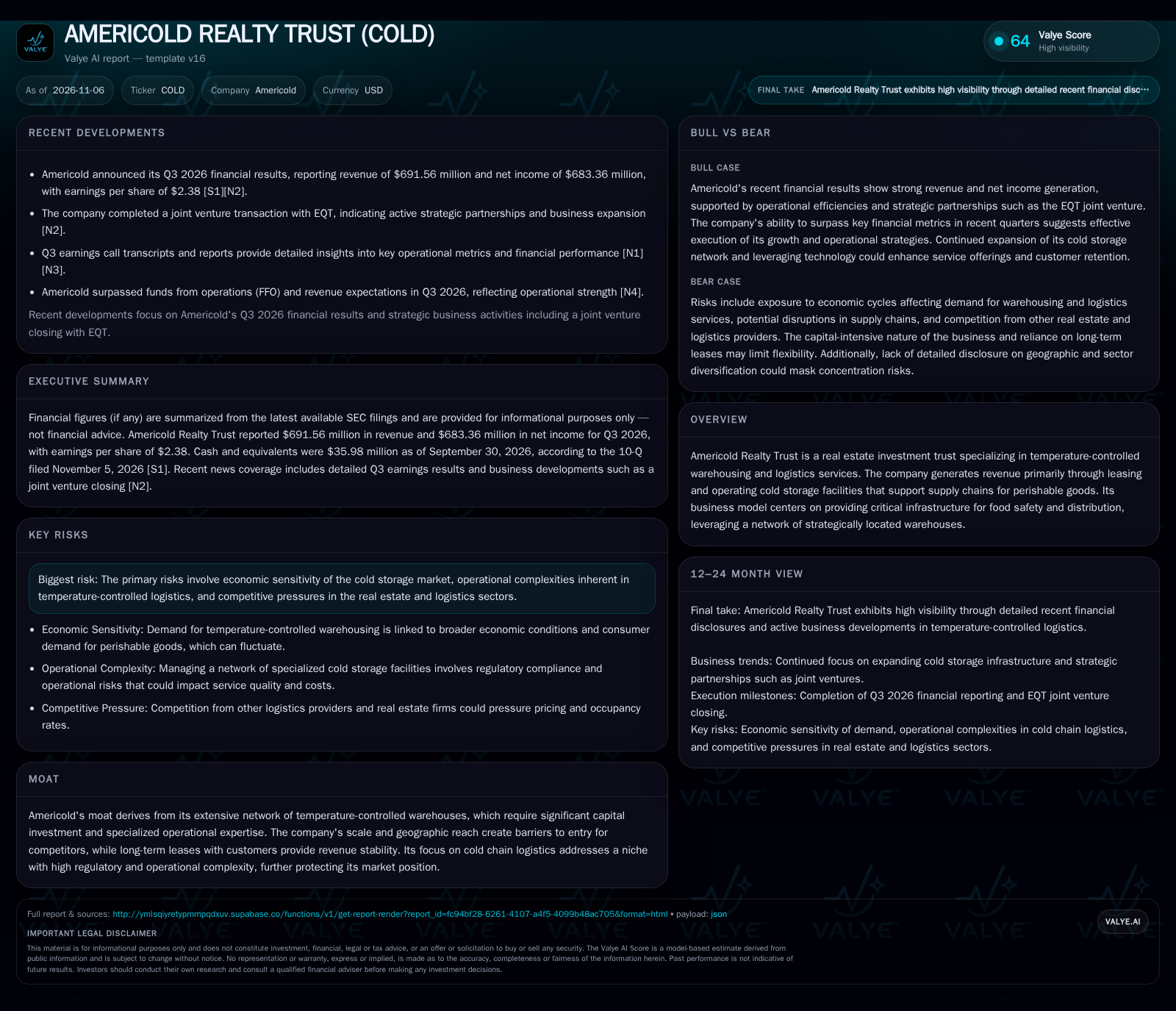
Americold Realty Trust reported $691.56M in Q3 2026 revenue and net income of $683.36M, surpassing expectations and closing a joint venture with EQT. Its large network of temperature-controlled warehouses creates high barriers to entry and revenue visibility, but the business is exposed to economic cycles, operational risks, and capital needs. Strategic growth and efficiency gains could drive upside, but watch for signs of competitive pressure and demand shifts. [S1] [N2] [N4]
Americold Realty Trust’s Q3 2026 performance underscores its central role in the North American cold chain, with nearly $692 million in revenue and a high-profile joint venture with EQT marking both operational momentum and strategic ambition. As a REIT focused on temperature-controlled warehousing and logistics, Americold benefits from scale-driven barriers and long-term customer relationships, yet faces the constant challenge of capital allocation, demand cyclicality, and technological evolution in food and pharmaceutical supply chains. The company's ability to leverage its infrastructure, maintain high occupancy, and adapt to shifting logistics trends will shape its future value proposition.
Q3 2026: Surpassing Expectations and Expanding Through Partnerships
Americold reported $691.56 million in revenue and $683.36 million in net income for Q3 2026, with basic and diluted EPS of $2.38. This performance outpaced prior expectations for both revenue and funds from operations (FFO), indicating operational strength and efficiency gains. [S1] [N4]
The company completed a joint venture with EQT, signaling active business development and a willingness to leverage partnerships for expansion. This move suggests Americold is seeking to accelerate growth, diversify its capital base, or access new markets through collaboration. [N2]
With $35.98 million in cash and equivalents on the balance sheet as of September 30, 2026, Americold retains some liquidity, though the capital-intensive nature of its business means cash requirements remain high for both maintenance and growth. [S1]
These developments together point to a period of operational execution and strategic repositioning, with Americold managing both near-term financial performance and longer-term infrastructure investment.
How Americold’s Business Model Converts Infrastructure into Cash Flow
Americold generates revenue primarily by leasing and operating temperature-controlled warehouses, with customers typically comprising food producers, distributors, and retailers who depend on reliable cold storage for perishable goods. The company’s pricing power is generally underpinned by the critical nature of cold chain logistics and the high switching costs for customers once facilities are integrated into their supply chains.
The economics of the model are driven by occupancy rates, lease duration, and the mix of fixed versus variable charges. Long-term leases with established customers provide revenue visibility, but variable charges (such as handling or value-added logistics services) can add incremental margin when utilization is high.
Operating leverage is significant: fixed costs for facility maintenance, energy, and labor are high, but incremental occupancy can drive disproportionately higher margins once breakeven is achieved. This dynamic makes volume growth and high utilization rates especially valuable.
Capital expenditures are substantial, both for new warehouse construction and ongoing technological upgrades (such as automation or energy efficiency improvements). Funding needs are ongoing, and Americold’s ability to access external capital—potentially via joint ventures or debt markets—will influence its pace of expansion and margin structure.
Barriers, Substitutes, and the Evolving Cold Storage Landscape
Americold’s competitive position is anchored by its scale, network density, and expertise in temperature-controlled logistics. The capital required to build, equip, and operate compliant facilities creates formidable barriers to entry, particularly as regulatory requirements tighten for food safety and pharmaceutical storage.
However, competition remains from other large cold storage REITs, diversified logistics providers, and in some regions, vertically integrated food distributors. Technological change—such as warehouse automation, IoT monitoring, and energy management—may allow competitors to leapfrog older infrastructure or reduce operating costs.
Substitution risk is limited by the lack of practical alternatives to temperature-controlled storage for perishable goods, but there is ongoing pressure on pricing and occupancy from new entrants and customers seeking multi-modal logistics solutions.
Americold’s long-term customer relationships, geographic reach, and ability to offer integrated logistics services help defend its market share, but the company must continue to invest in efficiency and technology to maintain its edge.
When Expansion and Efficiency Unlock Margin and Growth
A favorable scenario for Americold would see sustained demand growth in the cold chain driven by rising perishable food consumption, pharmaceutical logistics, and e-commerce grocery delivery. The EQT joint venture could accelerate network expansion or technological upgrades, enabling Americold to capture incremental share or improve asset utilization.
If occupancy rates increase and the company successfully upsells value-added logistics services, operating leverage could drive margin expansion beyond historical levels. Continued outperformance on FFO and revenue, as seen in recent quarters, would confirm this trajectory. [N4]
Evidence to confirm this scenario would include above-peer occupancy and rental rate growth, increased penetration of high-margin services, and announcements of further strategic partnerships or accretive acquisitions.
Sustaining Value in a Capital-Intensive, Cyclical Market
The most plausible outlook is for Americold to maintain steady revenue and occupancy, supported by long-term leases and gradual network expansion. The company would continue to leverage its scale and customer relationships to defend market share, while incrementally investing in operational improvements.
Periodic economic slowdowns or supply chain disruptions could pressure utilization, but the essential nature of perishable goods logistics would provide a floor to demand. Pricing power may be limited by competition and customer consolidation, but cost discipline and selective investment would help sustain margins.
Confirmation of this scenario would come from stable occupancy rates, predictable cash flow, and moderate growth in FFO and revenue in line with sector peers.
How Economic Shocks and Disruption Could Erode Stability
A negative outcome could result from a sharp economic downturn reducing demand for perishable goods, or from significant supply chain disruptions impacting inventory turnover and storage needs. Underutilization of facilities would quickly erode operating margins given the high fixed-cost base.
If new competitors deploy more efficient or automated facilities, Americold could face pricing pressure or loss of key accounts, especially if it underinvests in technology. High leverage or constrained access to capital markets could force the company to slow expansion or defer maintenance, compounding competitive disadvantage.
Signs supporting this scenario would include declining occupancy, reduced rental rates, negative FFO trends, or evidence of customer churn and delayed capital investment.
Tracking the Drivers of Americold’s Long-Term Value Creation
Occupancy rates and utilization levels across the warehouse network—if disclosed—would provide insight into demand resilience and operating leverage.
Rental rate growth relative to inflation and sector peers would help gauge pricing power and competitive dynamics.
The scale, structure, and returns of the EQT joint venture and any subsequent partnerships or acquisitions should be monitored for accretive impact.
Capital expenditure trends and the proportion allocated to new development versus maintenance would indicate strategic priorities and growth appetite.
Growth in value-added logistics services revenue—if broken out—would test Americold’s ability to deepen customer relationships and improve margins.
Evidence of technological upgrades (automation, energy efficiency) and their impact on cost structure and service quality would help test Americold’s ability to defend its moat.
Disclaimer: This is research-only, informational analysis and not investment advice. It may include AI-generated interpretation and general industry context. Always verify important details using primary sources.

Comments