
Cryoport’s Crossroads: Scaling Life Sciences Logistics Amid Persistent Losses and Supply Chain Strain
Cryoport, Inc. continues to grow revenue in its global life sciences logistics business, but ongoing losses and exposure to supply chain, liability, and operational risks raise questions about the path to sustainable profitability and competitive endurance.
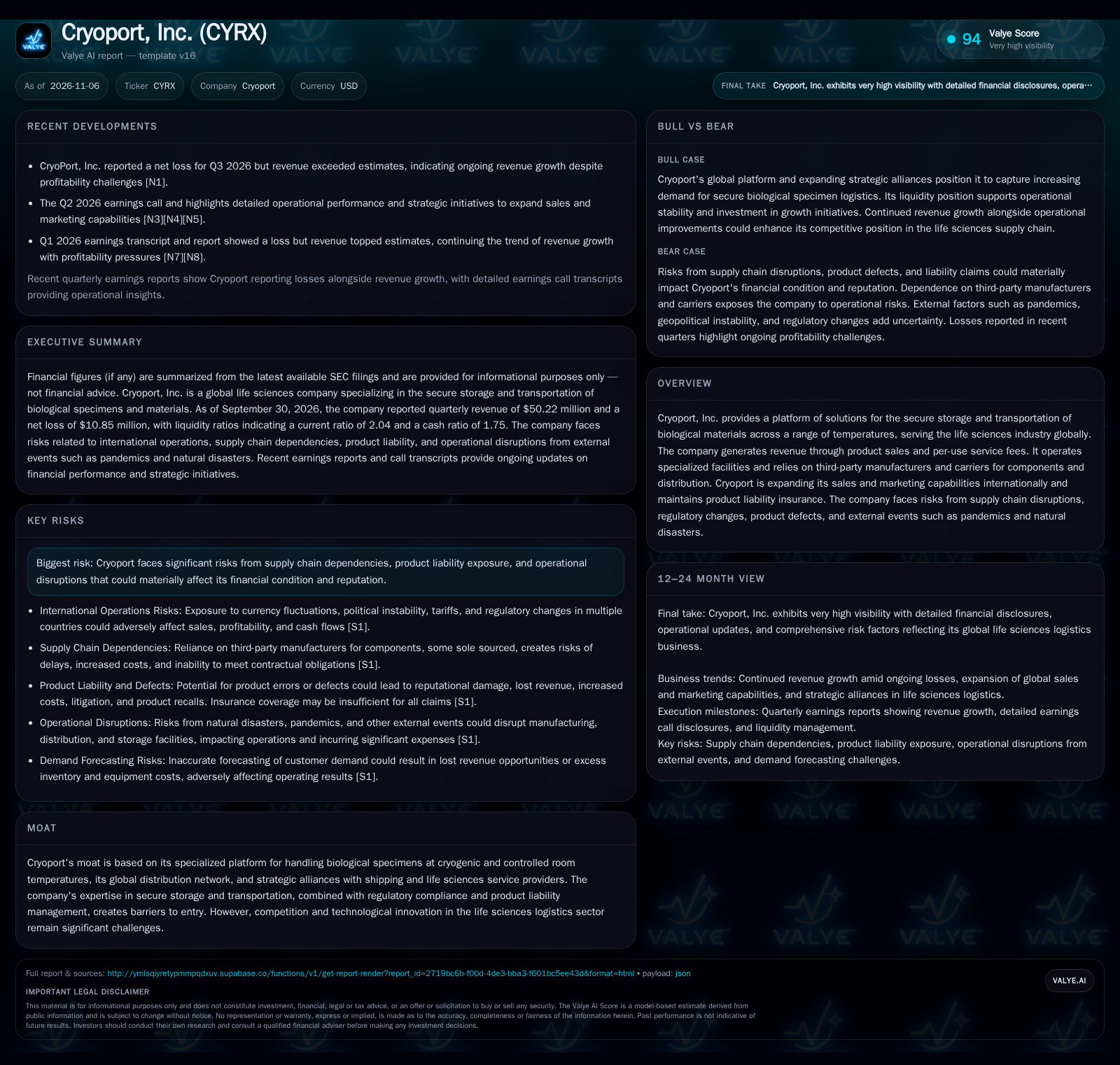
Cryoport is expanding its platform for the global storage and transport of biological specimens, reporting revenue growth but persistent losses as of Q3 2026. The core question is whether Cryoport can convert revenue growth into durable profits while managing complex risks inherent to life sciences logistics. [N1] [S2]
Cryoport, Inc. occupies a strategically important but operationally demanding niche: the secure global storage and transportation of biological specimens for the life sciences industry. The company’s recent quarterly results underscore a familiar tension—steady revenue growth, but persistent net losses—while highlighting the capital intensity, risk exposure, and operational complexity of its business. With a reported liquidity position cushion and active expansion into new geographies and partnerships, Cryoport is betting on market scale and platform depth. Yet, its heavy reliance on third-party suppliers, exposure to liability from sensitive cargo, and vulnerability to supply chain or facility disruptions create a set of risks that could significantly impact its ability to achieve sustainable margins and long-term differentiation. [N1] [S2]
Recent Financial Results Highlight Growth–Profitability Gap
As of September 30, 2026, Cryoport reported quarterly revenue of $50.22 million and a net loss of $10.85 million, translating to an EPS of -$0.25. This continues a pattern of revenue exceeding estimates but with persistent losses, as seen in recent quarters. The company’s liquidity position is considerable, with $279.18 million in cash and equivalents, $113.90 million in short-term investments, and a current ratio of 2.04. Cryoport is actively expanding its global sales and marketing footprint and building new strategic alliances, signaling an ambition to capture a larger share of the growing life sciences logistics market. However, the company’s reliance on third-party manufacturers—some sole-sourced—for critical components, as well as on outside carriers for distribution, leaves it exposed to supply chain disruptions that could materially impact operations and financial results. [N1] [S2]
Revenue Model, Cost Structure, and the Elusive Path to Margin Expansion
Cryoport monetizes its platform primarily through per-use service fees and product sales for the secure storage and transport of biological specimens. The business is inherently capital-intensive: it requires investments in specialized facilities, equipment, and regulatory compliance, as well as ongoing operational spending on logistics, insurance, and risk management. While the per-use fee structure suggests a recurring revenue element, the degree of contract-based revenue visibility, customer retention, and pricing power is not established in current disclosures.
Fixed costs are significant—comprising facility operations, regulatory compliance, and core technology—while variable costs are largely tied to shipment volume, third-party carrier fees, and consumables. This structure creates the potential for operating leverage as volumes scale, but also exposes the company to input cost volatility and underutilization risk if demand falls short. The company reported cash and liquidity metrics for the period; these figures do not by themselves establish operating runway, investment capacity, financial flexibility, or financing capacity. The critical question is whether Cryoport can achieve sufficient scale and process efficiency to move from revenue growth to sustainable margins, especially given the high risks and insurance costs associated with biological specimen logistics.
Defensibility in a Crowded, High-Stakes Logistics Landscape
Cryoport’s competitive positioning is built on its specialized platform for handling temperature-sensitive biological materials, its global distribution network, and its expertise in regulatory compliance. Strategic alliances with shipping and life sciences service providers may enhance reach and credibility, but the industry remains crowded with both large-scale logistics providers and niche, technology-driven upstarts.
Switching costs for customers can be substantial due to the critical nature of biological shipments, regulatory requirements, and integration into clinical trial or pharmaceutical supply chains. However, these barriers are counterbalanced by the risk that product defects, shipment delays, or liability events could rapidly erode customer trust and trigger churn. The pace of innovation in logistics technology—such as real-time tracking, AI-driven risk management, and new packaging solutions—also poses a threat if Cryoport fails to keep up. Ultimately, competitive advantage will depend on reliability, compliance, breadth of service, and the ability to manage risk at scale.
When Scale and Process Excellence Unlock Profitable Growth
The most favorable path for Cryoport is one where its ongoing investments in facilities, sales, and alliances translate into accelerated volume growth, higher utilization of fixed assets, and improved operating leverage. If the company can leverage its liquidity to deepen partnerships with large biopharma and clinical trial customers, it could secure more predictable, multi-year revenue streams and drive margin expansion through process automation and cost discipline.
Evidence that would confirm this scenario includes: a declining trend in net losses relative to revenue growth, rising gross and operating margins, increased proportion of revenue from long-term or recurring contracts, and public disclosure of major new customer wins or renewals. Further, the successful management of supply chain risks—measured by stable or improving delivery reliability and absence of major service disruptions—would validate the operational foundation needed for profitable scaling.
Incremental Progress Amid Persistent Risk and Margin Pressure
The most plausible near-term outcome is that Cryoport continues to grow revenue through expanded geographic reach and deeper industry partnerships, but struggles to achieve consistent profitability due to the capital intensity and risk profile of the business. Operating leverage may improve gradually as volumes rise, but periodic supply chain disruptions, cost inflation, or liability events could offset efficiency gains.
Confirmation of this scenario would come from continued revenue growth in quarterly reports paired with only modest or inconsistent improvements in net loss and margin metrics. Persistent disclosure of operational risks, ongoing investment in facilities and risk management, and the absence of clear evidence for either major cost breakthroughs or runaway losses would support this middle path.
Supply Chain or Liability Shocks Trigger Financial and Reputational Strain
The adverse scenario materializes if Cryoport experiences a major supply chain disruption—such as a failure by a sole-sourced supplier or carrier—or a significant product defect or liability event that exceeds insurance coverage. Such incidents could cause shipment delays or loss of sensitive biological materials, leading not only to direct financial losses and litigation, but also to lasting reputational harm that drives customer defections.
Evidence of this downside would include a sudden spike in product recall or litigation costs, a material increase in net losses or cash burn, negative customer or partner announcements, or public disclosures of major operational failures.
What Will Determine Cryoport’s Long-Term Value Creation?
Quarterly trends in gross margin, operating margin, and net loss—especially relative to revenue growth—would help clarify whether scaling is translating into improved profitability.
Disclosure of contract structures, including the proportion of revenue derived from long-term or recurring agreements, would provide insight into revenue visibility and retention.
Shipment volume growth rates and customer concentration metrics, if disclosed, would signal the depth and breadth of underlying demand.
Updates on supply chain stability, such as the diversification of third-party suppliers or mitigation of sole-sourcing risk, would test operational resilience.
Incidence of product defects, service disruptions, or liability claims—and associated financial impact—should be tracked as leading indicators of operational and reputational risk.
Capital expenditure and working capital trends, particularly in relation to liquidity levels, would indicate the sustainability of ongoing expansion and the risk of overextension.
Progress in strategic alliances, new customer wins, or expansion into new geographies should be watched for signs of competitive momentum.
Any material changes in regulatory environment or logistics technology adoption that could alter the competitive landscape or cost structure would be relevant to the thesis.
Disclaimer: This is research-only, informational analysis and not investment advice. It may include AI-generated interpretation and general industry context. Always verify important details using primary sources.

Comments