
Citigroup’s Profitability Reset: Cost Discipline, Revenue Diversity, and the Challenge of Sustainable Returns
Citigroup is executing a strategic shift focused on cost reduction and operational efficiency, aiming to enhance long-term profitability amid a decade-high revenue base and persistent industry headwinds. The outcome depends on execution, evolving credit quality, and the durability of its diversified model.
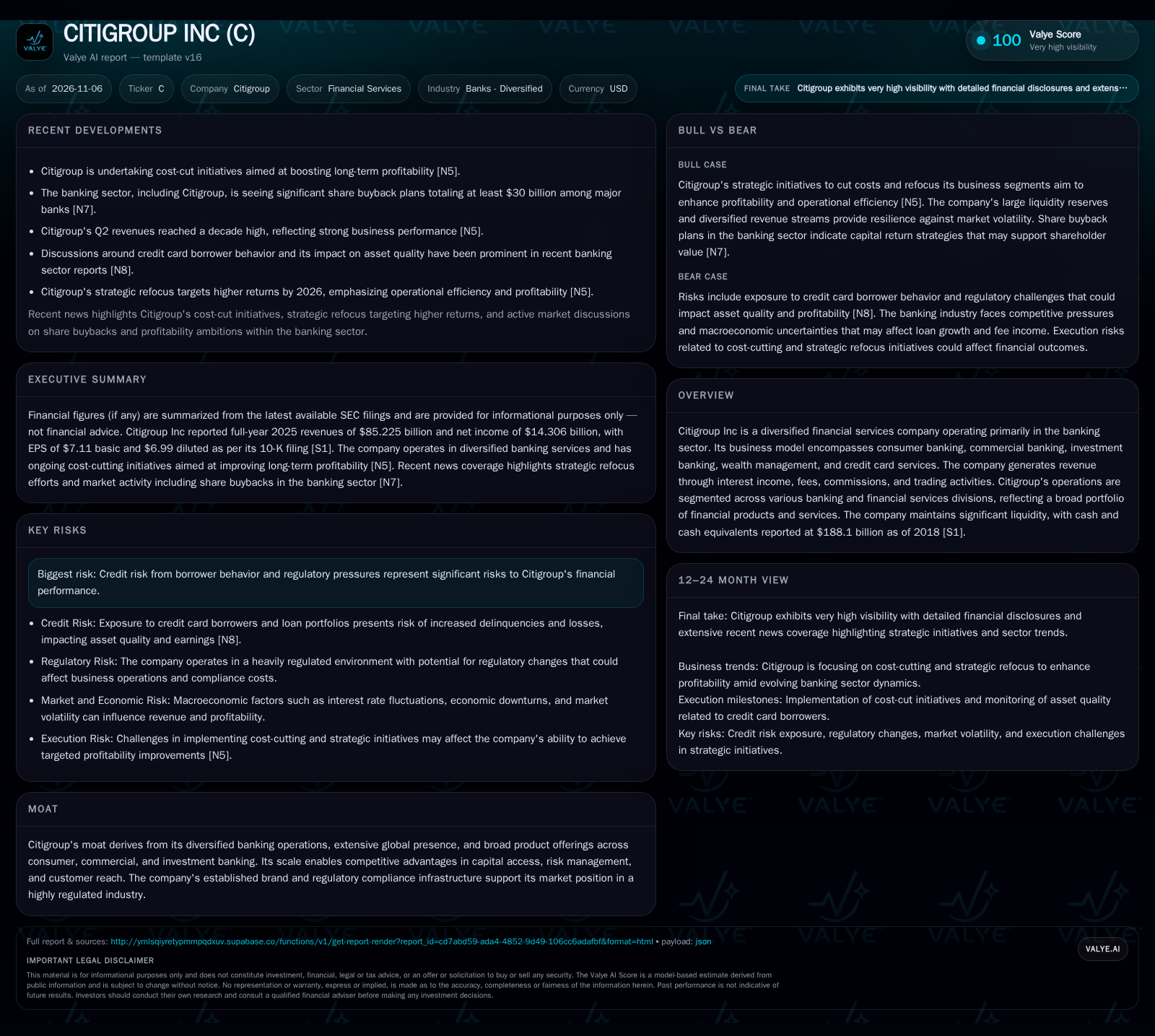
Citigroup reported $85.2B in 2025 revenue and $14.3B in net income, with cost-cutting and strategic refocus initiatives underway to drive higher returns by 2026. The bank’s broad revenue base—spanning consumer, commercial, investment banking, and wealth management—offers resilience, but the real test lies in execution and adapting to ongoing industry and macroeconomic pressures. Close monitoring of cost savings, credit performance, and segment profitability will determine whether Citigroup can deliver sustainable value.
Citigroup stands at an inflection point, executing a multi-year transformation centered on cost discipline and a sharper focus on high-return business lines. With 2025 revenues at $85.2 billion and net income over $14 billion, the bank’s financial foundation is robust, but management’s ability to drive sustainable profitability improvements through cost cuts and strategic realignment is under scrutiny. As the banking sector contends with structural pressures—ranging from digital disruption to macroeconomic uncertainty—Citigroup’s diversified platform and scale offer both cushioning and complexity. The next phase will test whether operational streamlining can unlock durable value without sacrificing growth or risk management.
Recent Performance and the Strategic Pivot: What’s Changing Now
Citigroup reported $85.225 billion in revenue and $14.306 billion in net income for 2025, with basic EPS at $7.11 and diluted EPS at $6.99 [S1]. These results reflect a strong operational year, highlighted by Q2 revenues reaching a decade high [N5]. However, the most consequential development is Citigroup’s ongoing cost-cutting program and a strategic refocus aimed at boosting long-term profitability and efficiency [N5]. The company has publicly set its sights on higher returns by 2026, indicating a willingness to reshape its expense base and business mix to adapt to evolving industry conditions. This context sets the stage for a critical test of execution: can Citigroup translate scale and revenue diversity into structurally higher returns in a challenging environment?
How Citigroup Makes—and Could Lose—Money: Revenue Streams, Cost Structure, and Leverage
Citigroup’s business model is built on multiple income streams: net interest income from lending, fee-based revenue from investment banking and wealth management, card and transaction fees, and trading profits [S1]. This diversity helps buffer the bank against single-segment volatility, but each line carries its own sensitivities. For example, consumer banking and credit cards are volume-driven but exposed to credit cycles, while investment banking and trading depend on market activity and risk appetite.
The company’s cost base is significant, reflecting both the operational complexity of a global institution and regulatory compliance demands. Fixed costs—especially technology, branch infrastructure, and compliance—are high, meaning that efficiency gains can drive substantial incremental profitability if volumes are stable or growing. Conversely, failure to execute on cost discipline or a material downturn in loan quality could erode margins rapidly.
Operating leverage is a double-edged sword: successful cost cuts and revenue growth can expand margins quickly, but shocks to asset quality or fee income can magnify downside. The company reported cash and liquidity metrics for the period; these figures do not by themselves establish operating runway, investment capacity, financial flexibility, or financing capacity.
Assessing Citigroup’s Edge: Scale, Breadth, and the Threat of Substitution
Citigroup’s global reach and product breadth are its primary competitive advantages, enabling cross-border banking, diverse customer acquisition, and economies of scale in both funding and technology. Its presence across consumer, commercial, and investment banking allows for cross-selling and risk diversification, and its brand is recognized worldwide.
Yet, these strengths are increasingly challenged. Large universal banks face competition from specialized financial institutions, fintech disruptors, and digital-first banks that can cherry-pick profitable niches without legacy cost structures. Regulatory burdens and capital requirements are higher for global systemically important banks, which can limit agility compared to smaller or less regulated competitors.
Switching costs for large corporate and institutional clients can be substantial, but retail customers and small businesses are increasingly mobile, especially as digital offerings proliferate. The question is whether Citigroup’s scale and integration can deliver sufficient customer value to offset the cost and complexity of its global operations.
If Execution Delivers: Cost Cuts, Credit Quality, and Gains from the Strategic Refocus
The most favorable scenario for Citigroup is one in which management successfully implements cost reductions without impairing revenue growth or customer experience. If expense reductions translate into a lower efficiency ratio and segment profitability improves, the bank could see meaningful EPS and ROE expansion. Sustained credit quality—particularly in cards and consumer lending—would reinforce this outcome, allowing the company to allocate capital to higher-return activities.
Evidence confirming this scenario would include a demonstrable decline in non-interest expense relative to revenue, stable or improving net interest margins, and strong asset quality metrics (e.g., low charge-offs and non-performing asset ratios). Additionally, visible progress in streamlining underperforming business lines or geographies would support the thesis that Citigroup’s strategic refocus is creating a more resilient, higher-return institution.
What Sustained Progress Could Look Like: Incremental Gains, Execution Risks, and Macro Sensitivity
The most likely path is that Citigroup achieves moderate cost savings and some improvement in operating efficiency, but faces ongoing competitive and regulatory pressures that cap returns below pre-crisis levels. Revenue growth may be uneven across segments—stronger in cards and wealth management, less so in investment banking if capital markets remain volatile. Credit costs could rise modestly if consumer delinquencies pick up, partially offsetting expense gains.
In this scenario, Citigroup maintains solid profitability and capital levels, but ROE and EPS growth are incremental rather than transformational. Confirmation would come from gradual improvement in the efficiency ratio, stable credit quality, and consistent (if not accelerating) top-line growth. Falsification would be signaled by stalling cost cuts, an uptick in credit losses, or renewed regulatory setbacks.
Where the Model Breaks: Credit Deterioration, Execution Shortfalls, and Structural Headwinds
The adverse scenario centers on failure to deliver cost savings or a sharp deterioration in credit quality—particularly in consumer loans and credit cards. If execution on the strategic refocus stalls or is derailed by regulatory, legal, or operational setbacks, expense ratios could remain stubbornly high and profitability erode. Rising charge-offs or non-performing assets would not only pressure earnings, but could also force higher capital reserves or regulatory intervention.
Additional headwinds could come from intensifying digital competition, margin compression from lower-for-longer interest rates, or geopolitical/regulatory shocks in key international markets. Evidence for this scenario would be a rising efficiency ratio, negative operating leverage, and deteriorating asset quality metrics. A failure to deliver visible progress on business simplification or cost reduction would further undermine the investment case.
Milestones That Will Test Citigroup’s Profitability Transformation
Progress on non-interest expense reduction as a share of revenue; a useful metric would be quarterly updates on the efficiency ratio and absolute expense levels if disclosed.
Trends in net charge-offs and non-performing assets, particularly in the consumer and credit card portfolios, to gauge asset quality and early signs of credit stress.
Segment profit contribution and revenue mix—tracking whether growth is coming from higher-return businesses or offset by declines in legacy or low-margin operations.
Capital ratios (CET1, Tier 1) and management commentary on capital allocation, as these will reflect both resilience and flexibility amid regulatory change.
Market share shifts in key business lines, especially in cards, wealth management, and institutional banking, to assess whether Citigroup is gaining ground or losing to competitors.
Updates on digital investment and technology deployment, since digital adoption is both a cost lever and a competitive necessity.
Management’s progress reports on strategic refocus milestones, including any divestitures, restructuring charges, or exit from underperforming markets or segments.
Disclaimer: This is research-only, informational analysis and not investment advice. It may include AI-generated interpretation and general industry context. Always verify important details using primary sources.

Comments