
Trupanion’s Data-Driven Pet Insurance Model: Margin Pressures, Veterinary Integration, and the Next Phase of Market Expansion
Trupanion leverages proprietary pet health data and direct veterinary payments to differentiate its subscription-based insurance, but faces intensifying cost pressures and competitive threats as the pet insurance market evolves. The sustainability of its value proposition depends on its ability to balance rising claims costs, deepen veterinary partnerships, and expand internationally.
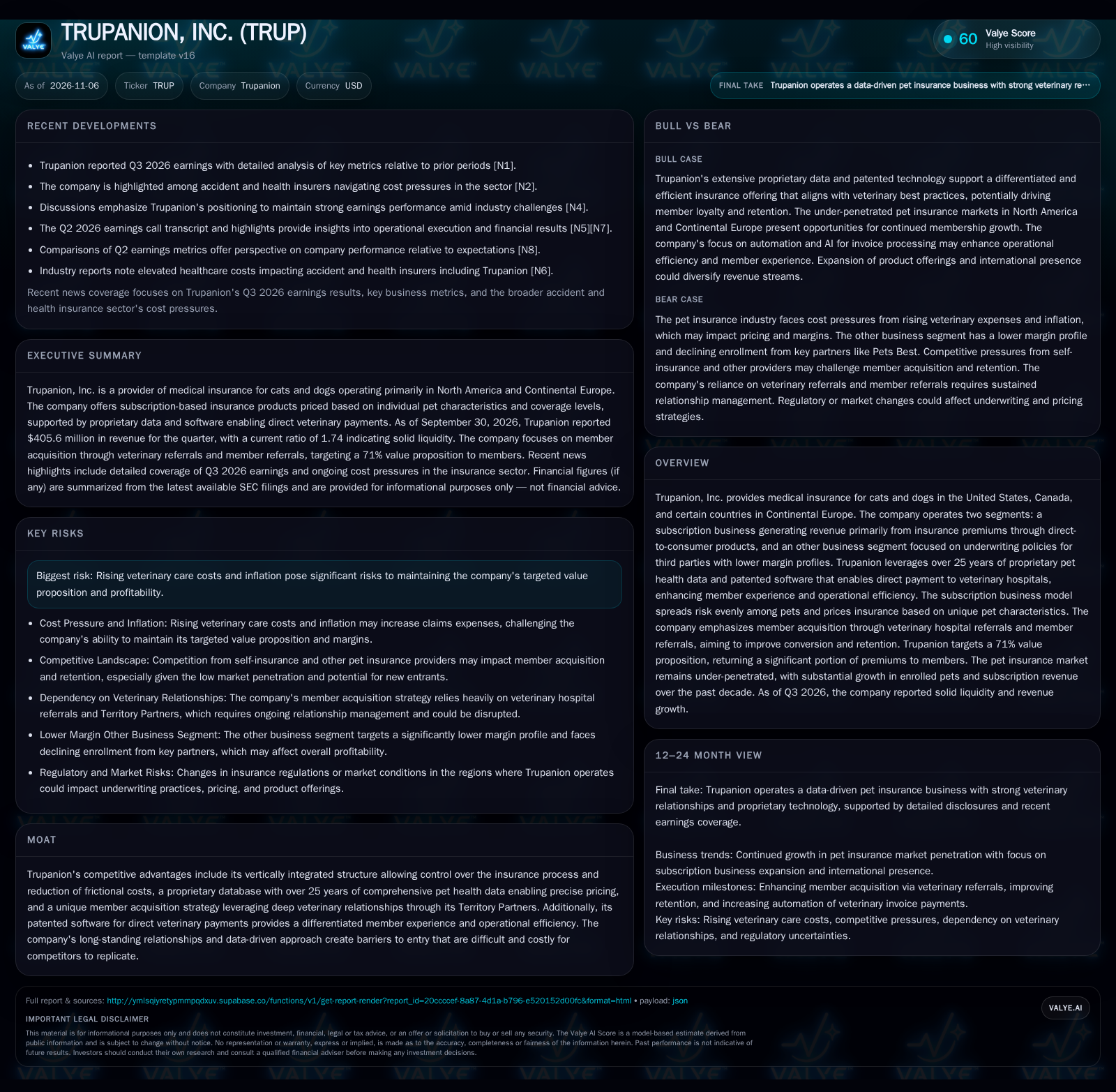
Trupanion reported $405.6 million in Q3 2026 revenue, maintaining a current ratio of 1.74. Its core subscription business uses proprietary data and patented software for direct veterinary payments, aiming to deliver a 71% value proposition to members. Sustained growth relies on managing cost inflation, defending its differentiated model, and expanding beyond North America. Margin compression and competitive threats from lower-margin segments and new entrants remain key risks. [S2] [N1]
Trupanion operates at the intersection of insurance, pet healthcare, and software, seeking to redefine the pet insurance experience through proprietary data and deep integration with veterinary practices. Its subscription-centric model has enabled consistent revenue growth, but the company now faces a complex landscape of rising claims costs, competitive encroachment, and the challenge of balancing value with profitability. The next phase will test whether its technology and relationship-driven approach can sustain margin and defend against both traditional and emerging rivals.
Recent Performance Highlights and Strategic Context
Trupanion reported $405.6 million in revenue for Q3 2026, continuing a multi-year trend of topline growth in its core subscription pet insurance business. The company reported a current ratio of 1.74 for the period. [S2] [N1]
Recent earnings coverage emphasizes Trupanion’s ability to maintain earnings momentum amid broader insurance sector cost pressures, but also notes persistent industry-wide challenges related to veterinary inflation and claims expense. The company’s dual-segment structure—subscription and 'other' (third-party underwriting)—remains intact, with the latter contributing lower margins and facing enrollment declines from key partners. [N1] [N4]
Trupanion continues to prioritize member acquisition through veterinary referrals and proprietary technology for direct payments to clinics, reinforcing its differentiated model as it pursues both domestic and international expansion. [S2]
Subscription Model Economics and Margin Dynamics
Trupanion’s core revenue driver is its subscription insurance segment, where members pay monthly premiums for coverage tailored to individual pet characteristics. The company targets a 71% value proposition—returning a significant portion of premiums to members through claims—while aiming to cover fixed costs (technology, data, and administrative infrastructure) and generate a modest underwriting margin. This approach is designed to maximize member satisfaction and retention, but it narrows the margin buffer available to absorb shocks from rising veterinary costs or claims inflation.
Premium pricing is risk-based, leveraging over 25 years of proprietary pet health data. This allows for granular pricing by breed, age, and geography, potentially mitigating adverse selection but increasing the complexity of actuarial management as the portfolio expands. Variable costs scale with claims frequency and severity, while fixed costs are spread over a growing member base, providing some operating leverage as enrollment rises.
The 'other' business segment, focused on third-party underwriting, delivers lower margins and is subject to partner-driven enrollment volatility. If this segment continues to shrink or remains structurally less profitable, it may dilute consolidated margin expansion even as subscription revenue grows. The company reported cash and liquidity metrics for the period; these figures do not by themselves establish operating runway, investment capacity, financial flexibility, or financing capacity. [S2]
Veterinary Integration and Data as Differentiators—But for How Long?
Trupanion’s moat is built on three pillars: proprietary pet health data, patented software for real-time, direct veterinary payments, and a distribution strategy deeply integrated with veterinary practices via Territory Partners. This structure reduces claims processing friction, aligns incentives with veterinarians, and can improve member experience and retention.
However, these advantages are not unassailable. The pet insurance market remains under-penetrated, attracting new entrants and legacy insurers who may replicate elements of Trupanion’s approach or compete on price and breadth. Self-insurance, employer-sponsored pet benefits, and alternative wellness plans also serve as partial substitutes, particularly if price transparency or claims experience deteriorates.
The 'other' segment’s lower margin profile and reliance on third-party partners expose Trupanion to competitive displacement and margin pressure. Regulatory changes or technological advances in claims automation could erode barriers over time, especially if rivals can match or exceed Trupanion’s data-driven pricing and veterinary integration.
If Automation and Veterinary Relationships Drive Retention and Margin Expansion
A favorable outcome for Trupanion hinges on successfully leveraging its proprietary data and patented payment technology to further reduce claims friction and improve the member experience. If ongoing investments in automation and AI for invoice processing translate into materially lower operating costs and faster claims resolution, the company could both defend and expand its 71% value proposition target, supporting high retention and positive word-of-mouth.
Should veterinary referrals continue to scale efficiently, and if international expansion or new product offerings gain traction, Trupanion could see a compounding effect on revenue growth and operating leverage. Evidence confirming this scenario would include sustained or accelerating growth in subscription enrollment, improving combined ratios despite sector inflation, and positive trends in member lifetime value relative to acquisition cost.
Further, a reversal or stabilization of declining enrollment in the 'other' segment would signal improved partner relationships or product innovation, potentially bolstering consolidated profitability.
Balancing Growth with Cost Headwinds in a Competitive Market
The most plausible outcome is continued subscription revenue growth, offset by persistent pressure on underwriting margins due to rising veterinary costs and inflation. Trupanion’s proprietary data and direct-pay software may help mitigate some claims volatility and maintain member loyalty, but incremental improvements will be needed to offset industry-wide cost creep.
Veterinary and member referrals are likely to remain the primary acquisition channels, but their effectiveness may plateau as market penetration increases and as competitors intensify marketing efforts. The 'other' business segment may continue to shrink or remain less profitable, acting as a drag on consolidated results unless product repositioning or new partnerships emerge.
Confirmation of this scenario would include steady but decelerating subscriber growth, stable or modestly declining margins, and ongoing investments in technology and international expansion without a dramatic shift in the core business mix.
Margin Compression and Channel Disruption Undermine the Model
The adverse scenario for Trupanion involves a combination of rapid claims cost inflation, ineffective premium repricing, and channel disruption. If veterinary care costs accelerate faster than anticipated and regulatory or competitive pressure prevents timely premium adjustments, the company’s 71% value proposition could become unsustainable, forcing margin sacrifice or member churn.
A breakdown in veterinary or member referral channels—due to competitive poaching, relationship fatigue, or regulatory intervention—could slow acquisition and degrade retention, eroding the core subscription base. Further declines in the 'other' segment would exacerbate topline and margin pressure, especially if fixed costs rise with international expansion or technology investments do not yield expected efficiency gains.
Evidence for this scenario would include rising loss ratios, negative trends in member retention, accelerating declines in 'other' segment revenue, and signs of competitive share loss or heightened price competition.
Testing the Thesis: Data Points That Will Clarify Trupanion’s Trajectory
Sustained growth in subscription enrollment and average premium per pet—if disclosed—will be crucial for validating expansion and pricing power.
Trends in consolidated and segment-level combined ratios (loss plus expense ratio) will indicate the company’s ability to manage claims cost inflation and defend margins.
Member retention rates, especially for cohorts acquired through veterinary referrals, would help test the stickiness of Trupanion’s distribution model.
Updates on the rate of direct veterinary payment adoption and software penetration among clinics would clarify the moat’s durability.
Revenue and enrollment trends in the 'other' business segment, particularly with key partners, will signal whether margin drag is structural or reversible.
Disclosures on international revenue mix and new market launches will illustrate the pace and execution risk of geographic diversification.
Any commentary on regulatory developments or changes to insurance pricing flexibility in key markets could materially affect the risk profile.
If disclosed, member acquisition cost (CAC) and lifetime value (LTV) by channel would provide insight into the sustainability of Trupanion’s growth engine.
Disclaimer: This is research-only, informational analysis and not investment advice. It may include AI-generated interpretation and general industry context. Always verify important details using primary sources.

Comments