
Guardant Health’s Precision Oncology Platform: Commercial Expansion, Data Leverage, and the Tension Between Innovation and Profitability
Guardant Health’s FDA-approved liquid biopsy and screening portfolio, notably Guardant360 CDx and Shield, positions the company at the center of precision oncology. As regulatory acceptance and payer coverage grow, the challenge shifts to scaling adoption and achieving sustainable margins amid persistent net losses, cybersecurity threats, and intense competition.
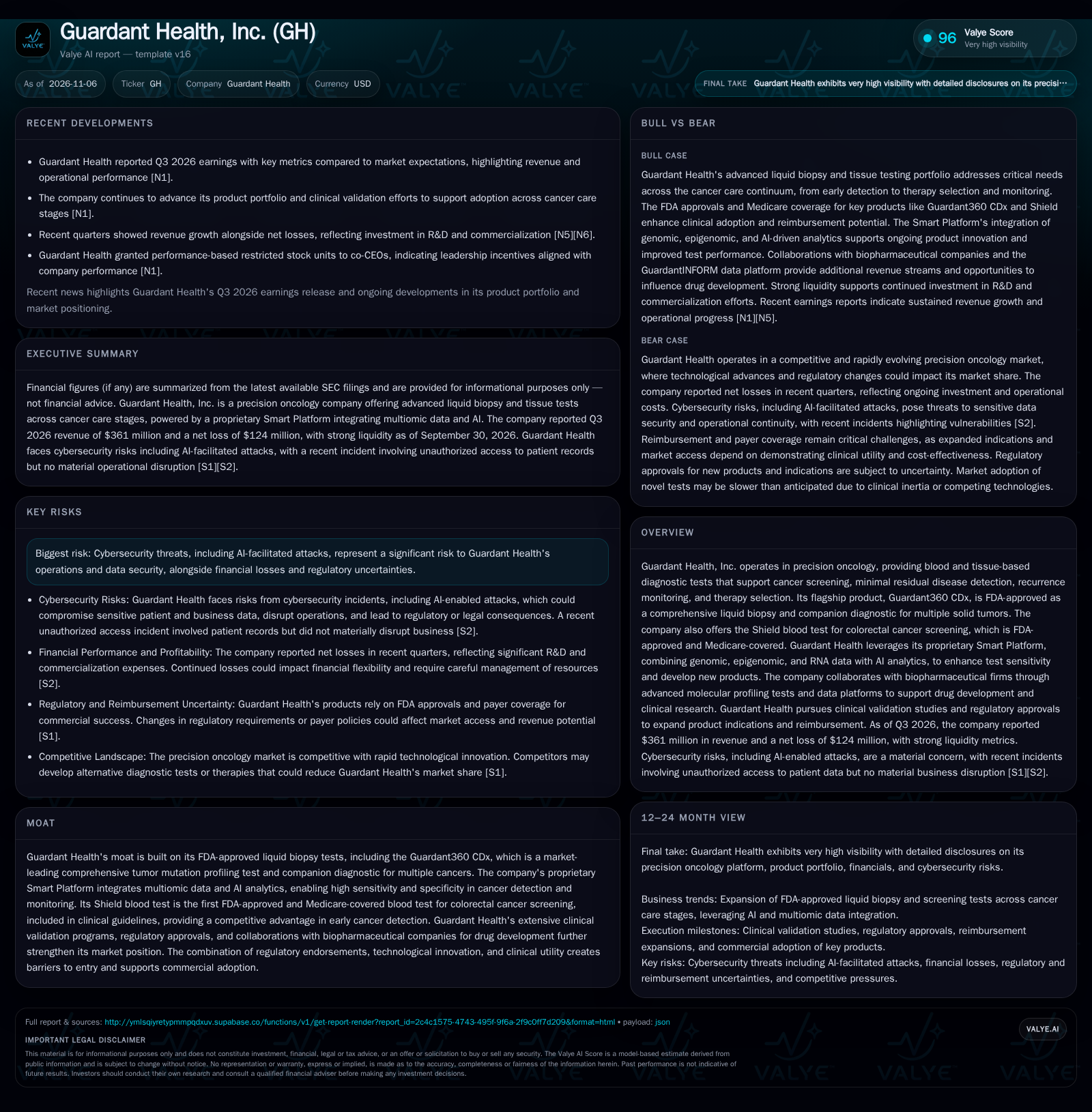
Guardant Health’s liquid biopsy and blood-based cancer screening tests have achieved FDA approval and Medicare coverage, supporting their clinical credibility and reimbursement pathway. The company continues to invest heavily in R&D and commercialization, resulting in ongoing net losses despite revenue growth. Its proprietary Smart Platform and data assets could support long-term differentiation, but the path to profitability depends on broadening clinical adoption, expanding reimbursement, and managing operational risks including cybersecurity threats. [S1] [S2]
Guardant Health stands at the intersection of diagnostics, data, and AI-driven precision oncology. Its FDA-cleared and Medicare-covered liquid biopsy and blood-based screening tests, including Guardant360 CDx (for tumor mutation profiling) and Shield (for colorectal cancer screening), have achieved significant regulatory and clinical milestones. Yet, the company’s financials reveal the tension between commercial momentum and sustained losses as it invests in product development, validation, and market expansion. With over a billion dollars in cash and a suite of advanced data and analytic platforms, Guardant Health must now convert clinical credibility into widespread adoption and scalable economics, while navigating cybersecurity threats and an evolving competitive landscape. [S1] [S2]
Where Guardant Health Stands: Q3 2026 Financials, Product Validation, and Operational Risks
Guardant Health reported $361 million in revenue and a net loss of $124 million for Q3 2026, with basic and diluted EPS of -$0.93. The company’s cash and equivalents stood at $1.03 billion, and its current ratio was 3.6 as of September 30, 2026, reflecting a reported liquidity position. [S2]
The Guardant360 CDx liquid biopsy test and Shield blood test for colorectal cancer are both FDA-approved and have achieved Medicare coverage, with Shield also included in NCCN guidelines. This regulatory and payer acceptance is a crucial enabler for clinical adoption and reimbursement. [S1]
A recent cybersecurity incident resulted in unauthorized access to patient records, underscoring the company’s exposure to data risks, though the event did not materially disrupt business operations. [S2]
These facts set the stage: Guardant Health’s platform and products have regulatory and payer validation, but the company remains loss-making, and operational risks, especially around data security, are non-trivial.
How Guardant Health’s Business Model Scales—And Where Margin Pressure Persists
Guardant Health’s revenue model is anchored in advanced diagnostic testing, with the bulk of sales likely coming from clinical laboratory tests for oncology patients (liquid biopsy for tumor profiling, screening, and residual disease detection), supplemented by pharma partnerships and data solutions. The company’s FDA-approved and Medicare-covered products suggest a pathway to reimbursement at scale, but the precise mix of payor, self-pay, and research revenue is not disclosed. [S1] [S2]
Unit economics in diagnostic testing are typically characterized by high fixed costs (in R&D, regulatory, and lab infrastructure) and variable costs tied to consumables, sample processing, and logistics. As test volumes increase, operating leverage should improve—assuming pricing holds and payor mix does not deteriorate. However, Guardant Health’s ongoing net losses and substantial R&D and commercialization spend indicate that the company has not yet reached break-even scale, likely due to a combination of volume ramp-up, sustained investment in clinical validation, and the need to support a broadening portfolio.
The Smart Platform’s integration of genomic, epigenomic, and AI data may support higher-value test offerings and incremental pricing power, especially for more complex or actionable tests. However, pricing pressure from payors and competition is an ongoing threat, and the need for continuous innovation to stay ahead technologically increases capital requirements.
The company’s biopharma services and data platforms (e.g., GuardantINFORM, GuardantINFINITY) provide additional, likely higher-margin revenue streams, but these are not yet the core driver. Over time, the ability to leverage large clinical and molecular datasets for pharma partnerships and clinical trial support could diversify revenue and improve blended margins—if adoption grows and competitive differentiation is maintained.
Defensibility in a Crowded Precision Oncology Arena: Regulatory, Data, and Ecosystem Advantages—But Not Guaranteed
Guardant Health’s most defensible assets are its FDA-approved, Medicare-covered tests (notably Guardant360 CDx and Shield), its inclusion in clinical guidelines, and its proprietary Smart Platform, which integrates multiomic data and AI analytics. These create regulatory and clinical hurdles for new entrants, and the company’s ongoing clinical validation efforts further reinforce its position. [S1]
However, the precision oncology diagnostics market is highly competitive and fast-evolving. Major diagnostics firms, emerging liquid biopsy startups, and large reference labs are all investing in similar technologies. Barriers to entry are meaningful in terms of regulatory approval and clinical adoption, but not insurmountable—especially as technology advances and payors push for cost-effectiveness.
Guardant Health’s differentiated data assets and pharma collaborations may confer a network advantage: as more samples and outcomes are aggregated, the Smart Platform could improve test performance and support new applications. Yet, this advantage is only durable if Guardant maintains data quality, clinical relevance, and compliance with evolving privacy regulations.
Switching costs for clinicians and health systems are moderate: while integration into workflows and guidelines helps, payors and providers will still evaluate alternatives on price, coverage, and evidence. Sustained leadership will require ongoing investment in evidence generation, regulatory submissions, and customer support.
If Adoption Accelerates: Testing Volume Scale, Expanded Reimbursement, and Data Monetization
The bullish scenario for Guardant Health is predicated on rapid expansion of test volumes—especially for Shield (colorectal cancer screening) as it benefits from guideline inclusion and broad Medicare coverage, and for Guardant360 CDx as more targeted therapies require companion diagnostics. As awareness and clinical comfort increase, the company could see sustained double-digit revenue growth and improved operating leverage.
Expanded reimbursement from commercial payors, additional FDA approvals for new indications, and successful international market expansion could further accelerate growth. The Smart Platform could enable the launch of next-generation tests (e.g., for other cancer types or pan-cancer screening) and support pharma partnerships, unlocking new high-margin revenue streams.
Confirmation of this scenario would come from: a clear inflection in test volumes, sequential margin improvement, new positive reimbursement decisions, and evidence of pharma/data revenue scaling as a share of total sales. If disclosed, higher retention rates among prescribing clinicians and increased share of testing from non-invasive modalities would also support the thesis.
Clinical Adoption Ramps, But Margin Expansion Lags Investment
The most plausible trajectory is that Guardant Health continues to grow test volumes and revenue as clinical adoption of its FDA-approved products increases, but the pace of margin improvement is gradual due to sustained R&D, clinical validation, and go-to-market spend. Net losses persist in the near term as the company prioritizes market share and pipeline development over immediate profitability.
Reimbursement expands incrementally, but commercial payor adoption lags Medicare, and new product launches face regulatory and clinical evidence hurdles. Pharma/data revenue grows, but remains a minority of total sales while the core diagnostics business scales.
Evidence supporting this scenario would include steady, but not accelerating, revenue growth; continued net losses; ongoing news of clinical studies and product extensions; and a slow, stepwise improvement in gross and operating margins. If disclosed, metrics like average reimbursement per test, test mix, and R&D expense as a share of revenue would help validate the base case.
Adoption Bottlenecks, Margin Compression, and Operational Shocks Threaten the Model
The bear scenario centers on slower-than-expected clinical adoption—either due to competition, reimbursement delays, or insufficient clinical evidence for expanded indications. If commercial payors are slow to cover new tests, or if competing technologies (including alternative liquid biopsy or imaging modalities) gain traction, test volume growth could stall.
Margin compression could result from pricing pressure, higher-than-expected cost of goods, or operational inefficiencies as the company scales. A major data breach or regulatory setback could disrupt business and erode customer trust, while persistent net losses may eventually constrain investment in innovation.
Confirmation of this scenario would include flat or declining test volumes, negative reimbursement developments, worsening margins, or a material business disruption from a cybersecurity incident. If disclosed, a spike in customer churn, loss of guideline inclusion, or adverse regulatory outcomes would further support the downside case.
Milestones and Metrics That Will Determine Guardant Health’s Trajectory
Trends in test volume growth, especially for Shield and Guardant360 CDx, as these products are key revenue drivers and adoption proxies. If disclosed, monthly or quarterly volume data would help test the thesis.
Updates on gross margin and operating margin trends, which would indicate whether scale and mix improvements are translating into economic leverage.
Progress on new reimbursement decisions from commercial payors or international authorities, particularly for Shield and new product indications.
The launch and adoption rates of next-generation products or expanded indications, as evidenced by new FDA approvals or guideline inclusions.
Pharma and data platform revenue growth, and the share of total revenue attributable to these segments. If disclosed, metrics on partnership count, contract size, or data utilization would be useful.
Incidence and impact of cybersecurity or data privacy incidents, including any regulatory or legal consequences beyond the most recent event.
R&D and commercialization expense trends relative to revenue, as a gauge of investment intensity versus scaling efficiency.
Changes in clinical guideline recommendations or payer coverage criteria that could affect demand for core tests.
Disclaimer: This is research-only, informational analysis and not investment advice. It may include AI-generated interpretation and general industry context. Always verify important details using primary sources.

Comments