
Excelerate Energy: LNG Infrastructure Scale Meets a Shifting Global Gas Landscape
The company’s ability to leverage its infrastructure investments will define its trajectory as global demand, regulatory currents, and capital intensity reshape the competitive field.
The company’s moat hinges on its capital-intensive infrastructure and regulatory barriers, but it faces ongoing risks from commodity price swings and high fixed costs. The key question is whether Excelerate can translate sector tailwinds and operational transparency into sustainable margin expansion and cash-flow growth as global LNG dynamics evolve. [S2] [N5]
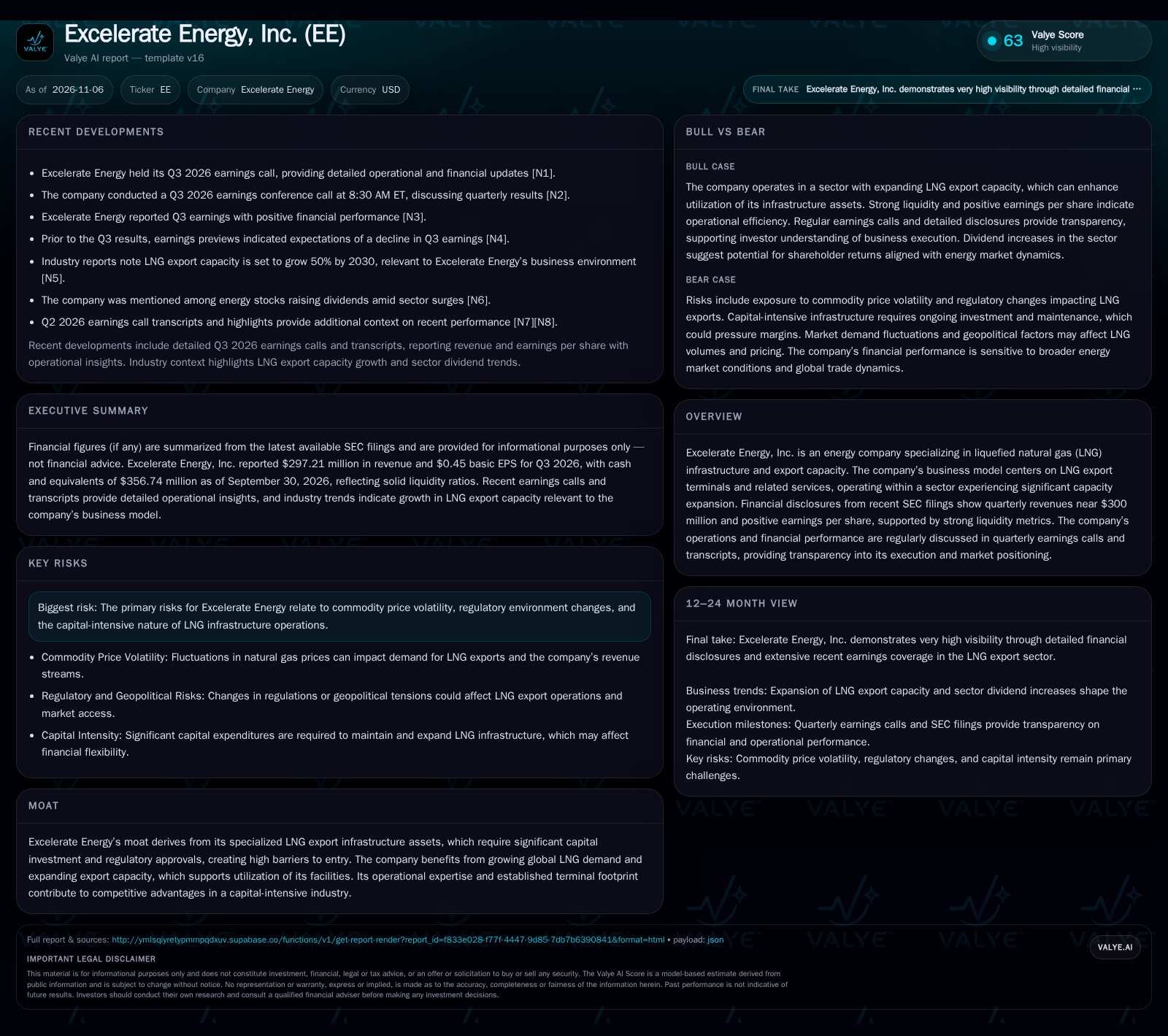
Excelerate Energy, Inc. is strategically positioned within the rapidly evolving liquefied natural gas (LNG) export market, reporting nearly $300 million in Q3 2026 revenue and maintaining a reported liquidity position cushion. As global LNG export capacity is poised for a major expansion by 2030, Excelerate’s infrastructure-heavy model offers both insulation from new entrants and exposure to sector volatility. The company’s challenge now is to convert sector tailwinds and operational visibility into durable returns, even as capital intensity and regulatory flux continue to shape the landscape.
Recent Results Highlight Financial Strength and Industry Tailwinds
Excelerate Energy reported Q3 2026 revenue of $297.21 million, with basic and diluted EPS of $0.45 and $0.44, respectively [S2]. Cash and equivalents stood at $356.74 million, underpinning a current ratio of 1.95 and a cash ratio of 1.13 as of September 30, 2026 [S2]. The company’s latest earnings calls and transcripts have provided additional operational transparency, while sector commentary points to a 50% projected increase in LNG export capacity by 2030—a trend highly relevant to Excelerate’s infrastructure-centric model [N1] [N2] [N5].
Infrastructure-Driven Revenue Model and the Stakes of Capital Intensity
Excelerate Energy’s core economics are anchored in owning and operating LNG export terminals and related infrastructure. Revenue is generally influenced by factors such as capacity utilization and throughput, and in the broader industry, long-term offtake agreements or capacity contracts are common, though the specific commercial mechanics for Excelerate are not detailed in the current report. The business is highly capital-intensive, with substantial fixed costs tied to construction, maintenance, and regulatory compliance. This structure means operating leverage can be significant—incremental volumes can drive substantial margin expansion when utilization rates are high.
However, capital intensity also creates pressure on free cash flow, especially in periods of underutilization or when major upgrades are required. With $617.99 million in current assets versus $316.95 million in current liabilities [S2], Excelerate has near-term balance sheet strength, but the need for ongoing investment in infrastructure to capture future demand could constrain capital allocation for dividends, buybacks, or growth initiatives if market conditions turn adverse. The company’s ability to secure long-term demand commitments and manage commodity exposure will be critical to sustaining positive unit economics over the long term.
Barriers to Entry, Regulatory Friction, and the LNG Infrastructure Arms Race
Excelerate’s competitive position is built on high barriers to entry—LNG terminals require massive upfront capital, complex permitting, and operational expertise. This creates a natural moat against new entrants and offers pricing power when capacity is scarce. However, the projected 50% expansion in global LNG export capacity by 2030 [N5] suggests that competitive intensity among established infrastructure players could rise, putting pressure on utilization rates and margins if supply outpaces demand.
Substitutes in the form of pipeline gas, renewables, or regional LNG production could also erode pricing power over time, especially if global decarbonization efforts accelerate. Regulatory and geopolitical risks further complicate the picture: shifting export policies, tariffs, or international tensions could disrupt operations or alter market access. To maintain its advantage, Excelerate must continue to demonstrate operational reliability, regulatory agility, and the ability to secure durable customer relationships—factors that are not guaranteed by infrastructure alone.
Leveraging Infrastructure to Capture Expanding LNG Demand
In a favorable scenario, Excelerate Energy benefits from a synchronized surge in global LNG demand, driven by energy security concerns and the transition from coal to gas in emerging markets. If the company is able to secure long-term demand commitments or capacity contracts at attractive rates—a common industry mechanism—rising utilization would drive incremental margin expansion due to high fixed-cost leverage. The sector’s move to raise dividends [N6] hints at improving cash flows and management’s confidence in future revenue stability.
Confirmation of this scenario would come from disclosures of new multi-year commitments, consistently rising throughput volumes, and evidence of above-sector-average utilization rates. Additional proof would be upward revisions to earnings guidance and continued positive free cash flow after accounting for sustaining capex. Falsification would occur if capacity additions across the sector lead to oversupply, driving down realized prices or forcing Excelerate to discount capacity to maintain volumes.
Navigating Market Cycles with Operational Discipline and Transparency
The most plausible outcome is that Excelerate Energy maintains steady utilization of its core infrastructure, benefiting from secular LNG growth but facing intermittent volume and pricing pressure as new capacity comes online globally. The company’s operational transparency through regular earnings calls and detailed disclosures suggests a bias toward prudent capital management and incremental improvement in margins.
Under this scenario, Excelerate’s financial results would reflect moderate revenue growth, stable or slightly improving margins, and continued ability to fund maintenance capex and modest dividends from operating cash flow. Key confirming evidence would be steady quarterly revenues, maintenance of liquidity ratios above sector averages, and absence of major negative surprises in earnings calls. Falsifying evidence would be persistent underutilization, rising operating costs without corresponding volume growth, or negative surprises related to contract renewals or regulatory compliance.
Commodity Shocks and Overcapacity Threaten Returns on Invested Capital
In an adverse scenario, Excelerate faces a convergence of falling global LNG prices, weaker-than-expected demand growth, and an industry-wide glut of export capacity. This would erode throughput volumes and force the company to compete aggressively on price, compressing margins and potentially leading to underutilization of high-fixed-cost assets. If regulatory or geopolitical events further restrict access to key export markets, the revenue impact could be amplified.
Evidence supporting this downside would include declining quarterly revenues, negative revisions to earnings guidance, rising leverage, or the need to suspend or reduce dividends. Additional warning signs would be disclosures of idle or mothballed capacity, or a spike in maintenance capex not matched by growth in contracted volumes. Falsification would require a clear demonstration of resilience: stable or growing utilization rates and the ability to pass through higher costs or maintain pricing power even in a weaker market.
Milestones That Will Shape Excelerate Energy’s Long-Term Value Proposition
Quarterly trends in LNG terminal utilization rates—if disclosed—would clarify whether Excelerate is capturing sector growth or losing share to new entrants.
The proportion of revenue derived from long-term contracts versus spot or short-term agreements would help assess earnings visibility and downside protection.
Incremental capex announcements and financing disclosures will reveal whether growth is being funded sustainably or at the expense of potential financial flexibility.
Any material change in regulatory regimes or international trade policies affecting LNG exports should be watched for potential disruption to Excelerate’s addressable market.
Earnings call commentary on customer pipeline, contract renewal rates, and pricing trends would provide leading indicators of future performance.
Updates on major infrastructure projects—such as expansions, new terminal developments, or asset divestitures—will shape the company’s competitive footprint.
Disclaimer: This is research-only, informational analysis and not investment advice. It may include AI-generated interpretation and general industry context. Always verify important details using primary sources.

Comments