
Westrock Coffee: Traceability Ambition, Margin Pressures, and the Search for Scalable Beverage Economics
Westrock Coffee is betting on integrated beverage solutions and digital supply chain transparency to carve out a differentiated position in a crowded global market.
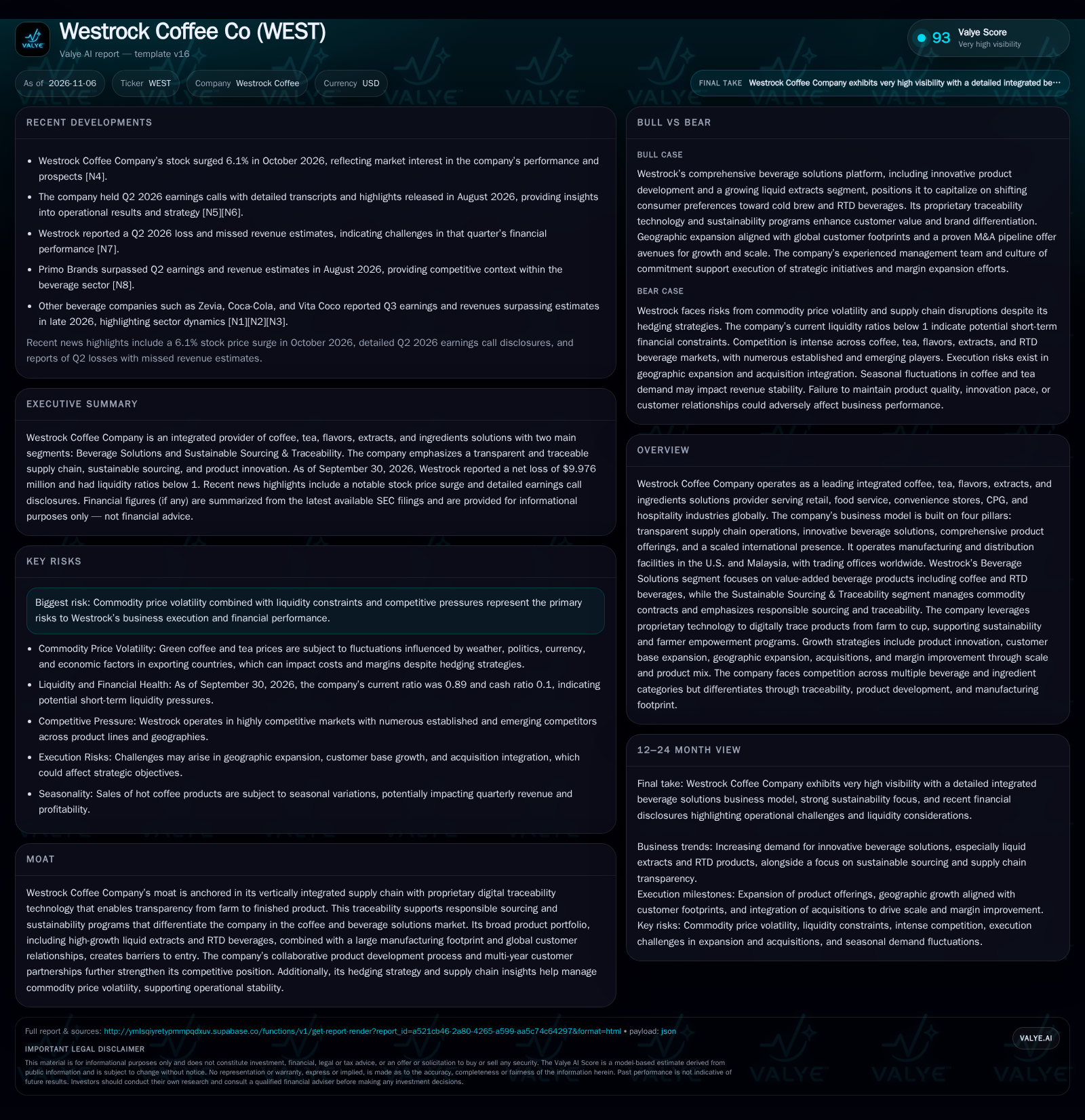
Westrock Coffee’s vertically integrated model and proprietary traceability technology position it as a differentiated supplier to global beverage customers. However, a recent net loss, missed revenue estimates, and liquidity ratios below 1 signal ongoing operational and financial pressures. The company’s prospects hinge on scaling high-growth segments like liquid extracts and RTD beverages while managing commodity volatility and capital constraints. Execution of product innovation and international expansion could unlock margin improvement, but competition and financial discipline remain central uncertainties. [S1] [S2] [N4] [N5] [N6] [N7]
Westrock Coffee is attempting to rewrite the economics of the global coffee and beverage supply chain by integrating proprietary traceability technology, sustainability programs, and value-added product innovation. Its ambitions span from retail and hospitality customers in the U.S. to international markets, with a focus on high-growth beverage segments like liquid extracts and ready-to-drink (RTD) offerings. The next phase will test whether Westrock’s investments in transparency and product development can convert into sustained margin expansion and improved financial resilience.
Westrock’s Integrated Platform and Recent Financial Signals
Westrock Coffee Company positions itself as a leading integrated provider of coffee, tea, flavors, extracts, and ingredients solutions, serving a diverse global customer base across retail, food service, convenience stores, CPG, and hospitality sectors. The company operates two primary segments: Beverage Solutions, which focuses on value-added beverage products and innovative formats such as liquid extracts and RTD beverages, and Sustainable Sourcing & Traceability (SS&T), which manages commodity contracts and emphasizes responsible sourcing and traceability. [S1]
The company leverages proprietary technology to enable digital traceability from farm to finished product, supporting sustainability initiatives like Farmer Direct Verified® and Raíz Sustainability. This approach is designed to meet rising customer demand for transparency and ethical sourcing, while also aiming to improve the economic well-being of smallholder farmers. [S1]
Financially, Westrock reported a net loss of $9.976 million for the quarter ended September 30, 2026, with basic and diluted EPS of -$0.10. As of the same date, the company had cash and equivalents of $41.1 million, current assets of $368.3 million, current liabilities of $414.7 million, a current ratio of 0.89, and a cash ratio of 0.1. These liquidity metrics indicate potential short-term financial pressures, and recent news highlighted a Q2 loss and missed revenue estimates. [S2] [N4] [N7]
Integrated Model Seeks Margin Expansion Amid Commodity Volatility
Westrock’s business model is built on vertically integrated operations that span sourcing, processing, manufacturing, and delivery of coffee, tea, and ingredient solutions. The Beverage Solutions segment is positioned to capture higher gross margins through differentiated products, packaging, and formulation, especially in high-growth categories like liquid extracts and RTD beverages. These segments, however, require ongoing investment in R&D, manufacturing, and customer-specific product development. [S1]
The SS&T segment is more exposed to the volatility of green coffee prices and typically operates with thinner margins, though hedging strategies are employed to mitigate some of this risk. The company’s fixed cost base—driven by manufacturing facilities in the U.S. and Malaysia—offers operating leverage if volumes scale, but can amplify losses if demand softens or commodity prices move unfavorably. [S1] [S2]
Traceability and Sustainability as Differentiators in a Crowded Market
Westrock faces competition from established beverage conglomerates, specialty ingredient suppliers, and regional coffee processors. Its proprietary supply chain traceability technology—enabling digital tracking from farm to cup—serves as a potential moat, appealing to large customers seeking verifiable sustainability and ethical sourcing credentials. Programs like Farmer Direct Verified® and Raíz Sustainability further reinforce this positioning, potentially enabling premium pricing or preferred supplier status with sustainability-focused buyers. [S1]
However, these advantages are not insurmountable. Competitors such as Keurig Dr. Pepper, Mother Parkers, and Givaudan have scale, distribution, and product development resources of their own. The challenge for Westrock is to convert traceability and innovation into concrete switching costs or defensible customer relationships, rather than features that can be matched or leapfrogged as sustainability and transparency become table stakes across the industry. The breadth of Westrock’s manufacturing and trading footprint supports global reach, but also exposes it to complexity and execution risk.
If Liquid Extracts and RTD Growth Outpace Fixed-Cost Drag
A favorable trajectory for Westrock would see its investments in product innovation and traceability translate into outsized growth in high-margin categories such as liquid extracts, cold brew, and RTD beverages. If the company successfully leverages consumer insights and customer partnerships to expand shelf space and contract volumes, the resulting scale could drive operating leverage in its manufacturing base, improving gross and EBITDA margins.
Confirmation of this scenario would come from accelerating revenue growth in the Beverage Solutions segment, rising contribution from new product categories, and evidence of positive margin inflection despite commodity volatility. Sustained market share gains or customer wins in international markets would further validate the upside case.
Balancing Innovation with Financial Discipline in a Competitive Landscape
The most plausible path for Westrock is one of gradual improvement in product mix and operational efficiency, offset by persistent headwinds from commodity price volatility and intense competition. The company may continue to expand its presence in high-growth beverage categories, but this growth could be partially offset by the margin pressures and capital demands of its integrated model. Execution risk in geographic expansion and acquisition integration remains a drag on near-term profitability.
Evidence supporting this scenario would include modest sequential improvement in gross margin, stable or slightly improving liquidity ratios, and incremental customer or geographic wins without a sharp inflection in profitability. Falsification would come from continued net losses, further deterioration in liquidity, or inability to demonstrate increased traction in differentiated product segments.
Commodity Shocks and Capital Shortfalls Derail Scale Ambitions
The adverse scenario for Westrock involves a combination of unfavorable commodity price moves, supply chain disruptions, or customer attrition that further erode margins and cash flow. Given the current liquidity position, any significant operational setback—or failure to offset commodity inflation with pricing power—could necessitate dilutive capital raises, asset sales, or cutbacks in growth initiatives.
Confirmation of this scenario would be persistent or widening net losses, additional missed revenue or margin targets, and negative trends in working capital metrics. External signals could include credit downgrades, increased reliance on short-term financing, or management guidance that prioritizes survival over growth. Failure to demonstrate traction in high-growth segments or loss of major customer relationships would also validate downside risks.
Milestones and Metrics That Will Test Westrock’s Beverage Ambitions
Quarterly gross margin trends by segment, particularly in Beverage Solutions, would help assess the effectiveness of product mix and scale strategies.
Revenue growth rates for liquid extracts and RTD beverages (if disclosed) are critical to validating the focus on high-growth categories.
Liquidity ratio movement—specifically, progress toward or above a 1.0 current ratio—will indicate whether short-term capital pressures are abating.
Working capital turnover and days sales outstanding would help reveal underlying cash conversion and operational discipline.
Updates on multi-year or recurring customer agreements, especially in differentiated product lines, would clarify the strength of Westrock’s customer relationships.
Any new or expanded geographic contracts tied to international expansion would serve as proof points for global scaling ability.
Management commentary or disclosures regarding commodity price hedging effectiveness and supply chain resilience would provide early warning of cost shocks.
Evidence of successful integration and margin improvement from any announced acquisitions would help test the company’s ability to drive scale benefits.
Disclaimer: This is research-only, informational analysis and not investment advice. It may include AI-generated interpretation and general industry context. Always verify important details using primary sources.

Comments