
Kinetik Holdings: Permian Basin Exposure, Volume Dependency, and the Test of Midstream Resilience
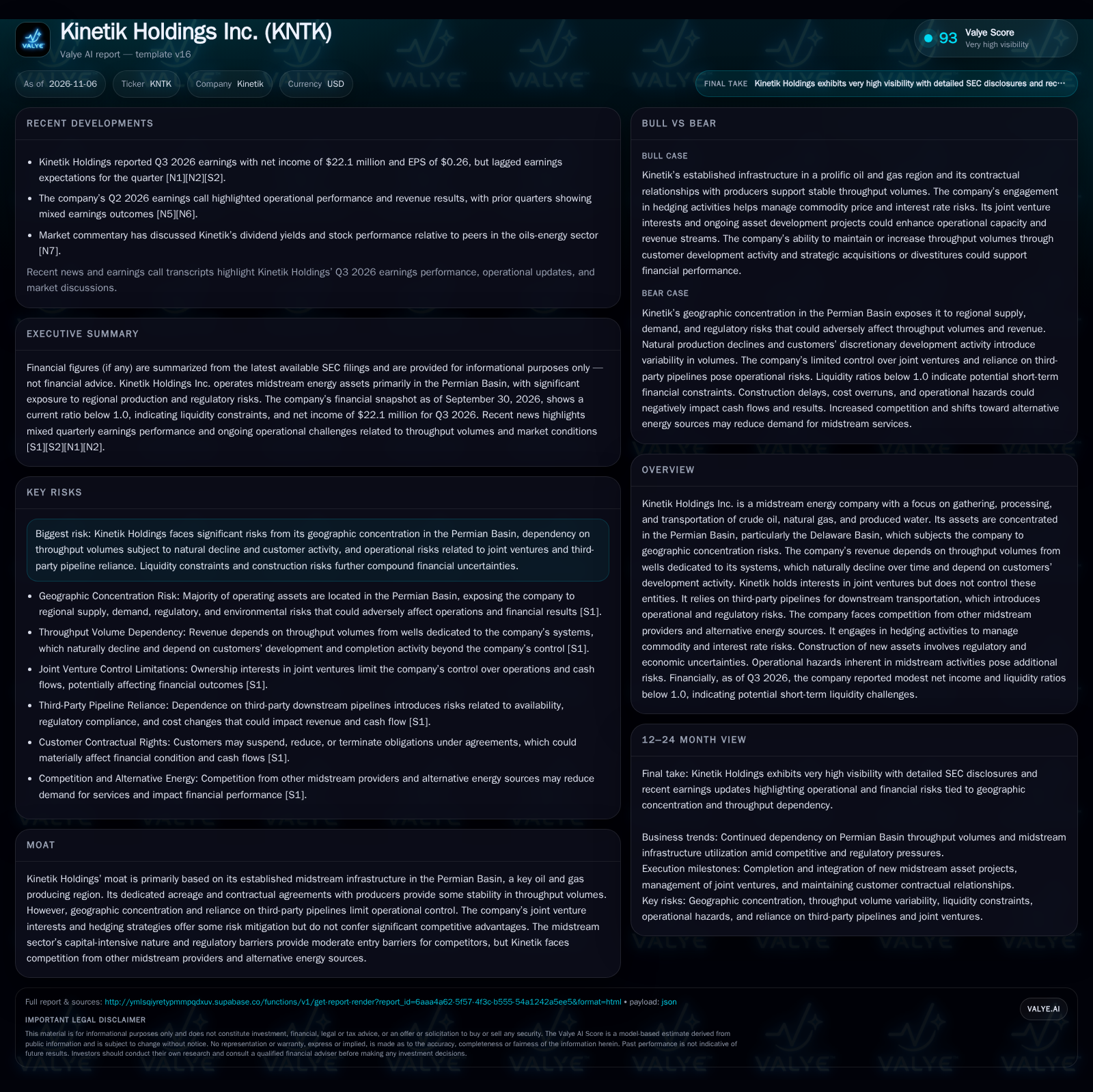
Kinetik Holdings’ concentrated Permian Basin midstream footprint enables scale but amplifies exposure to regional production cycles, customer development choices, and liquidity pressures.
The company’s future hinges on maintaining or growing throughput, managing joint venture outcomes, and navigating competitive and regulatory risks.
Kinetik Holdings Inc., a midstream energy operator anchored in the Delaware Basin, stands at a crossroads defined by both opportunity and risk. Its extensive Permian infrastructure positions it to capitalize on regional oil and gas production, but this same concentration amplifies sensitivity to customer drilling decisions, natural production declines, and regulatory disruptions.
Recent Financials and Volume Sensitivity Define the Present Challenge
Kinetik Holdings’ Q3 2026 net income of $22.1 million and EPS of $0.26 fell short of analyst expectations, reflecting both operational volatility and the company’s acute dependence on regional oil and gas production trends [N1] [N2] [S2]. The company’s balance sheet as of September 30, 2026, shows $7.02 million in cash and equivalents, current assets of $428.8 million, and current liabilities of $668.3 million, resulting in a current ratio of 0.64 and a cash ratio of 0.01 [S2]. These liquidity metrics highlight potential short-term pressures, especially if customer throughput or payment timing deteriorates.
Kinetik’s operations are deeply tied to the Delaware Basin, with most revenue linked to gathering, processing, and transporting hydrocarbons from wells whose output naturally declines. The company’s reliance on customer development activity and third-party pipeline access compounds its exposure to factors outside direct control [S1].
Throughput-Driven Revenue and the Realities of Midstream Cost Structure
Kinetik’s business model derives revenue from gathering, processing, and transporting crude oil, natural gas, and produced water. Most contracts in the midstream sector are volume-based, where revenue is a function of throughput—either on a fee-for-service or, less commonly, commodity-linked basis. Since the company’s assets are tied to the Delaware Basin, throughput volumes depend on both the natural decline of existing wells and new drilling by upstream customers.
Fixed costs are substantial, including infrastructure maintenance, regulatory compliance, and staffing. Variable costs scale with throughput, but the high fixed-cost base means that small changes in volume can have outsized effects on margins and returns—a classic case of operating leverage. This dynamic amplifies both upside in periods of robust regional activity and downside when drilling slows or production slips.
[S2] The company’s engagement in hedging mitigates some commodity price and interest rate risk, but cannot offset volume risk or counterparty exposure.
The interplay between fixed and variable costs in Kinetik’s operations also underscores the importance of capacity utilization. When throughput falls below certain thresholds, the company may face under-recovery of fixed costs, pressuring margins disproportionately. Conversely, incremental volume increases can be highly accretive once fixed costs are largely covered. This non-linear cost behavior necessitates careful capital allocation and operational efficiency to avoid margin erosion during downturns. Moreover, the midstream sector’s capital intensity means that asset depreciation and amortization significantly impact reported earnings, potentially masking underlying cash flow dynamics tied to throughput fluctuations.
Permian Scale, but Competitive and Structural Vulnerabilities
Kinetik’s core advantage lies in its established network of pipelines, processing plants, and storage facilities in the Delaware Basin—a prolific and low-cost oil and gas region. This infrastructure, underpinned by dedicated acreage and long-term relationships with producers, creates switching frictions for existing customers, as alternative connections may be costly or unavailable.
However, the company’s competitive position is constrained by several factors. First, geographic concentration means that any slowdown in Permian activity, regulatory action, or environmental event directly impacts the entire business. Second, the reliance on third-party pipelines for downstream transportation introduces bottleneck and counterparty risks. Third, joint venture structures limit Kinetik’s control over key assets and cash flows, reducing strategic flexibility [S1].
The threat from alternative midstream providers is ever-present, as pipeline and processing capacity in the Permian is extensive and often contested. Over time, the rise of renewable energy and electrification could also erode demand for traditional hydrocarbon transport, though such substitution is likely to play out over a longer horizon.
The structural reliance on third-party pipelines and joint ventures introduces nuanced risk layers beyond operational control. For instance, bottlenecks or capacity constraints downstream can limit Kinetik’s ability to capture incremental volumes, even if upstream production rises. Additionally, joint venture governance arrangements may slow decision-making or limit strategic agility, especially in rapidly changing market conditions. The competitive landscape is further complicated by potential regulatory shifts favoring pipeline capacity expansions or alternative transport modes, which could alter relative cost structures and customer preferences. Understanding these interdependencies is critical to assessing Kinetik’s resilience and bargaining power in the Permian midstream ecosystem.
Throughput Expansion and Asset Optimization Could Unlock Margin Leverage
The most favorable trajectory for Kinetik would involve a sustained uptick in regional drilling and completion activity, driving higher throughput across its gathering and processing systems. If upstream customers accelerate development—whether due to favorable commodity prices, technological advances, or regulatory clarity—Kinetik could see volumes rise enough to unlock significant operating leverage, improving margins and cash flow.
Further upside could materialize if the company successfully expands or integrates new midstream assets, optimizing system utilization and reducing per-unit costs. Strategic renegotiation or extension of customer contracts, with minimum volume commitments or improved tariff terms, would also enhance revenue visibility and reduce earnings volatility.
Confirmation of this scenario would include reported increases in system throughput, new or expanded customer agreements, improved segment margins, and evidence of successful project execution without major cost overruns or delays.
Volume Stability Amid Competitive and Financial Constraints
The most plausible near-term scenario is one of modest, volume-driven revenue growth constrained by regional production trends and competitive dynamics. Under this path, Kinetik maintains relatively stable throughput as existing wells decline but are offset by incremental new drilling. The company continues to manage costs and optimize current assets, but lacks the potential financial flexibility for major expansion without external funding.
Earnings may remain volatile quarter-to-quarter, reflecting both customer activity and the timing of maintenance or outages. Joint venture distributions and third-party pipeline access persist as sources of both revenue and risk. The company’s liquidity remains tight, with any improvement contingent on sustained cash generation or successful refinancing.
This scenario would be confirmed by steady reported throughput, stable or slightly improving margins, no major contract losses or regulatory setbacks, and ongoing liquidity management without distress signals such as covenant breaches or emergency financings.
In this scenario, Kinetik’s ability to maintain volume stability will likely depend on upstream capital discipline and the pace of well completions, which are themselves influenced by commodity price trends and technological advancements in drilling efficiency. Competitive pressures may limit pricing power, constraining margin expansion despite stable throughput. Financial constraints could restrict opportunistic investments in asset enhancements or expansions, potentially ceding market share to more capital-flexible competitors. Furthermore, ongoing reliance on joint ventures and third-party pipelines may continue to introduce operational variability and limit cash flow visibility, underscoring the importance of reported liquidity position management and covenant compliance to avoid financial distress.
Production Slowdown or Contract Losses Could Trigger Cash Flow Stress
A less favorable path would see regional drilling slow due to weaker commodity prices, regulatory intervention, or capital discipline among upstream producers. In this scenario, throughput volumes drop, and Kinetik faces declining revenues while fixed costs remain high, compressing margins and potentially pushing free cash flow negative.
Compounding this, the loss or renegotiation of key customer contracts—especially if minimum volume commitments are not present or are unenforceable—could further erode revenue. Operational issues with third-party pipelines or joint venture assets could disrupt flows, while cost overruns or delays in new projects would exacerbate cash pressures.
Evidence for this scenario would include sequential declines in reported throughput, margin compression, customer contract terminations or reductions, negative free cash flow, and potential warnings or disclosures around liquidity, covenant compliance, or refinancing needs.
Factors That Will Determine Kinetik’s Resilience in a Shifting Midstream Landscape
Quarterly throughput volumes by segment (gas, crude, water) and their trajectory relative to regional drilling activity.
Disclosure of customer contract terms—especially minimum volume commitments, durations, and any recent renegotiations or terminations (if disclosed).
Utilization rates of key infrastructure assets, such as processing plants and pipelines, to gauge operating leverage.
Updates on joint venture distributions, performance, and any changes in ownership or governance rights (if disclosed).
Material regulatory, environmental, or permitting developments affecting the Permian Basin or Kinetik’s specific assets.
Status and terms of refinancing activities, covenant compliance, or other liquidity management initiatives.
Competitive developments in Permian midstream—such as new projects, tariff changes, or customer defections—that could impact volumes or pricing.
Disclaimer: This is research-only, informational analysis and not investment advice. It may include AI-generated interpretation and general industry context. Always verify important details using primary sources.

Comments