
iRhythm Holdings: Cardiac Monitoring Leadership, Product Expansion, and the Challenge of Compliance at Scale
iRhythm dominates U.S. long-term cardiac monitoring with its Zio platform and FDA-cleared analytics, but faces mounting regulatory, integration, and investment hurdles as it diversifies into multi-modal and adjacent diagnostics.
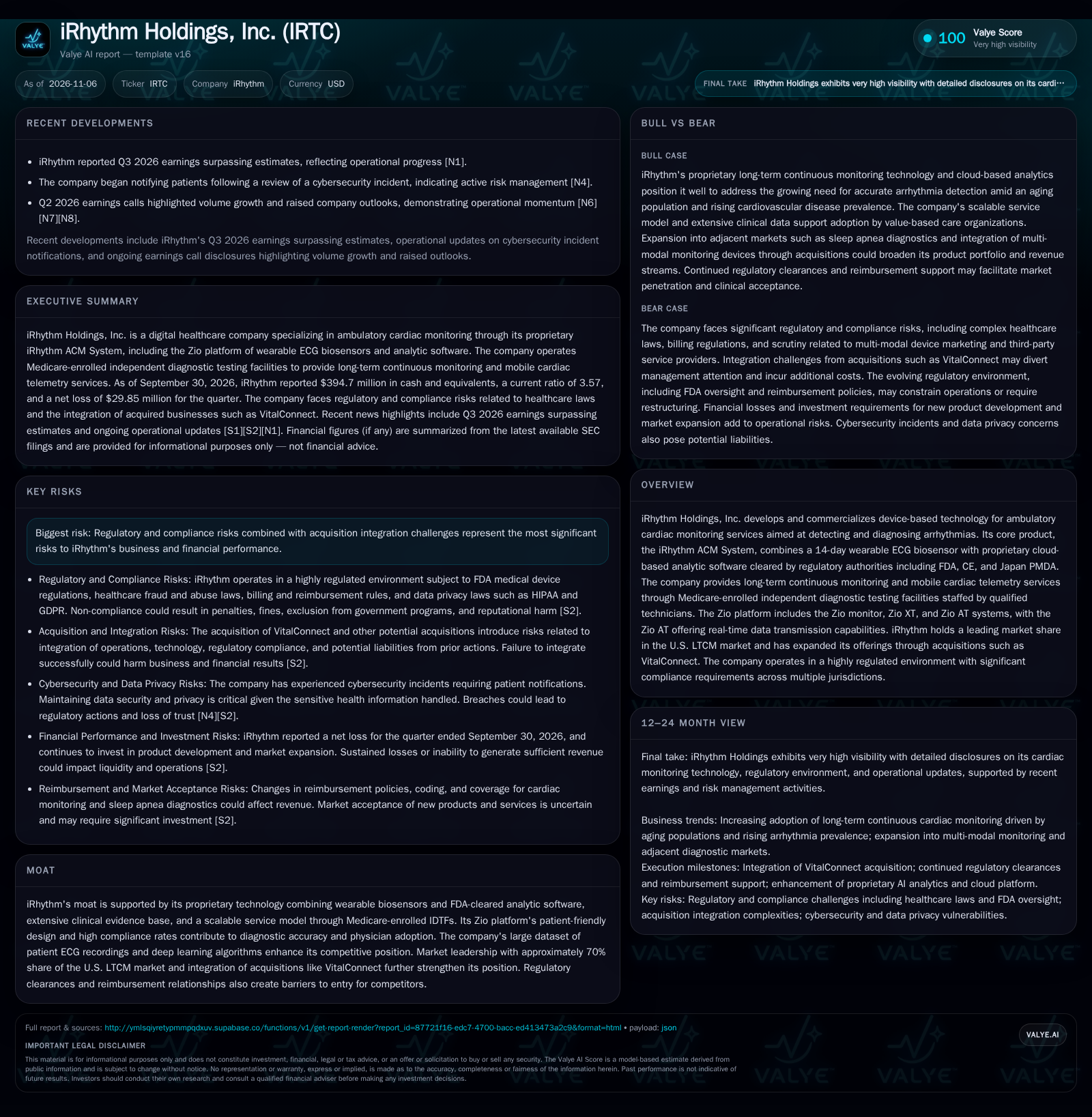
iRhythm Holdings leads the U.S. long-term continuous cardiac monitoring market with its Zio platform, leveraging proprietary wearable technology and cloud-based analytics. While recent earnings have exceeded estimates, the company remains unprofitable and faces complex regulatory and integration risks—especially following the VitalConnect acquisition and ongoing expansion into new diagnostic markets. Sustained growth will depend on successful compliance management, reimbursement stability, and the ability to leverage its large ECG dataset for clinical and commercial advantage. [S1] [S2] [N1]
iRhythm Holdings stands at the forefront of digital cardiac diagnostics, commanding a decisive lead in U.S. ambulatory cardiac monitoring with its Zio platform—a combination of unobtrusive wearable sensors and deep-learning analytics. The company’s scale, clinical validation, and regulatory clearances give it a formidable competitive foundation. However, as iRhythm moves beyond its core arrhythmia detection business into multi-modal and adjacent diagnostics, it must navigate a far more complex landscape of regulatory, reimbursement, and operational challenges. Recent financial results show progress, but the company’s ability to translate technical leadership into sustainable profitability will hinge on successful integration of acquisitions, continued reimbursement support, and ongoing risk management. [S1] [S2] [N1] [N4]
Recent Performance and Strategic Moves: Market Leadership, Losses, and Expansion
iRhythm holds a commanding 70% share of the U.S. long-term continuous cardiac monitoring (LTCM) market, supported by its Zio platform—a wire-free, 14-day wearable ECG biosensor paired with proprietary cloud analytics. The company has delivered over twelve million patient reports and amassed nearly three billion hours of heartbeat data since 2009, underscoring its clinical reach and data scale. [S1]
Financially, iRhythm reported $394.7 million in cash and equivalents and a current ratio of 3.57 as of September 30, 2026, but remains unprofitable, posting a net loss of $29.85 million for the quarter. [S2]
Strategically, iRhythm is diversifying its portfolio beyond arrhythmia monitoring, acquiring VitalConnect to add multi-modal remote cardiac monitoring devices and services, and developing diagnostics for sleep apnea—a move that introduces new regulatory and reimbursement complexities. [S2]
Operationally, the company continues to experience cybersecurity incidents, as evidenced by a recent patient notification event, highlighting the ongoing challenge of data privacy in digital health. [N4]
How iRhythm’s Model Scales—and Where Costs and Leverage Converge
iRhythm’s revenue is primarily driven by the volume of ambulatory cardiac monitoring tests—mainly LTCM and mobile cardiac telemetry (MCT)—with reimbursement from Medicare and commercial payors. The Zio platform’s integrated service, combining proprietary, FDA-cleared biosensors and cloud-based analytics, allows for premium pricing compared to traditional Holter monitors, especially given the longer wear time and higher diagnostic yield.
The company’s cost structure includes biosensor manufacturing, cloud infrastructure for data processing, technician-based ECG validation, and compliance overhead. While fixed costs (R&D, regulatory, cloud infrastructure, and compliance) are significant, the business model exhibits potential operating leverage: as test volumes increase, incremental gross margins could expand if device manufacturing and technician costs scale efficiently.
However, expansion into multi-modal monitoring and adjacent diagnostics (like sleep apnea) may require substantial upfront investment in R&D, regulatory submissions, and market education, delaying profitability. The integration of VitalConnect adds further fixed and variable costs, as well as increased compliance demands. If reimbursement rates decline, or if new services face reimbursement headwinds, the economics could tighten quickly.
Capital requirements remain substantial due to ongoing product development, regulatory compliance, and potential future acquisitions. The company reported $394.7 million in cash and equivalents as of September 30, 2026, and a current ratio of 3.57. However, persistent net losses indicate a need for continued growth and margin improvement to achieve self-sustaining economics. [S2]
Defending Share: Data, Algorithms, and Barriers in a Crowded Diagnostic Landscape
iRhythm’s competitive edge rests on its proprietary Zio technology and deep-learning ECG analytics, both cleared by major regulatory bodies (FDA, CE, PMDA). Its accumulated dataset of nearly three billion hours of heartbeat data provides a foundation for algorithmic refinement and clinical validation—a scale that is difficult for newer entrants to replicate quickly.
The company benefits from physician familiarity, high patient compliance (due to the form factor and comfort of its wearable), and robust integrations with EHRs and provider workflows. Its Medicare-enrolled independent diagnostic testing facilities (IDTFs) and technician oversight further increase clinical trust.
However, the ambulatory cardiac monitoring market is populated by both established device manufacturers and digital health startups, many seeking to combine wearables, AI, and cloud analytics. Substitution risk exists from both lower-cost traditional devices and newer consumer health technologies if they achieve regulatory clearance and reimbursement. Adjacent markets such as sleep apnea diagnostics are even less consolidated, and iRhythm’s brand carries little inherent advantage there.
Barriers to entry remain substantial in terms of regulatory clearance, clinical validation, and payer contracting, but these can erode if reimbursement policies change or if rivals achieve technical and regulatory parity.
What a Virtuous Cycle of Volume, Data, and Market Expansion Could Deliver
The most bullish scenario for iRhythm involves continued expansion of LTCM testing volumes, supported by demographic tailwinds (aging population, rising cardiovascular disease). As test volumes rise, the company could realize significant operating leverage—reducing per-test costs while maintaining or even expanding reimbursement rates, driving gross margin improvement.
If the integration of VitalConnect is smooth and new multi-modal and sleep apnea diagnostics gain regulatory clearance and reimbursement, iRhythm could unlock new revenue streams and cross-sell opportunities. Its massive ECG dataset and AI algorithms could further differentiate its offerings, potentially enabling new predictive tools or population health applications.
Confirmation of this thesis would require sustained double-digit volume growth, margin expansion, successful regulatory approvals for new products, and minimal reimbursement pressure. Additional evidence would be rapid provider adoption of new modalities, positive clinical data, and successful cross-selling into existing accounts.
Falsification would come from stagnant or declining test volumes, margin compression, regulatory setbacks, or slow adoption of new services—particularly if integration costs or compliance issues mount.
Sustaining Leadership Amid Rising Costs and Compliance Demands
The most plausible outlook sees iRhythm maintaining its leadership in U.S. LTCM and MCT, with steady (but not explosive) volume growth driven by demographic and clinical trends. Margins may improve modestly as scale is realized, but ongoing investments in R&D, compliance, and product expansion will likely keep the company near breakeven or modestly unprofitable in the near term.
The integration of VitalConnect introduces transitional costs and operational focus on regulatory and reimbursement compliance, limiting immediate financial upside. New product introductions in sleep apnea or multi-modal monitoring may face slow payer adoption and require iterative clinical and market validation.
This scenario would be confirmed by stable or slightly improving gross margins, steady cash burn, and incremental new product clearances and launches—without major reimbursement setbacks or compliance failures. Falsification would be evident if regulatory penalties, reimbursement cuts, or major integration issues materially disrupt financial or operational performance.
How Regulatory Setbacks or Reimbursement Cuts Could Derail Momentum
A bearish outcome could unfold if regulatory scrutiny intensifies—triggered by compliance lapses, billing errors, or unresolved cybersecurity incidents—leading to penalties, exclusion from government programs, or reputational damage. Integration missteps with VitalConnect could exacerbate operational complexity, increasing costs and distracting management from core execution.
Reimbursement risk is acute: changes in Medicare or commercial payor policies could reduce payment rates for LTCM or new diagnostic services, quickly compressing margins and cash flow. In emerging areas like sleep apnea diagnostics, failure to secure adequate reimbursement or regulatory clearance could lead to sunk costs without meaningful offsetting revenue.
Confirmation of this scenario would be regulatory actions, reimbursement cuts, or publicized compliance failures. Evidence might also include rising legal, compliance, or cybersecurity costs, or a sharp contraction in test volumes or commercial adoption.
Milestones That Will Shape iRhythm’s Ability to Deliver Sustainable Growth
Trends in LTCM and MCT testing volumes—sustained growth would support operating leverage; stagnation or decline would challenge the bull case.
Gross margin trajectory—improvement would signal successful scaling and cost management; contraction could indicate reimbursement or operational pressures.
Integration progress with VitalConnect—updates on operational, technical, and compliance integration would clarify acquisition execution risk.
Regulatory milestones for new products—FDA or other regulatory clearances for multi-modal or sleep apnea devices would validate product expansion.
Reimbursement policy developments—any changes in Medicare or commercial payor rates, coverage, or coding for core and new services.
Cybersecurity incident frequency and severity—further breaches or regulatory scrutiny could elevate risk and cost.
Cash burn rate and liquidity trends—persistent or accelerating losses would raise sustainability concerns, regardless of current cash reserves.
Adoption rates and physician feedback for new diagnostic offerings—if disclosed, these would help test the commercial potential of product extensions.
Disclaimer: This is research-only, informational analysis and not investment advice. It may include AI-generated interpretation and general industry context. Always verify important details using primary sources.

Comments