
Comstock’s Asset-Light Model: Scaling Fee Revenue in Transit-Oriented Real Estate
Comstock Holding Companies leverages a vertically integrated, fee-driven platform focused on mixed-use, Metro-adjacent assets in the Washington, D.C. region.
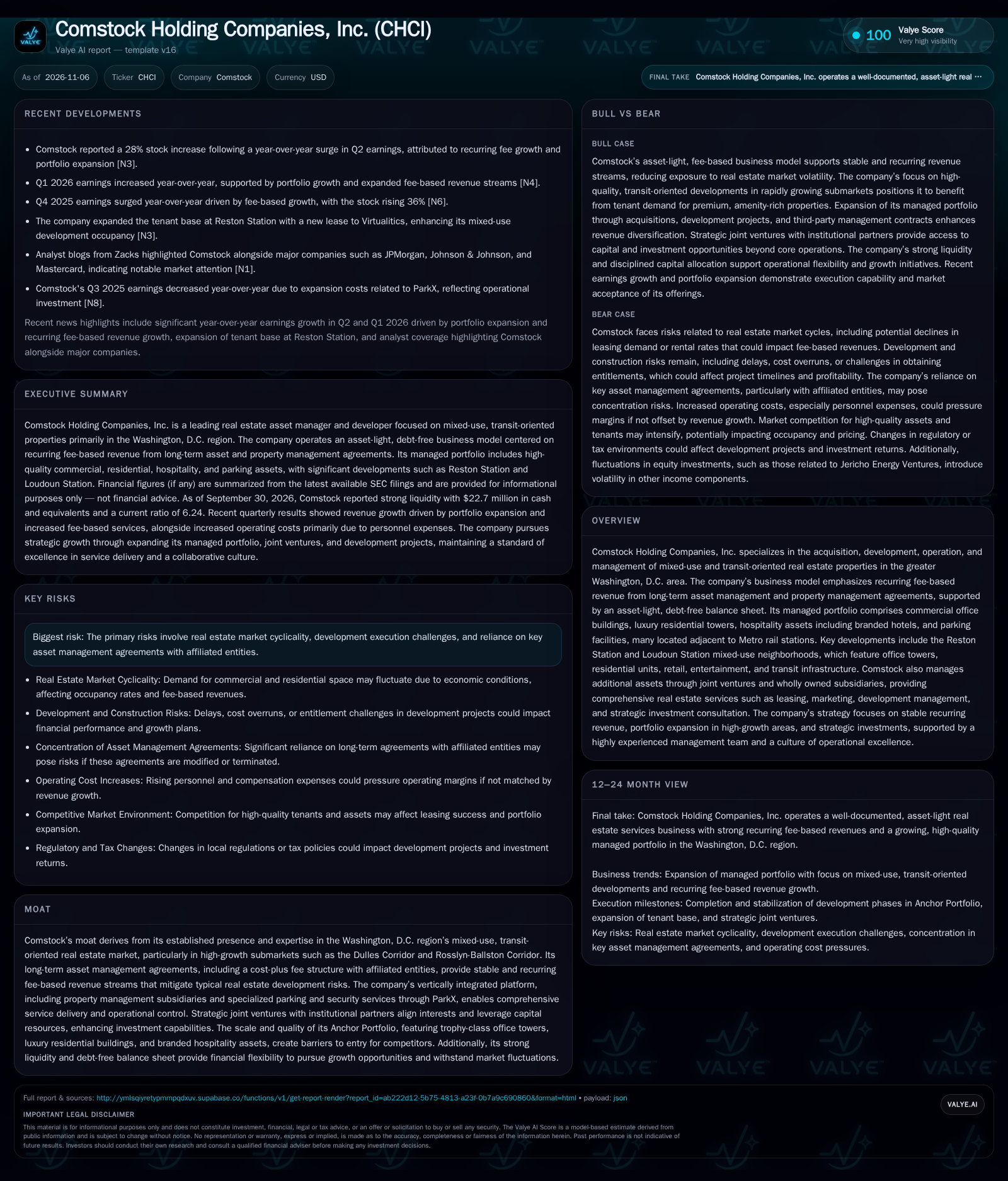
Comstock’s managed portfolio now spans over 10 million square feet across high-profile commercial, residential, hospitality, and parking assets, concentrated in Metro-connected developments. With a cost-plus fee structure, strong current liquidity, and high occupancy in core properties, the company has grown recurring revenues. However, increased operating costs and development exposure raise questions about future margin trajectory and risk-adjusted growth potential. [S2]
Comstock Holding Companies, Inc. occupies a specialized niche as an asset-light manager, developer, and operator of high-end, transit-oriented real estate, with a commanding presence in the Washington, D.C. Metro corridor. Its focus on large, mixed-use developments adjacent to Metro rail stations—such as Reston Station and Loudoun Station—enables the company to offer a vertically integrated suite of services to both affiliated and third-party owners.
Recent Portfolio Growth, Revenue Mix, and Financial Position
As of September 30, 2026, Comstock manages 115 assets totaling approximately 10.5 million square feet, with the portfolio spanning commercial, residential, hospitality, and parking assets largely concentrated in Metro-adjacent developments. Key properties such as Reston Station and Loudoun Station anchor the portfolio, with commercial occupancy at 92% and residential occupancy at 84%. The company’s Q3 2026 revenue mix is split across asset management (40.4%), property management (23.8%), and ParkX management (35.8%). Cash and equivalents stand at $22.7 million, and a current ratio of 6.24 points to a reported liquidity position. However, operating costs and expenses rose 27.9% year-over-year, largely due to increased personnel and stock-based compensation, pressuring operating margins even as net income edged up to $0.588 million for the quarter. [S2]
Fee-Based Revenue Model and Operating Leverage Dynamics
Comstock’s economics are driven by a cost-plus, fee-based structure, especially through its long-term asset management agreement with Comstock Partners, LC. The company generates recurring fees from asset management, property management, and specialized services (via ParkX), with the ability to scale revenues as the managed portfolio grows. The cost-plus model may provide a buffer against some operating expense inflation, but absolute margin expansion depends on the pace of portfolio growth relative to fixed and variable cost increases. Personnel and stock-based compensation represent growing expense categories, suggesting that scaling the platform may require continued investment in talent and technology.
The asset-light nature of Comstock’s platform limits direct capital requirements for property acquisition or construction, but exposes the company to development and stabilization risk as it expands the managed portfolio. Joint ventures and third-party management contracts can offer incremental fee streams without proportional balance sheet risk, but also mean that upside is capped relative to traditional real estate ownership models. Operating leverage could improve if incremental assets are added with modest increases in overhead, but rising costs in Q3 2026 indicate that achieving margin expansion is not automatic.
Advantages and Challenges in a Crowded Metro-Adjacent Market
Comstock’s competitive position is anchored in its expertise with transit-oriented, mixed-use assets in the Washington, D.C. region—a market characterized by high barriers to entry due to zoning, entitlement, and capital requirements. Its vertically integrated subsidiaries enable comprehensive property, parking, and security management, which may enhance client retention and allow for pricing differentiation. The scale and quality of its Anchor Portfolio, including trophy-class office towers and luxury residential buildings, provide a platform for attracting institutional clients and tenants seeking premium, amenity-rich environments.
However, the company faces competition from larger national real estate managers, local developers, and specialized property management firms. Success in winning and retaining management contracts depends on maintaining high occupancy, delivering superior tenant experiences, and adapting to evolving regulatory and market demands. The concentration of key management agreements with affiliated entities introduces counterparty risk, and the company’s regional focus could limit diversification benefits if the D.C. market softens. New entrants and substitutes—such as direct institutional investment or technology-driven property management platforms—could pressure fee rates or erode share over time.
Portfolio Expansion and Leasing Success Drive Sustained Fee Growth
A favorable scenario for Comstock involves continued expansion of its managed portfolio—through both ground-up development and additional third-party contracts—while maintaining or improving occupancy and rent levels in core assets. If the company successfully completes and stabilizes new phases at Reston Station and Loudoun Station, and fills incremental square footage with high-quality tenants, recurring management fees could rise with limited incremental costs. Collaboration with institutional partners via joint ventures may unlock new sources of capital and deal flow, amplifying the company’s ability to scale without overextending its balance sheet.
Evidence that would confirm the upside case includes: sustained increases in managed square footage, new contract wins with unaffiliated third parties, improving occupancy rates (especially in residential assets), and stable or rising margins despite higher personnel costs. Consistent growth in fee-based revenue streams, with operating expense increases lagging revenue growth, would further validate the scenario.
Growth Moderates as Costs Rise and Development Activity Continues
The most plausible near-term outcome is that Comstock maintains moderate portfolio and revenue growth, but faces ongoing margin pressure from rising operating costs and the demands of new development. Occupancy rates in stabilized assets remain high, supporting recurring fees, but the pace of incremental asset additions slows as the company becomes more selective in pursuing new projects or contracts.
Confirmation of the base scenario would include: steady, but not accelerating, growth in managed assets; operating margins that remain flat or compress modestly; and periodic increases in operating expenses tied to development or service expansion. Signs of successful project stabilization and tenant retention—but without a step-change in fee margin—would further support this outlook.
Development Delays, Leasing Softness, and Cost Inflation Erode Earnings Power
A negative scenario for Comstock centers on adverse real estate market conditions—such as reduced tenant demand, declining occupancy, or downward pressure on rents—leading to slower fee growth or even revenue contraction. If the company encounters delays, cost overruns, or entitlement challenges in its development pipeline, anticipated fee streams from new projects could be deferred or diminished. Further, if operating costs (especially personnel and stock-based compensation) continue to outpace revenue growth, operating margins could compress, eroding net income and limiting reinvestment capacity.
Evidence confirming the downside would include: declining occupancy in core assets, delays in completing or stabilizing new projects, negative operating leverage (expenses rising faster than revenues), or loss/modification of key management agreements—especially with affiliated entities. Material unrealized losses on equity investments or negative mark-to-market impacts could further cloud earnings predictability.
Benchmarks for Testing Comstock’s Scalable Fee Platform Thesis
Sustained growth in managed square footage and asset count, particularly through third-party management contracts, would help validate the platform’s scalability.
Occupancy rates in both commercial and residential portfolios—especially any movement below the current 92% and 84% levels, respectively—will be critical for recurring fee stability.
Gross and net margin trends, particularly the relationship between fee revenue growth and operating cost inflation, are essential for testing operating leverage.
Progress and completion timelines for major development projects (e.g., new phases at Reston Station and Loudoun Station) will indicate execution quality and future fee visibility.
Personnel and stock-based compensation expense as a percentage of revenue—if disclosed—would clarify the sustainability of recent cost increases.
Pipeline of new joint ventures or unaffiliated third-party management agreements would provide early evidence of incremental growth opportunities.
Material changes in the terms, duration, or counterparty mix of key asset management agreements, especially those with affiliated entities, would impact revenue visibility and concentration risk.
Disclosure of retention rates for existing management contracts or client relationships would be useful for assessing the stickiness of Comstock’s fee streams.
Disclaimer: This is research-only, informational analysis and not investment advice. It may include AI-generated interpretation and general industry context. Always verify important details using primary sources.

Comments