
CXApp’s AI Workplace Platform: Testing Recurring Revenue Ambitions Amid Competitive and Financial Pressures
CXApp’s mobile-first, AI-powered SaaS platform targets enterprise hybrid work needs with a patent-protected technology stack and a subscription-based model. As the company pursues recurring revenue and operational leverage, it faces persistent net losses, heightened competition, and Nasdaq listing compliance risk. The next phase will test whether innovation and execution can convert technical differentiation into durable customer and financial momentum.
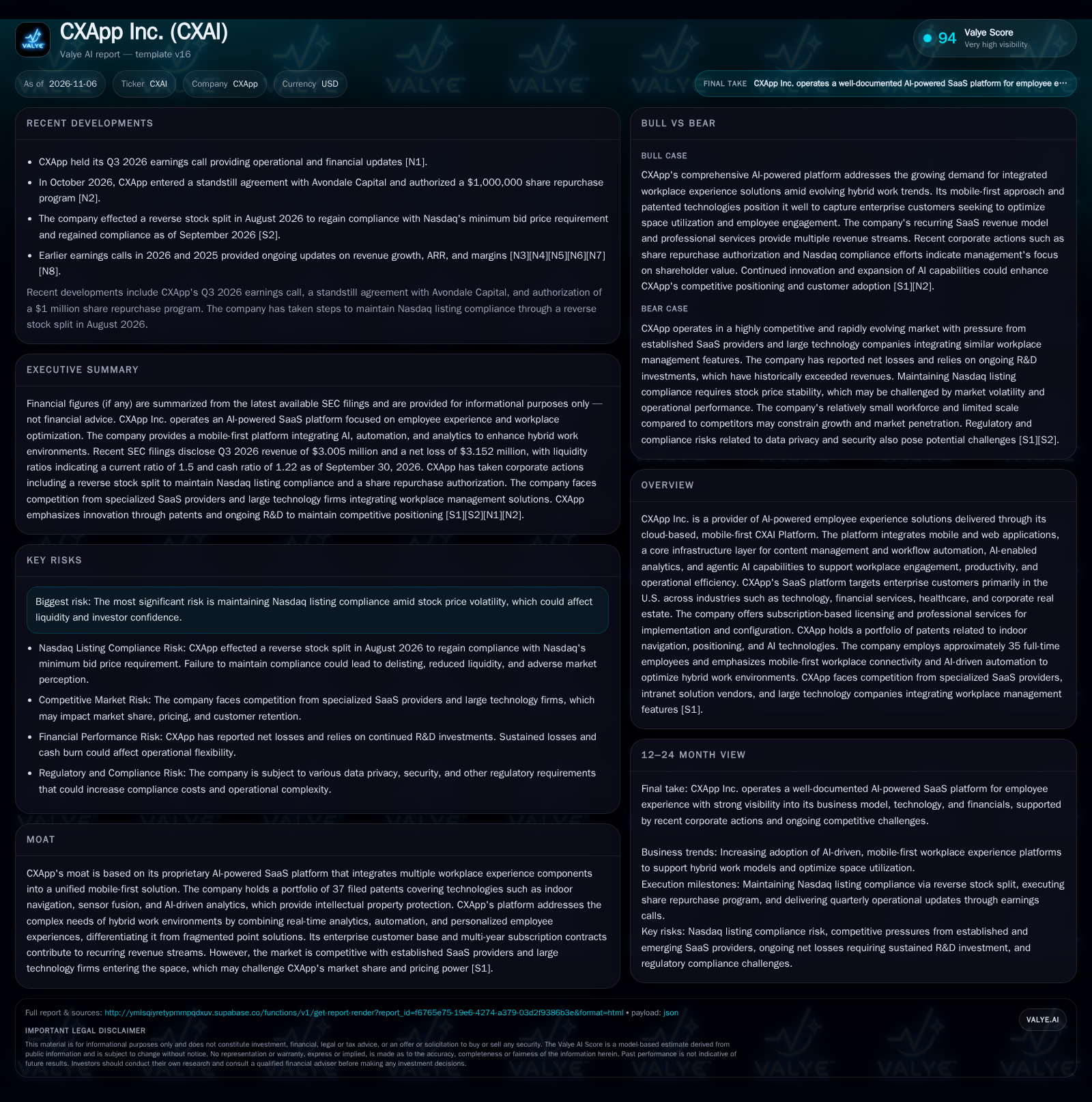
CXApp delivers an AI-powered, mobile-first SaaS platform for enterprise workplace experience, with Q3 2026 revenue of $3.005 million and a net loss of $3.152 million. Despite a robust patent portfolio and recent corporate actions to support its share price and investor appeal, the company faces stiff competition and ongoing losses. The core question is whether CXApp can scale its recurring revenue base and achieve operational leverage before competition or financial constraints erode its position. [S2] [N1] [N2]
CXApp Inc. is positioning itself at the intersection of AI, mobile-first enterprise software, and the evolving hybrid work environment. The company’s cloud-based CXAI Platform integrates analytics, workflow automation, and agentic AI capabilities to drive workplace optimization and employee engagement. While CXApp’s patent portfolio and focus on recurring SaaS revenues offer a foundation for defensibility and scale, persistent losses and fierce competition from both niche SaaS providers and tech giants place its long-term trajectory in question. Its recent financials and corporate maneuvers underscore the urgency—and difficulty—of converting technical promise into sustainable growth and profitability.
Recent Developments Reshape Strategic Roadmap
CXApp reported Q3 2026 revenue of $3.005 million and a net loss of $3.152 million, reinforcing the company’s pattern of growing top-line but not yet achieving profitability. As of September 30, 2026, cash and equivalents stood at $8.986 million, with a current ratio of 1.5 and a cash ratio of 1.22. These figures indicate the company’s ability to meet near-term obligations but do not resolve the underlying challenge of ongoing cash burn. [S2] [N1]
To address listing risk, CXApp executed a reverse stock split in August 2026 and regained Nasdaq compliance by September. In October, a $1 million share repurchase program and a standstill agreement with Avondale Capital were authorized, signaling management’s intent to stabilize the share price and potentially boost investor confidence. [S2] [N2]
The company continues to invest in its patent portfolio, with 37 filed patents covering AI, indoor navigation, and related technologies, aiming to defend its differentiation in a crowded market. [S1]
Recurring Revenue Model Meets High Fixed-Cost Structure
CXApp’s revenue is anchored by subscription-based licensing of its cloud SaaS platform, supplemented by professional services for implementation and configuration. This model aims for predictable, recurring revenue and high gross margins typical of enterprise software, but scale is critical to reach operating leverage.
The fixed cost base—driven by R&D, software development, and ongoing platform innovation—remains high relative to revenue, as evidenced by the persistent net losses. Professional service fees provide incremental revenue, but are typically lower-margin and less scalable than pure SaaS subscriptions.
If CXApp can expand its enterprise customer base and drive higher wallet share per account, operating leverage could emerge, as incremental software revenue would not require proportional increases in headcount or infrastructure. However, the ongoing need for R&D and customer acquisition in a competitive market suggests breakeven may remain distant without accelerated top-line growth or cost discipline.
Capital needs may intensify if losses persist, particularly if the company aims to fund further product development or expand go-to-market efforts. The company reported cash and liquidity metrics for the period; these figures do not by themselves establish operating runway, investment capacity, financial flexibility, or financing capacity.
Defending Differentiation in a Crowded Hybrid Work Tech Arena
CXApp’s competitive set spans specialized SaaS providers (Envoy, Modo Labs, Condeco, Robin, Petur), intranet and digital workplace vendors, and large technology companies integrating workplace management into broader platforms. This landscape features both nimble point-solution specialists and deep-pocketed incumbents capable of bundling similar features at scale. [S1]
CXApp’s moat is rooted in its mobile-first, integrated AI platform and its IP portfolio—particularly in indoor navigation and real-time analytics. However, patents alone do not guarantee commercial success, especially if competitors can offer broader ecosystems, better integrations, or lower switching costs.
Customer lock-in may be limited by the prevalence of annual SaaS contracts and the ease with which enterprises can pilot or transition between platforms. True switching costs would require deep workflow integration, data entrenchment, or unique automation capabilities not easily replicated.
The company’s relatively small workforce compared to larger rivals may constrain the speed at which it can innovate, scale customer support, or execute complex enterprise deployments.
AI-Driven Adoption Unlocks Operating Leverage and Revenue Expansion
A favorable scenario would see enterprises accelerating investment in hybrid workplace optimization, with CXApp’s AI-driven analytics and mobile-first engagement emerging as a must-have solution for productivity, space utilization, and employee experience.
If CXApp’s patent-protected features (e.g., indoor navigation, agentic AI workflows) prove uniquely valuable—leading to higher win rates, longer contract durations, or higher per-customer spend—the company could achieve faster ARR growth and margin expansion. This would be evidenced by a rising base of large enterprise accounts, increasing average contract value, and gross margin improvement.
Confirmation would come from quarterly disclosures of rapid ARR growth, reduced churn, and evidence of upselling/cross-selling within existing accounts. Additional signals would include third-party integrations, marquee customer wins, and references to multi-year contracts or deep workflow integration.
A virtuous cycle could take hold if CXApp’s analytics drive measurable ROI for customers, feeding word-of-mouth adoption and reducing customer acquisition costs. Successful execution here would likely coincide with a narrowing of losses and eventual operating profitability.
Steady Expansion Amid Persistent Losses and Competitive Pressures
The most plausible trajectory is gradual revenue growth through ongoing enterprise wins and expansion of existing customer relationships, but with persistent net losses as R&D and customer acquisition spend remain elevated.
Competitive intensity likely forces CXApp to invest heavily in product development and sales to defend differentiation, limiting near-term margin expansion. The company may secure a niche among innovation-forward enterprises or sectors with complex hybrid work needs, but broader market penetration could be slow.
Evidence for this scenario would be modest quarterly revenue increases, stable or only slightly improving margins, and continued cash burn offset by periodic cost controls or incremental financing. The company maintains Nasdaq compliance and avoids acute liquidity crises, but does not yet achieve the scale needed for sustainable profitability.
This path could persist as long as the hybrid work trend endures and the company continues to innovate, but any macro slowdown or competitive disruption could quickly alter the outlook.
Competitive Encroachment and Cash Burn Threaten Business Continuity
In a negative scenario, larger SaaS vendors and technology incumbents accelerate their push into workplace experience platforms, commoditizing core features and squeezing CXApp on both pricing and customer retention.
If CXApp fails to demonstrate product superiority or unique integration value, customer churn could rise and new wins slow, flattening or even reducing revenue. The company’s small scale makes it vulnerable to sales execution missteps or adverse shifts in enterprise IT budgets.
Evidence for this trajectory would include declining or stagnant ARR, deteriorating gross margin, and explicit warnings about cash runway or going-concern risk in filings or earnings calls.
Additional downside risk comes from regulatory or data privacy events, which could trigger customer loss, reputational damage, or increased compliance costs.
Factors That Will Decide Whether CXApp Converts Innovation into Durable Growth
Quarterly ARR (annual recurring revenue) growth rate disclosures, if provided, would clarify the pace of SaaS subscription expansion and customer momentum.
Gross margin trends and operating expense ratios will reveal whether operating leverage is emerging or whether high fixed costs remain an anchor.
Net customer additions or enterprise logo wins would signal competitive traction and market acceptance.
Retention and churn metrics—especially among large enterprise accounts—would help test whether CXApp’s platform creates true switching frictions.
Updates on product roadmap, particularly around new AI-driven features or integrations with third-party workplace platforms, could indicate innovation velocity.
Cash flow from operations and updated commentary on cash runway or financing needs are essential to assess financial sustainability.
Any new regulatory disclosures or data privacy incidents would be material, given the sensitivity of workplace analytics and employee data.
Progress on the $1 million share repurchase program, if referenced in future filings or calls, may signal management’s confidence and capital allocation priorities.
Disclaimer: This is research-only, informational analysis and not investment advice. It may include AI-generated interpretation and general industry context. Always verify important details using primary sources.

Comments