
Profound Medical’s Prostate Care Ambition: Scaling Innovation Amid Persistent Losses and Clinical Adoption Hurdles
Profound Medical Corp. is pursuing growth in prostate care technologies through strategic partnerships and clinical data dissemination, but persistent net losses and the slow pace of medical adoption present significant challenges.
Profound Medical is growing its revenue and forging partnerships, notably a co-education deal with Telix Pharma to advance PSMA-informed prostate care, while maintaining a reported liquidity position. However, continued net losses reflect the long path to profitability and the commercialization risk typical of novel medical technologies. The next phase will test whether Profound can convert clinical progress and collaborations into durable, higher-margin sales.
Profound Medical Corp. stands at an important juncture: the company’s focus on innovative prostate care technologies and recent partnership with Telix Pharma signal commercial and clinical momentum, but its financials remain challenged by ongoing net losses despite growing revenue.
Recent Revenue Growth Meets Persistent Losses and Strategic Collaboration
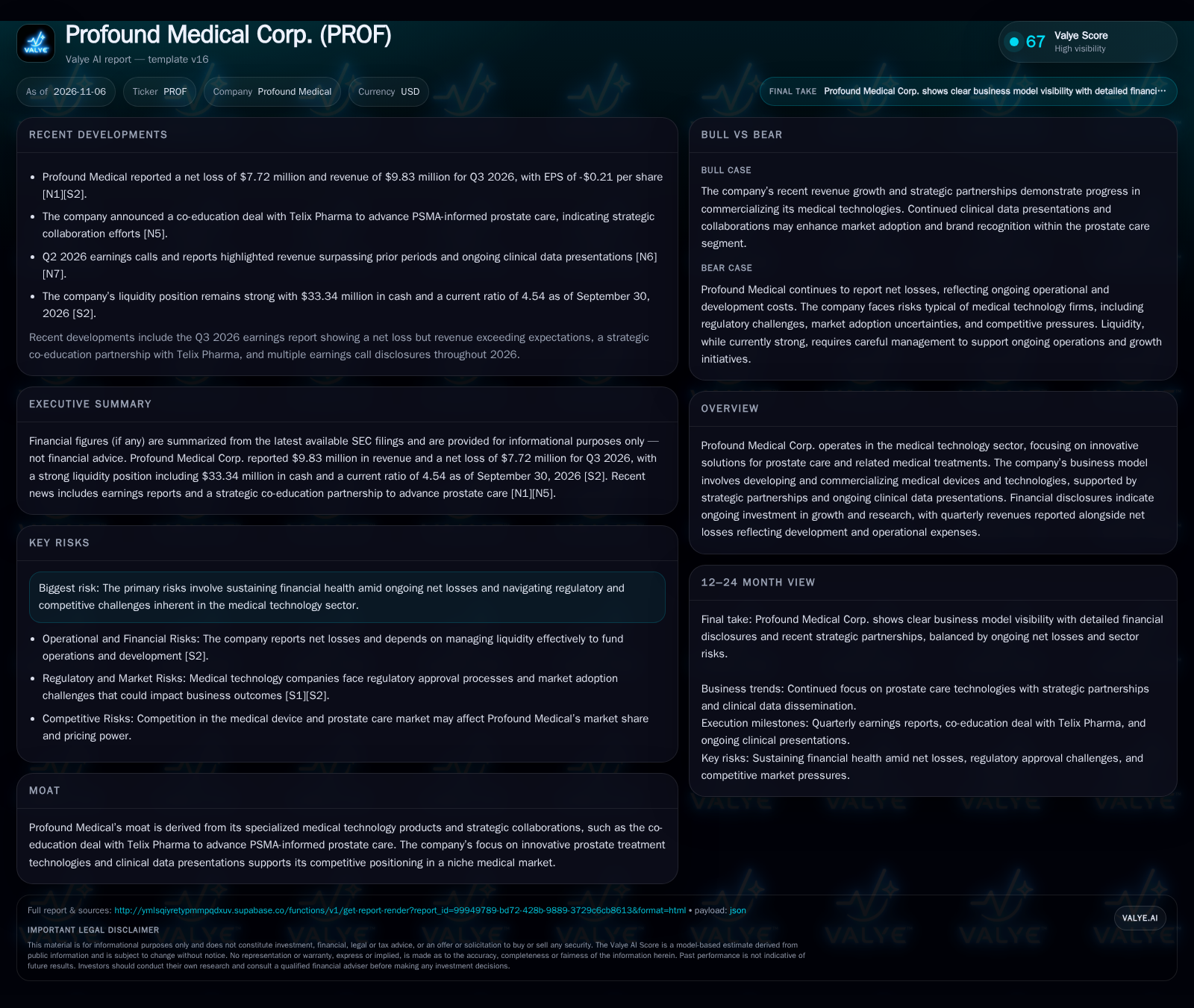
Profound Medical reported $9.83 million in revenue for Q3 2026, marking a period where top-line growth exceeded analyst expectations [S2] [N1]. However, this growth was accompanied by a net loss of $7.72 million and EPS of -$0.21, underscoring the company’s ongoing struggle to achieve profitability. As of September 30, 2026, Profound held $33.34 million in cash and posted a current ratio of 4.54, indicating a reported liquidity position [S2]. A notable recent development is the co-education partnership with Telix Pharma, which aims to advance PSMA-informed prostate care and could facilitate broader adoption of Profound’s technology platform [N5]. These developments matter because they highlight both the company’s progress in commercial and clinical arenas and the unresolved challenge of operating at a loss, a common hurdle in the medical technology sector.
How Profound Medical’s Economics Depend on Scaling, Reimbursement, and Clinical Adoption
Profound Medical’s business model relies on commercializing proprietary medical devices and technologies targeting prostate care, with revenue streams likely composed of capital equipment sales, procedure-based fees, and potentially recurring service or consumable revenue if adoption increases. The company’s current cost structure appears heavily weighted toward fixed R&D, regulatory, and commercial infrastructure, as evidenced by ongoing net losses despite revenue growth [S2]. This suggests a high degree of operating leverage: if Profound can drive higher procedure volumes and system placements, margins could expand materially as fixed costs are absorbed over a larger revenue base.
However, the pathway to positive operating leverage is contingent on several difficult-to-control factors: the pace of clinical adoption, reimbursement approval and pricing, and the ability to demonstrate superior clinical outcomes versus incumbent therapies. Capital requirements remain significant, as evidenced by the company’s ongoing investments in growth and research. The company reported cash and liquidity metrics for the period; these figures do not by themselves establish operating runway, investment capacity, financial flexibility, or financing capacity.
A critical factor influencing Profound Medical’s path to profitability is the scalability of its sales and distribution channels. Medical device companies often face a high upfront cost in establishing a direct sales force or training third-party distributors, which can initially suppress margins. If Profound can leverage partnerships to extend its reach without proportionally increasing fixed selling expenses, it may achieve better operating leverage. Conversely, reliance on partner-driven sales could limit control over market messaging and slow adoption, creating a trade-off between cost efficiency and market penetration speed.
Reimbursement dynamics also introduce complexity into Profound’s economics. Successful reimbursement is not only about securing coverage but also about obtaining favorable pricing that reflects the clinical value of the technology. If payers remain cautious or impose restrictive criteria, procedure volumes may grow slower than anticipated, constraining revenue growth and margin expansion. Furthermore, reimbursement policies can vary significantly across regions and payers, requiring tailored market access strategies and increasing administrative overhead. Thus, the company’s ability to navigate this multifaceted landscape will be pivotal in converting clinical innovation into sustainable revenue streams.
Specialization in Prostate Care as Both Strength and Vulnerability
Profound Medical’s competitive position is defined by its focus on innovative, image-guided prostate care technologies and its attempt to build clinical differentiation through strategic partnerships and ongoing clinical data presentations. The recent co-education deal with Telix Pharma exemplifies this collaborative strategy, aiming to position Profound’s platform as a preferred option for PSMA-informed prostate interventions [N5].
However, the prostate care market is highly competitive, with established device manufacturers, pharmaceutical firms, and emerging technology entrants all vying for share. Barriers to adoption include entrenched clinical practices, payer skepticism, and the need for robust long-term outcome data. While Profound’s niche focus can enable targeted market penetration and brand recognition, it also concentrates risk: slow adoption or negative data in its core segment could have outsized impact. The company’s ability to turn clinical partnerships into durable commercial relationships remains a key competitive question.
The specialized focus on prostate care technologies offers Profound Medical a chance to develop deep clinical expertise and build strong relationships with key opinion leaders, which can be a formidable barrier to entry for generalist competitors. However, this specialization also means that the company’s growth prospects are closely tied to the trajectory of a single therapeutic area. Should competing technologies emerge that offer comparable or superior clinical benefits with lower costs or easier integration into existing workflows, Profound’s market share could be vulnerable. Thus, continuous innovation and evidence generation are essential to maintain differentiation and defend against encroachment from both established and emerging competitors.
Moreover, the company’s reliance on strategic partnerships as a channel to market introduces both opportunities and risks. While partnerships can accelerate adoption by leveraging established networks and shared expertise, they may also dilute Profound’s brand identity and limit its ability to capture full economic value. Effective partnership management, including alignment of incentives and clear delineation of responsibilities, is crucial to maximize commercial impact. Failure to execute on collaborative initiatives or misalignment of strategic goals could impair the company’s competitive positioning and slow the pace of market penetration.
Outsized Returns if Clinical Partnerships Drive Rapid Adoption and Margin Expansion
A favorable scenario would see Profound Medical’s clinical collaborations—particularly with Telix Pharma—catalyze accelerated adoption of its prostate care technology across major centers. Widespread clinical acceptance, positive reimbursement decisions, and strong real-world outcomes could drive a step-change in procedure volumes and system sales, quickly absorbing fixed costs and moving the company toward profitability. In this scenario, Profound could leverage its early-mover advantage in PSMA-informed interventions to expand into adjacent markets or new indications.
Evidence confirming this upside would include: sequential acceleration in revenue growth, disclosure of multi-year commercial contracts or large-scale system deployments, margin improvement, and new clinical guideline endorsements. Falsification would be indicated by flatlining revenue, continued high burn rates without margin lift, or slow uptake in key geographies despite partnership activity.
Gradual Progress with Prolonged Losses and Incremental Commercial Gains
The most plausible path sees Profound Medical making steady but modest progress: revenue grows incrementally as new clinical sites adopt its technology, but the ramp is gradual due to the conservative nature of medical device adoption and the time required for reimbursement and guideline integration. Strategic partnerships like the Telix Pharma co-education deal generate important clinical visibility but do not immediately translate into large commercial wins.
This scenario would be confirmed by consistent, if unspectacular, quarterly revenue growth, continued net losses, and periodic partnership or clinical trial announcements without a dramatic shift in margin structure. A deviation from this trajectory would be signaled by either a sudden acceleration in adoption (upside) or a marked slowdown in revenue growth, signaling market resistance (downside).
Stalled Commercialization and Cash Burn Erode Strategic Options
In a more adverse scenario, Profound Medical’s clinical and partnership momentum fails to translate into material commercial traction. Adoption may be hampered by regulatory setbacks, reimbursement denials, or lack of compelling comparative data versus incumbent solutions. Revenue growth stagnates or declines, while ongoing R&D and commercial expenses continue to drive net losses.
Evidence supporting this scenario would include sequential revenue declines, growing net losses, negative developments in reimbursement or clinical trials, and announcements of restructuring or emergency financing. Conversely, stabilization of losses and clear signs of accelerating adoption would challenge the downside case.
Milestones That Will Determine Profound Medical’s Path to Commercial Scale
Quarterly revenue growth rates, especially sequential acceleration or deceleration, as a proxy for adoption momentum [S2]—a useful metric would be disaggregated by product line or geography if disclosed.
Gross margin trends, which would reveal whether higher sales volumes are driving operating leverage or if pricing/mix pressures persist—disclosure of system ASPs and procedure-based revenues would further clarify this.
Updates on reimbursement approvals and payer coverage decisions for Profound’s core technologies, as these directly impact adoption and pricing power.
Clinical trial results and peer-reviewed outcomes data, particularly those that influence clinical guidelines or large-scale adoption.
Progress on commercial partnerships, especially any announcements of multi-year contracts, system installations at major centers, or expansion into new indications.
Regulatory filings, approvals, or setbacks in major markets, which could materially affect the adoption curve and competitive positioning.
Adoption by leading academic or community centers, as such early wins can signal broader market acceptance and influence peer adoption.
Disclaimer: This is research-only, informational analysis and not investment advice. It may include AI-generated interpretation and general industry context. Always verify important details using primary sources.

Comments