
Microchip Technology: Inventory Recovery, Supply Chain Leverage, and Semiconductor Competition Ahead
Microchip Technology’s recent sales rebound highlights the company’s ability to navigate channel inventory corrections, but ongoing reliance on third-party manufacturing and a highly competitive analog/mixed-signal landscape raise questions about the durability of its pricing power and margin profile.
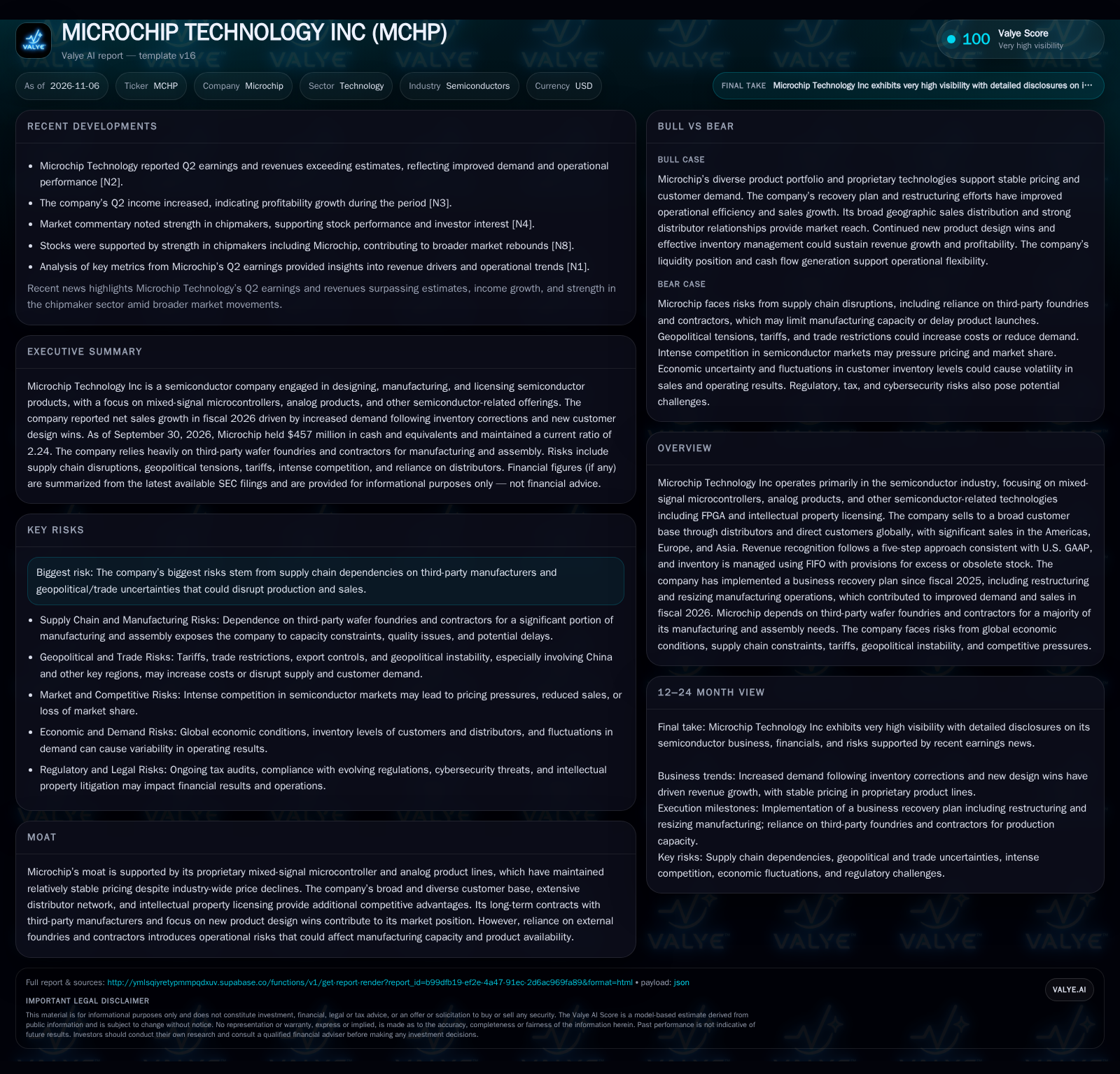
Microchip Technology posted a 7.1% revenue increase in fiscal 2026 as customers worked through excess inventory and new design wins entered production, with mixed-signal microcontrollers comprising half its sales. The firm’s business recovery plan has reshaped manufacturing and costs, but it remains heavily dependent on external foundries for most products. Pricing in proprietary segments has held up, yet the company faces persistent risks from supply chain volatility, geopolitical tensions, and intense competition. The next phase for Microchip will be defined by its ability to sustain design win momentum and manage external dependencies without eroding margins or market share. [S1] [S2] [N2] [N3]
Microchip Technology enters fiscal 2026 on the back of a notable sales recovery, driven by both the normalization of customer inventories and the ramp of new design wins. This rebound follows a period of channel digestion and operational restructuring, signaling that the company’s diversified product set—centered on mixed-signal microcontrollers and analog devices—remains relevant in a competitive market. However, Microchip’s reliance on external foundries, exposure to global supply chain risks, and the inherent cyclicality of the semiconductor industry mean that its margin and growth profile are still subject to disruption. The question for investors is whether Microchip can sustain its current momentum and pricing discipline as competitive and macro pressures evolve.
Recent Sales Growth Reflects Channel Inventory Adjustments
Microchip Technology reported a 7.1% increase in net sales for fiscal 2026, breaking out of a recent period of excess inventory in customer and distributor channels. The company attributes this rebound to both the normalization of channel inventories and the ramp-up of new customer design wins entering production. Mixed-signal microcontrollers remained the core revenue driver at 50% of sales, while analog products accounted for 28.2%. Distributors represented 47% of sales, with Arrow Electronics alone contributing 12%, reflecting Microchip’s continued dependence on broad channel reach. The company’s business recovery plan, implemented in fiscal 2025, included restructuring and resizing manufacturing operations, which, together with stronger demand, contributed to improved profitability and operational results. These developments suggest that Microchip has managed the acute phase of inventory correction, but its revenue and margin trajectory remain sensitive to supply chain fluctuations and broader economic conditions. [S1] [S2] [N2] [N3]
Economic Impact of Product Mix and Outsourcing on Microchip
Microchip generates the bulk of its revenue from proprietary mixed-signal microcontrollers and analog products, segments that generally carry higher gross margins due to their specialized, often application-specific nature. The company’s reported ability to hold pricing relatively stable in these categories, even as the broader semiconductor industry faces typical price declines, suggests a degree of product differentiation and customer stickiness. However, the commoditization pressure in other product lines—such as legacy ASICs and some FPGA offerings—could dilute blended margins over time.
A critical feature of Microchip’s cost structure is its reliance on third-party wafer foundries for approximately 66% of its net sales and on external contractors for a majority of assembly and testing. While this asset-light manufacturing model reduces fixed capital intensity and provides flexibility to scale production up or down, it also exposes the company to external cost, capacity, and quality risks. Any disruptions at key foundries or contractors can directly impact Microchip’s ability to fulfill orders or maintain lead times, with potential repercussions for revenue recognition and customer relationships.
Operating leverage is achievable in upcycles—when higher volumes flow through largely fixed SG&A and R&D expenses—but the company’s exposure to variable external manufacturing costs can limit the degree of margin expansion compared to firms with more captive production. The business recovery plan’s focus on resizing and cost control has likely improved near-term efficiency, but sustainable margin improvement will depend on Microchip’s ability to maintain mix, pricing, and utilization as market conditions shift.
Strengths and Weaknesses in Analog and Embedded Segments
Microchip’s competitive position is anchored in proprietary mixed-signal microcontroller and analog portfolios, which have historically supported more stable pricing and customer relationships compared to pure-play commodity chip producers. The breadth of its product offerings, combined with a global distributor network, allows Microchip to serve a wide range of end markets, from industrial automation to automotive and consumer electronics.
However, the company’s reliance on external manufacturing partners introduces operational vulnerabilities. In a scenario where wafer foundry capacity is constrained or where geopolitical tensions disrupt supply chains, Microchip could find itself at a disadvantage relative to vertically integrated peers. Additionally, intense competition from both established analog/microcontroller players and emerging low-cost Asian suppliers exerts ongoing pressure on pricing, design win retention, and customer loyalty.
Switching costs for customers are moderate: while embedded design wins often translate to multi-year revenue streams as products remain in production, customers can and do switch suppliers at the next design cycle if pricing, availability, or features are more attractive elsewhere. Microchip’s ongoing challenge is to maintain its design-in momentum and to avoid product commoditization that would erode both margins and customer stickiness.
Design Wins and Supply Chain Stability Could Boost Share and Margins
In a favorable scenario, Microchip capitalizes on its recent design win pipeline, converting new customer engagements into volume production across industrial, automotive, and IoT applications. If proprietary product segments maintain pricing discipline and the company’s asset-light supply chain operates without major disruptions, operating leverage could yield improving margins as volumes rise. The ongoing normalization of channel inventories reduces the risk of sudden demand air pockets, allowing for more predictable production planning and revenue recognition.
Confirmation of this scenario would come from continued sequential growth in net sales, stable or rising gross margin percentages, and evidence of further design wins in core end markets. Additional indicators would be a reduction in distributor inventory days (suggesting healthy sell-through), and commentary from management or customers highlighting superior product performance or supply reliability. Falsification would involve a sudden decline in design win announcements, pricing concessions in proprietary segments, or manufacturing delays tied to third-party foundry constraints.
Inventory Normalization Limits Margin Gains Amid External Pressures
The most plausible trajectory is that Microchip’s revenue growth moderates as the surge from inventory normalization and pent-up demand dissipates. The company continues to benefit from a diversified product mix, but faces ongoing cost volatility and competitive pricing pressures, particularly in less differentiated segments. Its reliance on third-party wafer foundries and contractors remains a double-edged sword—enabling capital efficiency, but limiting control during supply chain disruptions or periods of tight capacity.
Steady, but not accelerating, design win activity and relatively stable gross margins would confirm this scenario. If operating expenses remain in check and no major supply chain shocks occur, Microchip can sustain modest profitability growth. Falsification would come from either a renewed inventory buildup (suggesting end-market weakness or channel stuffing), or margin compression driven by input cost increases or competitive discounting.
Volume and Pricing Risks from Supply Chain or Competitive Disruptions
A negative scenario could materialize if Microchip faces a combination of supply chain disruption—such as capacity shortages or cost spikes at third-party foundries—and increased pricing pressure from competitors. Distributors or end customers may respond by reducing orders or switching to alternative suppliers, especially if Microchip cannot deliver on lead times or maintain price/performance parity. Geopolitical escalations or new tariffs could further disrupt supply chains or reduce demand in key Asian markets, which represent nearly half of sales.
This scenario would be confirmed by a sequential decline in net sales, rising distributor inventory days (suggesting slower sell-through), or explicit margin guidance cuts from management. Additional red flags would include reports of lost design wins to competitors or persistent delays in fulfilling customer orders due to external manufacturing constraints.
Factors Influencing the Durability of Microchip’s Channel and Design Win Progress
Sequential changes in net sales and gross margin—ongoing improvement would confirm sustained demand and pricing discipline; declines may indicate renewed inventory issues or competitive pressure.
Distributor inventory days—if disclosed, continued reductions would suggest healthy end-market demand and efficient channel management.
Frequency and size of new design win announcements—would help test whether Microchip is successfully embedding its products in next-generation platforms across key verticals.
Product segment mix—shifts toward higher-margin proprietary microcontrollers and analog parts would support margin expansion; a mix shift to commoditized products could dilute profitability.
Capacity utilization rates at key third-party foundries and contractors—if disclosed, would indicate Microchip’s ability to secure priority access and minimize supply chain risk.
Customer retention and share of wallet in major end markets—would help determine whether Microchip is maintaining or losing relevance amid competitive shifts.
Any changes in pricing trends for core product families—would signal whether Microchip’s differentiation is holding up in the face of industry-wide price declines.
Updates on geopolitical or regulatory developments affecting semiconductor supply chains—material changes could rapidly alter Microchip’s cost structure or market access.
Disclaimer: This is research-only, informational analysis and not investment advice. It may include AI-generated interpretation and general industry context. Always verify important details using primary sources.

Comments