
Revelation Biosciences: Gemini’s Clinical Momentum, Funding Hurdles, and the Challenge of Kidney Disease Innovation
Revelation Biosciences advances its Gemini platform targeting acute and chronic kidney disease, buoyed by recent positive clinical data and FDA-aligned trial design. Yet, the company faces a pivotal period defined by external financing needs, market listing risks, and the inherent uncertainties of late-stage drug development.
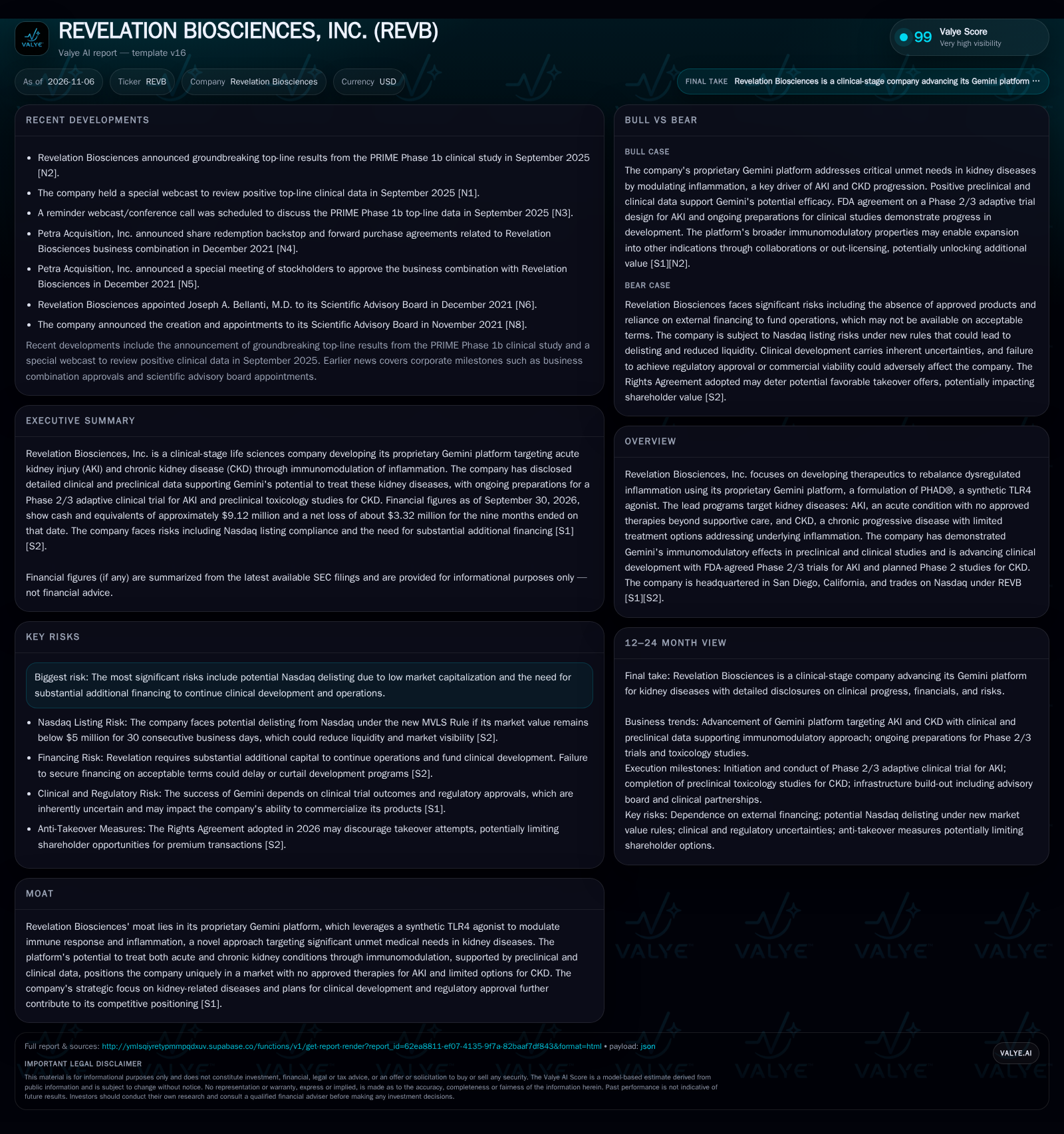
Revelation Biosciences is a clinical-stage biotech focused on kidney disease therapeutics using its Gemini immunomodulatory platform. Recent positive Phase 1b results and FDA alignment on Phase 2/3 trial design mark clinical progress, while a $9.12 million cash balance supports upcoming studies. However, the company has no approved products, depends on external funding, and faces potential Nasdaq delisting if it fails to meet market cap requirements. The next 12-24 months hinge on successful trial execution, financing, and regulatory milestones. [S1] [S2] [N1] [N2]
Revelation Biosciences is at a critical juncture in the biotech value chain, advancing its proprietary Gemini platform for kidney disease amid a landscape of high unmet need and no approved therapies for acute kidney injury. Recent positive Phase 1b clinical data and FDA alignment on a Phase 2/3 adaptive trial design provide tangible momentum, positioning the company for a potentially value-defining clinical readout. However, with no approved products, ongoing net losses, and dependence on new external financing, Revelation’s ability to convert scientific promise into commercial reality will depend on successful trial execution, timely capital raises, and navigating the regulatory and capital market gauntlet.
Recent Clinical Data and Financing Realities Define the Strategic Backdrop
Revelation Biosciences’ most recent milestones include the announcement of positive top-line results from its PRIME Phase 1b clinical study in September 2025 and a special webcast to review these data, which together marked a pivotal moment in Gemini’s development for kidney disease indications. The company has secured FDA agreement on a single Phase 2/3 adaptive design study for acute kidney injury (AKI), targeting a composite endpoint of death and/or dialysis—an approach that could streamline the path to a New Drug Application. Financially, Revelation reported $9.12 million in cash and equivalents as of September 30, 2026, with a net loss of $3.32 million for the first nine months of the year, and currently has no revenue from product sales. Ongoing operations and planned clinical trials will require substantial additional financing, and the company faces heightened risk of Nasdaq delisting under new market value rules if its capitalization remains below $5 million for 30 consecutive days. [S1] [S2] [N1] [N2]
Clinical Development Economics and the Pathway to Value Creation
Revelation’s business model is typical of a clinical-stage biotech: upfront R&D investment, no current product revenue, and a reliance on external funding to advance candidates through costly late-stage trials. The economics are defined by the binary nature of clinical outcomes—success can unlock high-margin, high-value markets, while setbacks can erase enterprise value. The Gemini platform is designed for indications with significant unmet need, notably AKI, where no approved therapies exist beyond supportive care. If Gemini demonstrates efficacy in pivotal trials, pricing could reflect the substantial value of reducing mortality and dialysis dependence in AKI, potentially supporting premium reimbursement in the U.S. and select international markets.
Fixed costs are dominated by R&D and infrastructure required for clinical trial execution, while variable costs would rise with commercialization, particularly for manufacturing, distribution, and post-market surveillance. Upfront capital needs are substantial, as evidenced by the company’s ongoing net losses and plans to build out trial infrastructure and conduct toxicology studies for CKD. Revelation’s ability to achieve operating leverage is contingent on successful trial outcomes, regulatory approval, and the scale of market uptake—none of which are guaranteed. Until then, the company’s economics are fundamentally tied to its ability to raise dilutive or non-dilutive capital, partner with larger firms, or out-license its technology.
Positioning Gemini in a Crowded and High-Stakes Therapeutics Landscape
The competitive landscape for kidney disease therapeutics is defined by significant unmet need, especially in AKI, where supportive care and dialysis remain the only options. Revelation’s approach—modulating inflammation through synthetic TLR4 agonism—offers a mechanistically differentiated strategy compared to traditional anti-inflammatory or anti-fibrotic agents. If clinical efficacy and safety are demonstrated, Gemini could enjoy first-mover advantage in AKI and a foothold in CKD, where competition is more robust from established nephrology players and pipeline-stage biotech firms.
Potential counterforces include the emergence of alternative immunomodulatory therapies, advances in cell therapy or gene editing, and the potential for larger biopharma to quickly outspend or out-license competing assets. Switching costs in the acute setting may be low if Gemini is proven safe and effective, as providers are highly motivated to adopt novel interventions for critically ill patients. However, payer skepticism about new high-cost therapies—especially in the absence of long-term outcomes data—could temper pricing power and uptake. Long-term defensibility would depend on patent life, regulatory exclusivity, and the ability to expand Gemini’s indications or combine it with other renal therapies.
Breakthrough Efficacy in Pivotal Trials Unlocks High-Value Market Entry
The most constructive scenario for Revelation hinges on Gemini delivering statistically and clinically meaningful reductions in death and dialysis in the Phase 2/3 AKI trial, followed by rapid regulatory acceptance and commercial launch. Successful execution would position the company as the first to market with a disease-modifying therapy for AKI, a multi-billion dollar opportunity given the prevalence and severity of the condition. This could drive partnership interest from larger biopharma, validate the Gemini platform for additional indications, and enable premium pricing supported by strong health economics.
Evidence that would confirm this scenario includes: robust, peer-reviewed publication of pivotal trial data showing clear benefit on primary endpoints; FDA acceptance of the NDA and favorable advisory committee review; and early signals of payer support or inclusion in clinical guidelines. Upfront licensing deals, non-dilutive funding, or acquisition interest would further support the upside case.
Gradual Progression Through Clinical and Regulatory Milestones, Tempered by Funding Constraints
The most plausible path for Revelation involves steady advancement of Gemini through the planned Phase 2/3 AKI trial, with interim results that are promising but not transformative. The company secures periodic financing—albeit on increasingly dilutive terms—to fund ongoing studies and maintain Nasdaq compliance. The CKD program advances to a repeat dose Phase 2 study following successful preclinical toxicology, but remains several years from pivotal data.
This scenario is confirmed by continued progress on trial enrollment, regular updates on scientific advisory board and clinical partnerships, and timely completion of preclinical and clinical milestones. However, financial reports would likely show persistent net losses and ongoing capital raises, with no near-term shift to commercial revenue. In this base case, Revelation’s valuation would be driven by its clinical pipeline momentum rather than revenue or profitability.
Clinical Setbacks and Capital Shortfalls Expose Existential Risks
Adverse outcomes could materialize if Gemini fails to demonstrate safety or efficacy in Phase 2/3 trials, or if unexpected toxicology signals emerge during CKD program development. In this scenario, Revelation struggles to raise additional capital, potentially triggering Nasdaq delisting and loss of public market access. The absence of positive clinical data would undermine partnering prospects and could force the company to curtail operations, seek asset sales, or pursue restructuring.
Evidence confirming this downside would include: negative or inconclusive clinical readouts; delays or halts in trial enrollment; missed regulatory milestones; repeated warnings about going concern or inability to secure funding; and eventual notification of Nasdaq delisting. In such a case, residual value would be limited to intellectual property and any remaining cash.
Upcoming Clinical, Regulatory, and Financing Events That Will Shape the Gemini Thesis
Initiation and enrollment pace of the Phase 2/3 AKI trial: Delays or rapid progress would be early signals of operational execution.
Disclosure of interim or top-line results from the pivotal AKI trial: Efficacy and safety outcomes are the primary clinical catalysts.
Completion of preclinical toxicology studies for the CKD program: Successful results would enable further clinical advancement.
Updates on regulatory engagement and milestones, including FDA feedback or NDA submission timing.
Financing events, including public or private capital raises, partnerships, or non-dilutive funding (if disclosed).
Nasdaq market capitalization and compliance status: Tracking risk of delisting under new MVLS rules.
Scientific advisory board activities and new clinical research organization partnerships: Indications of infrastructure build-out and preparedness for trial execution.
Publication of peer-reviewed data and inclusion in clinical guidelines or payer coverage policies (if and when achieved).
Disclaimer: This is research-only, informational analysis and not investment advice. It may include AI-generated interpretation and general industry context. Always verify important details using primary sources.

Comments