
Savers Value Village: Scaling Thrift Retail through Operational Innovation and Supply Chain Integration
Savers Value Village leverages its scale, integrated sourcing partnerships, and process automation to drive growth in the North American thrift sector. While recent store expansion and higher sales yields underscore operational momentum, the company faces persistent competition for both supply and customers, alongside cost pressures and a reported liquidity position cushion.
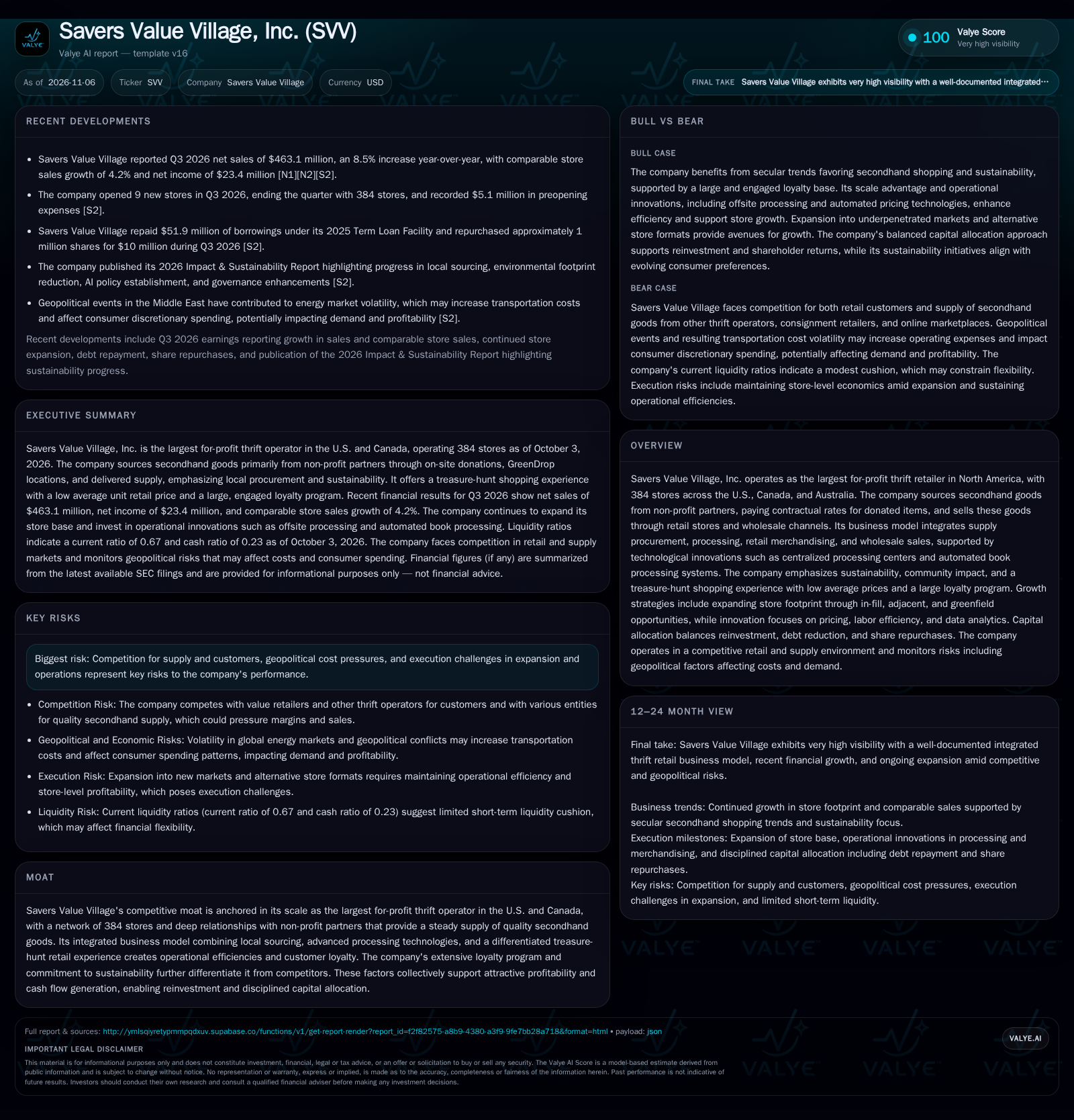
Savers Value Village reported 8.5% year-over-year sales growth to $463.1 million in Q3 2026, with comparable store sales up 4.2%. Expansion continues with 9 new stores opened and over 846 million pounds of goods processed year-to-date. Monitoring store-level economics, supply chain dynamics, and operational leverage will be critical to assessing the durability of growth and margin expansion [S2] [N1] [N2].
Savers Value Village stands at the intersection of sustainability trends, value retail, and operational scale, operating 384 stores across North America as of October 2026. The company’s model—sourcing secondhand goods from non-profit partners, processing them efficiently, and delivering a low-price, treasure-hunt retail experience—has yielded consistent sales growth and expanding store count. Yet, as the thrift sector becomes increasingly competitive and external cost pressures mount, Savers Value Village’s ability to maintain supply chain advantages, operational efficiency, and disciplined capital deployment will determine whether its growth remains profitable and durable.
Recent Growth Underscores Scale and Efficiency—But Reveals Liquidity Constraints
Savers Value Village reported net sales of $463.1 million for Q3 2026, representing an 8.5% increase year-over-year, with comparable store sales rising 4.2% [S2] [N1] [N2]. The company processed 298 million pounds of goods in the quarter and 846 million pounds year-to-date, reflecting both sourcing strength and throughput scale [S2]. Nine new stores opened in Q3, bringing the store count to 384 and signaling continued physical expansion [S2]. The company reported cash and liquidity metrics for the period; these figures do not by themselves establish operating runway, investment capacity, financial flexibility, or financing capacity. [S2] These facts matter because they illustrate both operational momentum and the need for careful working capital and capital allocation management as the company grows.
The interplay between operational momentum and liquidity constraints underscores the importance of dynamic working capital management in a high-velocity retail model. As Savers Value Village scales store count and throughput, the timing of cash inflows from sales versus outflows for inventory procurement, labor, and overhead becomes more critical. This dynamic can create periods of cash strain even amid strong sales growth, especially if inventory purchases or preopening expenses accelerate ahead of revenue realization. Therefore, the company’s ability to optimize payment terms with non-profit suppliers and manage inventory turnover efficiently will be pivotal to sustaining potential financial flexibility during expansion phases.
How Integrated Sourcing, Processing, and Retail Drive Margin Potential
Savers Value Village’s economics hinge on its vertically integrated value chain: it secures supply by purchasing donated goods from non-profit partners at contractual rates, processes inventory through a mix of store-based and centralized (offsite) facilities, and sells to end consumers at low average prices or to wholesale buyers [S1] [S2]. The average unit retail price of $5–$6 and high inventory turns (over 15x per year) reflect a high-velocity, low-margin retail model. Automation initiatives—such as Centralized Processing Centers and Automated Book Processing—aim to reduce per-unit labor costs and support scalable expansion [S1] [S2].
Revenue growth can be driven by store count expansion, increases in sales yield (retail sales per pound processed, which rose to $1.53 in Q3 2026 from $1.48 a year prior), and higher loyalty engagement, with 6.1 million active program members accounting for 72.7% of retail sales in 2025 [S2]. Fixed costs—especially lease and labor—are substantial at the store level, so operating leverage depends on maintaining high throughput and steady traffic. Capital is required for new store openings (as reflected in $5.1 million preopening expenses for 9 stores), processing infrastructure, and selective share repurchases or debt repayment [S2]. If store-level economics deteriorate or supply procurement costs rise, margin compression could follow.
The vertical integration also introduces complexity in balancing capital allocation between physical infrastructure and technology investments. While centralized processing centers and automation reduce unit labor costs and improve scalability, they require upfront capital and operational expertise to implement effectively. The pace at which these efficiencies can be realized depends on the company’s capacity to manage change, train staff, and maintain quality standards across geographically dispersed facilities. Moreover, the low-margin, high-turnover nature of the business means that incremental improvements in processing speed or yield can disproportionately impact overall profitability, but only if fixed costs are contained and throughput volume is sustained.
Competing for Supply and Shoppers in a Crowded Thrift and Value Retail Landscape
Savers Value Village’s primary competitive advantage is its scale: as the largest for-profit thrift operator in the U.S. and Canada, it enjoys bargaining power with non-profit partners and benefits from brand recognition across multiple banners [S1] [S2]. Its integrated sourcing and processing capabilities allow for more predictable supply and cost management compared to smaller local rivals. The large, engaged loyalty program and 'treasure-hunt' shopping experience foster repeat visits and customer stickiness.
However, the company faces intensifying competition on both the demand and supply sides. Other thrift and consignment retailers, online marketplaces, and value/off-price chains compete for budget-conscious consumers. On the supply side, non-profit organizations can shop their donations to alternative buyers, and online platforms have lowered barriers for individuals to sell directly. This competition can pressure both the cost of goods acquired and retail pricing. Online resale and peer-to-peer platforms are plausible substitutes, especially for higher-value or curated items, though Savers Value Village’s scale and local sourcing still offer a distinctive advantage for now.
From a strategic perspective, maintaining differentiated customer engagement through loyalty programs and in-store experience is essential to counteract the commoditization risk posed by online resale platforms and discount retailers. If Savers Value Village can deepen its data analytics capabilities to personalize marketing and optimize inventory assortments based on local preferences, it could enhance customer retention and reduce promotional pressure. However, such initiatives require investment in technology infrastructure and data governance, and their success depends on the company’s ability to translate insights into operational actions at the store level. Failure to innovate in this area could erode competitive advantage as consumer expectations around convenience and personalization evolve.
If Automation, Loyalty, and Expansion Drive Durable Margin Gains
The most favorable scenario is one where Savers Value Village capitalizes on secular secondhand shopping trends—driven by sustainability, affordability, and changing consumer attitudes—while leveraging its process automation and loyalty program to enhance efficiency and retention. If store expansion continues in underpenetrated markets and sales yield per pound keeps rising, the company could see durable margin expansion and higher returns on invested capital.
Evidence that would confirm this scenario includes: continued growth in comparable store sales above inflation, further increases in sales yield per pound, expanding active loyalty membership, and operating margin improvement despite store growth. Additional proof points would be stable or improving supply procurement costs and successful replication of store-level economics in new markets. If disclosed, improvements in cost per processed pound or per-store EBITDA would also support this scenario.
Sustained Growth with Margin Pressures as Competition and Costs Persist
The most plausible outcome is that Savers Value Village continues to grow its store footprint and sales, but faces ongoing margin pressures from competition for both supply and customers, as well as rising transportation and labor costs.
This scenario would be confirmed by moderate but positive comparable store sales growth, stable or slightly improving sales yield, and a steady store opening cadence. Margins may fluctuate quarter-to-quarter, reflecting input cost volatility and promotional intensity. Falsifying evidence would include a sustained decline in same-store sales, rising procurement costs not offset by pricing or efficiency gains, or negative operating leverage from rapid expansion in low-performing markets.
When Supply Constraints, Cost Shocks, or Execution Missteps Erode Profitability
The adverse scenario is one where increased competition for donations or changes in non-profit partner dynamics drive up supply procurement costs, while geopolitical events (such as energy market shocks) push transportation and operating expenses higher. If consumer discretionary spending weakens or if the company over-expands into markets with low demand, store-level profitability could erode.
If disclosed, rising per-store losses or negative free cash flow would further validate this scenario.
Measuring the Resilience of Scale, Supply, and Store Economics at Savers Value Village
Comparable store sales growth rates by geography and banner: Persistent outperformance or underperformance would signal the health of core demand.
Sales yield per pound processed: Further gains would indicate pricing power or merchandising efficiency; declines would flag margin pressure.
Active loyalty program membership and share of sales: Increased engagement would suggest growing repeat business and customer stickiness.
Store-level operating margins and per-store EBITDA, if disclosed: Essential for assessing whether expansion is value-creating or dilutive.
Procurement cost per pound and supply mix (OSD, GreenDrop, delivered): Shifts here would reveal supply-side pressures or efficiency gains.
Inventory turn rates and average days to sell: Lower turns or longer selling periods could signal excess inventory or softening demand.
Transportation and labor cost trends: Material increases, if disclosed, would impact operating leverage and overall profitability.
Disclaimer: This is research-only, informational analysis and not investment advice. It may include AI-generated interpretation and general industry context. Always verify important details using primary sources.

Comments