
Acacia Research: Cash-Rich Acquirer Seeks Value in Complexity, But Profitability Remains Elusive
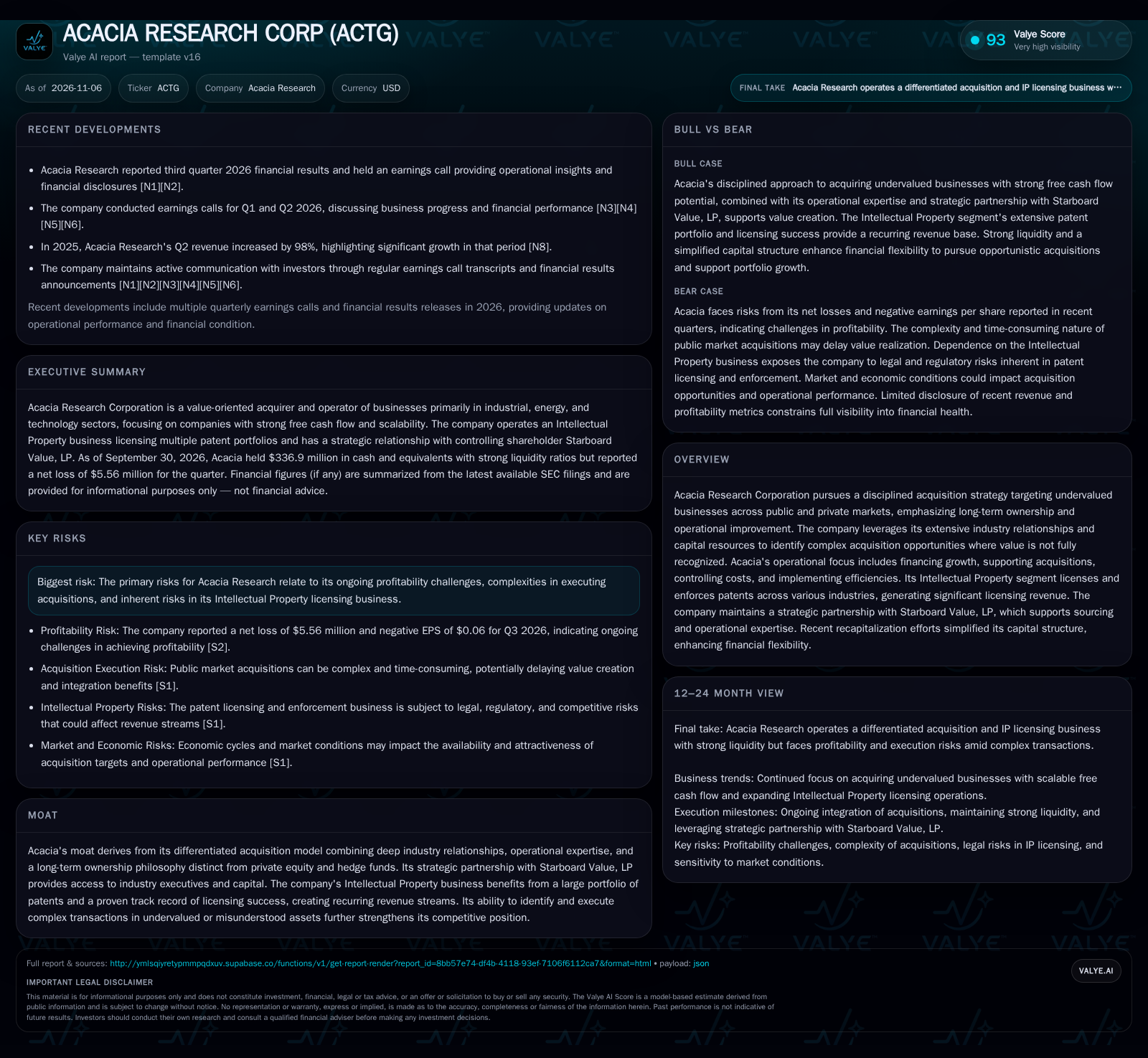
Acacia Research’s reported liquidity position following its recapitalization and strategic partnership with Starboard Value put it in a strong position to pursue complex acquisitions and IP monetization. Yet, the company’s persistent net losses and limited revenue transparency raise questions about the path to sustainable returns.
However, the company continues to report net losses and offers limited recent revenue detail, highlighting ongoing challenges in turning its acquisition and IP strategies into sustainable profits. The central tension: can Acacia’s value-oriented approach and Starboard Value partnership overcome execution and profitability hurdles in a market where complexity does not always guarantee returns? [S1] [S2]
Acacia Research Corporation stands at a crossroads: flush with liquidity after a major recapitalization, equipped with a deep-pocketed partner in Starboard Value, and armed with decades of experience acquiring and operating undervalued businesses. Its dual focus—disciplined acquisition and intellectual property monetization—offers the theoretical promise of recurring free cash flow and long-term book value growth. Yet, persistent net losses and scarce recent revenue disclosure suggest that the company’s ability to convert complexity and capital into durable shareholder returns is still unproven. The critical question for investors: can Acacia’s differentiated approach to value unlock real operating leverage, or will the challenges of execution and integration continue to weigh on its bottom line?
Liquidity and Capital Structure Set the Stage, But Profitability Lags
As of September 30, 2026, Acacia Research reported $336.9 million in cash and equivalents, with current assets of $421.8 million and current liabilities of $74.8 million—yielding a current ratio of 5.64 and a cash ratio of 5.18 [S2]. This liquidity follows a 2023 recapitalization that eliminated preferred stock, warrants, and senior secured notes, simplifying the capital structure and potentially lowering future financing costs [S1] [S2]. However, the company reported a net loss of $5.56 million for Q3 2026, with basic and diluted EPS at -$0.06 [S2]. Notably, recent revenue figures remain undisclosed in the latest filings, with the most recent figure from 2021 at $12.0 million [S2]. These facts highlight a company with potential financial flexibility and a clean balance sheet, but one that continues to struggle with profitability and transparency around current top-line performance.
How Acacia’s Value-Driven Model Could Translate to Cash Flow
Acacia’s core business model is predicated on acquiring undervalued or overlooked businesses—often in industrial, energy, and technology sectors—and driving operational improvements to unlock free cash flow over time [S1]. The company distinguishes itself from traditional private equity by emphasizing active ownership and operational intervention, not just financial engineering. In theory, this approach can produce significant returns if acquired businesses are scalable and the company can successfully implement cost controls and growth initiatives.
A second pillar is its Intellectual Property (IP) business, which involves acquiring, licensing, and enforcing patent portfolios. This segment has historically produced meaningful gross licensing revenue ($1.9 billion cumulatively, $282.6 million over the past five years), but the revenue profile is inherently lumpy and dependent on litigation outcomes, settlement cycles, and the ongoing validity and relevance of the patent assets [S1]. While the IP segment can generate high-margin revenue when successful, its cash flows are unpredictable and subject to legal and regulatory headwinds.
From a cost structure perspective, Acacia’s model involves both significant fixed costs (deal sourcing, legal, due diligence, and operational resources) and variable costs tied to acquisition integration and patent enforcement. The company reported cash and liquidity metrics for the period; these figures do not by themselves establish operating runway, investment capacity, financial flexibility, or financing capacity.
Differentiation Through Complexity: Acacia’s Niche and Its Limits
Acacia operates in a crowded field of financial buyers, including private equity firms, hedge funds, and corporate acquirers. Its edge lies in targeting complex, undervalued, or neglected businesses where mainstream buyers may lack appetite or expertise. The partnership with Starboard Value, LP—its controlling shareholder—provides access to industry relationships, operating partners, and capital, potentially giving Acacia an inside track on proprietary deal flow [S1].
However, this strategy is not without risks. The very complexity that creates opportunity also increases the risk of mispricing, integration failures, or protracted turnaround timelines. In the IP licensing business, competition comes from other patent aggregators and law firms, while the broader acquisition strategy competes with both traditional financial sponsors and strategic buyers. The company’s ability to consistently identify, execute, and integrate value-accretive deals will determine whether its differentiation is sustainable or merely theoretical. A potential vulnerability is the lack of recurring, predictable revenue streams, particularly in the IP segment, which could limit operating leverage and make it harder to absorb setbacks.
Unlocking Hidden Value: How Acacia Could Deliver Outsize Returns
The favorable scenario for Acacia centers on its ability to deploy significant liquidity into a pipeline of attractively priced, cash-generative businesses that can be improved operationally, yielding material growth in free cash flow and book value. Success in this scenario would likely be visible through a string of new acquisitions at compelling multiples, followed by evidence of integration-driven margin expansion and rising segment-level cash flow.
In the IP business, a series of successful, high-margin licensing agreements or litigation wins could add further upside, particularly if the company can demonstrate improved predictability and scale in this segment. The Starboard Value partnership could also unlock proprietary deal access or co-investment opportunities that would be out of reach for most competitors.
Evidence confirming this scenario would include: disclosure of major new acquisitions with favorable terms, sequential improvement in consolidated free cash flow, and a return to positive net income. Additional signals would be a resumption of regular, material revenue from the IP segment and improved transparency in financial reporting. Falsification would occur if acquisitions consistently underperform, integration costs spiral, or if the IP segment fails to deliver meaningful cash flows despite ongoing investment.
Disciplined Deployment, but Value Creation Proves Slower Than Hoped
The most plausible near-term path is that Acacia remains disciplined in its capital deployment, continuing to seek complex or undervalued deals but with a measured pace of execution. Integration efforts may produce gradual operational improvement, but the timeline to sustainable profitability could remain extended—especially if the acquired businesses require significant restructuring or if market conditions limit attractive deal flow.
The IP segment may continue to contribute sporadic, lumpy licensing revenues, but not at a scale or frequency sufficient to offset corporate overhead and acquisition-related costs.
Evidence supporting this scenario would be continued negative net income, incremental acquisition announcements without transformative impact, and limited progress in recurring revenue generation. Falsification would require either a decisive shift to consistent profitability or a deterioration in liquidity without corresponding asset growth.
When Complexity Fails: Prolonged Losses and Erosion of Value
The adverse scenario is one in which Acacia’s acquisition pipeline dries up or the assets acquired underperform expectations, consuming capital without generating sufficient returns. Integration challenges, misjudged turnarounds, or overpayment for assets could all contribute to persistent losses. In this scenario, the company’s liquidity cushion is gradually depleted, either through failed acquisitions, ongoing operating losses, or unsuccessful IP litigation.
A further risk is that the IP segment faces adverse legal outcomes, regulatory changes, or patent expirations, leading to a sharp decline in licensing revenue. Without a core of stable, recurring cash flow, the company may be forced to retrench, sell assets, or raise additional capital on unfavorable terms.
Evidence confirming this scenario would include a sustained increase in net losses, shrinking cash balances without offsetting asset growth, failed or impaired acquisitions, and a lack of material licensing wins or revenue in the IP segment. Falsification would require a clear inflection to positive cash flow and operating profitability, or a major asset sale at a premium to book value.
Milestones That Will Clarify If Acacia’s Strategy Can Deliver
Announcement and disclosure of new acquisitions, including purchase price multiples, integration plans, and expected free cash flow contributions.
Quarterly disclosure of segment-level and consolidated free cash flow (if disclosed), to assess whether acquisitions and IP licensing are translating to cash returns.
Material licensing wins or settlements in the IP segment, especially those that demonstrate improved predictability or scale.
Trends in consolidated net income and EPS, signaling whether the company is approaching sustainable profitability.
Movement in cash and equivalents relative to acquisition activity—does liquidity support asset growth or is it being eroded by losses?
Progress reports or transparency around Starboard Value’s involvement in sourcing, evaluating, or operating new investments.
Any regulatory or legal developments affecting the patent licensing environment that could impact future IP segment revenues.
Disclaimer: This is research-only, informational analysis and not investment advice. It may include AI-generated interpretation and general industry context. Always verify important details using primary sources.

Comments